16
sahtak - June 2010
W
ayne State University
School of Medicine re-
searchers have published
the findings of a pilot study that shows
hookah smoking is on the rise among
white Americans of non-Arab de-
scent. The team believes the hookah
trend could hold dangerous health im-
plications, including serving as a gate-
way to cigarette smoking and other
drug use.
While the hookah – a water pipe
used to burn and inhale flavored and
scented tobacco – conjures up images
of middle-aged and older men of Ara-
bic descent sharing a smoke in dark
cafes, BengtArnetz,M.D., Ph.D.,M.P.H.,
and Hikmet Jamil, M.D., Ph.D., profes-
sors in the Department of Family
Medicine and Public Health Sciences,
believe the practice is insidiously
working its way into a health hazard
for Americans.
“I am very concerned [that the
trend appears to be rising with
younger age groups],” said Dr.Arnetz,
who also is director of the Division of
Occupational and Environmental
Medicine.“Hookah use is now spread-
ing rapidly in the U.S. as well as across
the globe among those of non-Arab
descent. The moassel [tobacco and
various added flavors] makes the
smoking very smooth and appealing,
which makes it possible to smoke for
longer times. The hookah smoke
smells sweet and attractive. Thus, a
combination of low cost, social gath-
erings, peer pressure and perception
of less risk makes hookah smoking
very attractive.”
A number of hookah cafes have
been operating in metropolitan De-
troit. The state’s May 1 ban on smok-
ing in public places may extinguish
smoking in some of those establish-
ments, but a provision in the law could
allow them to continue. And a quick
scan of the Internet finds a number of
sites offering hookahs and related fla-
vored tobaccos readily for sale to
home users.
For their study,“Sociodemographic
risk indicators of hookah smoking
among White Americans: A pilot
study,” published in the March 2010
online edition of the Nicotine & To-
bacco Research journal, the doctors
surveyed 240 adults of non-Arab de-
scent in Southeast Michigan. They
found that 19 percent of those sur-
veyed were involved in hookah smok-
ing.Ten percent said they smoked only
using a hookah, and 9 percent smoked
both cigarettes and a hookah.
Surprisingly, 19 percent of the re-
spondents said they believed smoking
via a hookah was less harmful than
smoking cigarettes. Hookah smoking,
Dr.Arnetz said, is likely more danger-
ous than cigarette smoking. Hookah
smokers are exposed to and inhale
greater amounts of carbon dioxide,
nicotine and other carcinogens during
a session with the water pipe.
Dr.Arnetz said researchers do not
yet know whether the health risks for
second-hand smoke from hookahs are
similar to secondhand smoke from
cigarettes. The exposure dose and
time that nonsmokers spend when
visiting hookah bars will deter-
mine long-term risks. However,
hookah smoking has been
shown to increase the risk for
lung cancer, respiratory illness, low
birth weight and periodontal disease,
he said. And there are investigations
into whether the practice increases
the risks for communicable diseases
such as tuberculosis and hepatitis C.
Those most likely to use a hookah,
according to the survey results, were
22 and younger and lived with a fam-
ily member who used tobacco. The
study found no difference in the
prevalence of hookah use between
men and women. Hookah use was
more prevalent among students and
those who exercised regularly, lending
credence to the hypothesis that
smokers mistakenly believe the
hookah offers fewer health haz-
ards than cigarettes.
“We believe in
general the hookah venue attracts
both genders,” Dr. Arnetz said. “You
do it in groups, and there is a percep-
tion of less danger but also more so-
cial peer pressure to use it.”
Dr. Arnetz and Dr. Jamil have sub-
mitted a grant request to the National
Institutes of Health seeking $450,000
a year for five years to expand their
pilot study. They propose following a
random sample of adolescent stu-
dents from ninth grade through high
school.This would be the first random
sample study of hookah use among
students in general.
“We want to study the prevalence
of hookah use among different groups
of students, especially youth from un-
derserved families; how hookah use
might change during the high school
career and what factors determine
the uptake of hookah, including peer
pressure,” Dr. Arnetz
said. “Finally, we want to
study whether hookah
acts as a gateway drug for
cigarettes, marijuana and
heavier drugs, and poor
lifestyle choices in general.”
Wayne State Univer-
sity is a premier urban
research university offer-
ing more than 350 aca-
demic programs through
13 schools and colleges
to nearly 32,000 stu-
dents.
Hookah smoking on
the rise; smokers
mistakenly believe
it’s less harmful
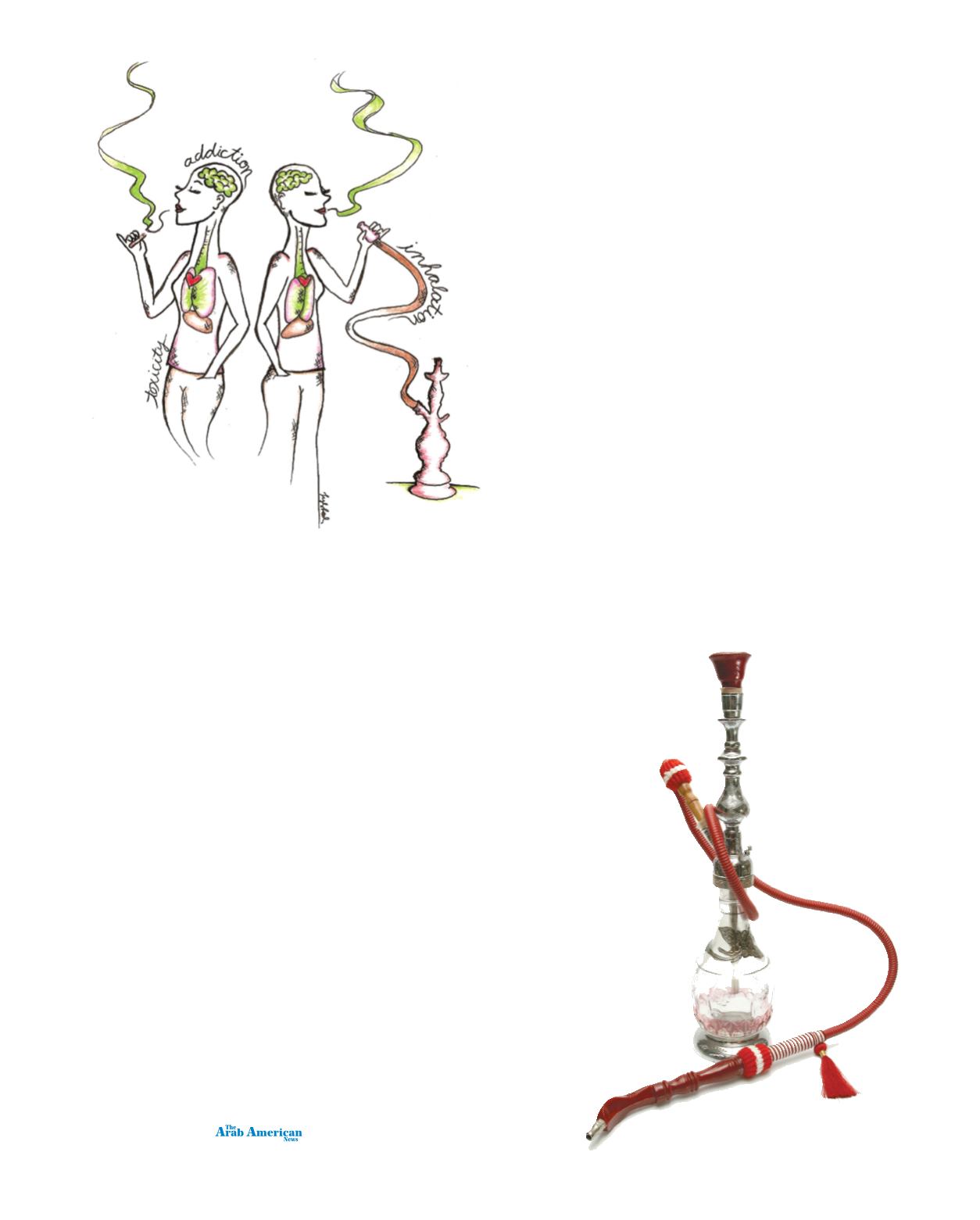
Surprisingly, 19 percent of the respondents
said they believed smoking via a hookah
was less harmful than smoking cigarettes.
Hookah smoking, Dr. Arnetz said, is likely
more dangerous than cigarette smoking.
Hookah smokers are exposed to and inhale
greater amounts of carbon dioxide, nico-
tine and other carcinogens during a session
with the water pipe.


