22
sahtak - June 2010
By Elizabeth Hughes
T
he car door slides open and
your bright and innocent little
boy, wheezing slightly after
sprinting from the school doors to
the van, jumps inside and buckles him-
self in. He’s talking a mile a minute
about how his best friend went home
sick today with the flu.
Instantly you think about last Satur-
day night, sitting in the ER because of
your son’s asthma. He’s been having
more severe asthma attacks and the
last thing you want is for him to catch
the flu and end up in the hospital yet
again because the flu has triggered a
severe asthma flare-up.Then you
wonder,“How could Ali possibly have
the flu?” It’s already May and the
school year is almost over. But then
you remember the H1N1 flu virus
that spread worldwide at this time
last year, making international news.
You heard that the flu was still going
around. Could your son’s friend have
the H1N1 flu? If so, how bad could it
be?
Since April 2009, when the H1N1
flu virus was first identified, the Cen-
ters for Disease Control and Preven-
tion (CDC) estimate that some 59
million people have been infected
with H1N1. Between 188,000 and
389,000 of these infections resulted in
hospitalization and between 8,520 and
17,620 H1N1-related deaths oc-
curred. As the school year comes to
an end and the weather becomes
nicer, many parents feel their loved
ones are no longer at risk of catching
the flu. Though rates of flu infections
appear to have stabilized, the greatest
risk of severe H1N1 flu infections and
related deaths affects those of us
younger than 65 years old.
Whys is H1N1 still such a
concern?
The H1N1 flu virus is a type of flu
that no one, prior toApril of 2009,
had developed any immunity against.
As a result, those who are infected
with the H1N1 virus tend to have
more severe symptoms and complica-
tions. Unlike the seasonal flu, which is
of particular concern for the very
young and the elderly, the H1N1 virus
infected more youth and young adults
than any other group of people. De-
spite overall rates of flu infections de-
clining or stabilizing, the H1N1 flu
strain continues to circulate across
America and the world and is the pri-
mary virus strain associated with cur-
rent flu hospitalizations.
When we don’t vaccinate our chil-
dren, or ourselves, we increase the
chances of becoming infected and ulti-
mately put our loved ones at in-
creased risk especially if they have
certain health conditions. These
health conditions include lung disease,
like asthma or chronic obstructive
pulmonary disease (COPD), diabetes,
heart or neurologic disease, and preg-
nancy. These increase the risk for
complications and hospitalization
from the H1N1 flu virus. Experts ex-
pect to continue seeing the H1N1
virus all summer long, and they antici-
pate it returning early this fall, before
the 2010 flu vaccinations are ready.
How can I protect my loved
ones?
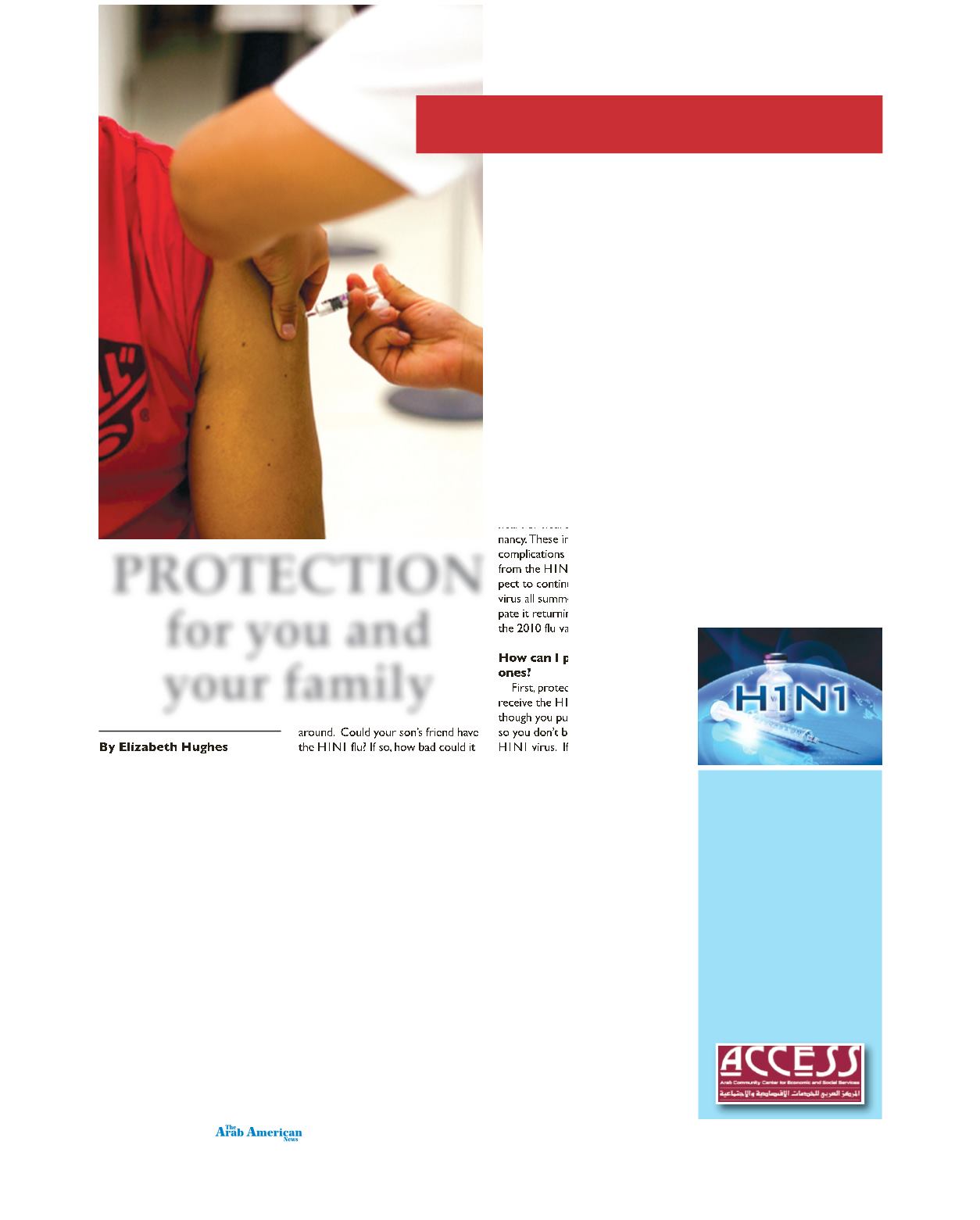
First, protect yourself.When you
receive the H1N1 vaccination it’s as
though you put up a protective shield
so you don’t become ill from the
H1N1 virus. If you aren’t sick, you
won’t spread germs and infect people
you are in close and regular contact
with, such as your children. Vaccina-
tion is the most important protective
step in preventing the flu.
Is the H1N1 vaccination safe
for me or my child?
The H1N1 vaccine is made following
the exact same process used to de-
velop each year’s seasonal flu vaccine
and has been tracked for adverse re-
actions since its initiation last spring.
So far the H1N1 vaccine has had very
similar safety ratings to the seasonal
vaccine. In fact, both the CDC and
the Food and Drug Administration
closely monitor the vaccine for signs
of adverse effects and work with local
and state health officials to investigate
any such events.The most common
side effects people may experience
after flu vaccinations are mild sore-
ness, redness, tenderness or slight
swelling in the spot where the vaccine
was given.
Where can I find the H1N1 flu
vaccination?
The Arab Community Center for
Economic and Social Services (AC-
CESS) is providing free H1N1 vaccina-
tions now! Call 313-216-2200 or
stop by the ACCESS Community
Health & Research Center at 6450
Maple Street in Dearborn to be vacci-
nated right away or to schedule an
appointment. It’s now even easier to
be vaccinated with a newACCESS
clinic opening in Sterling Heights,
Michigan, in the next few weeks.
Safe and sound
“Can I go outside now, Mom?”
Your 7-year-old’s eyes sparkle as he
looks to you for your permission.
“Yes, but stay in our yard.”
Dusk is approaching and you want
keep your child safe from harm’s way.
Just a week ago you made sure you
and your children all received the
H1N1 vaccination from the local
health center.You sigh in relief be-
cause you’ve protected your son from
catching the flu virus.
PROTECTION
for you and
your family
Get vaccinated today
and protect your loved
ones from infection
all year long.
To schedule an
appointment, call the
ACCESS Community
Health Clinic
today at
313-216-2203
or for more info,
please call
Bashar Shamo
at 313-216-2200
Vaccination is the most important
protective step in preventing the flu.


