18
sahtak - June 2010
A
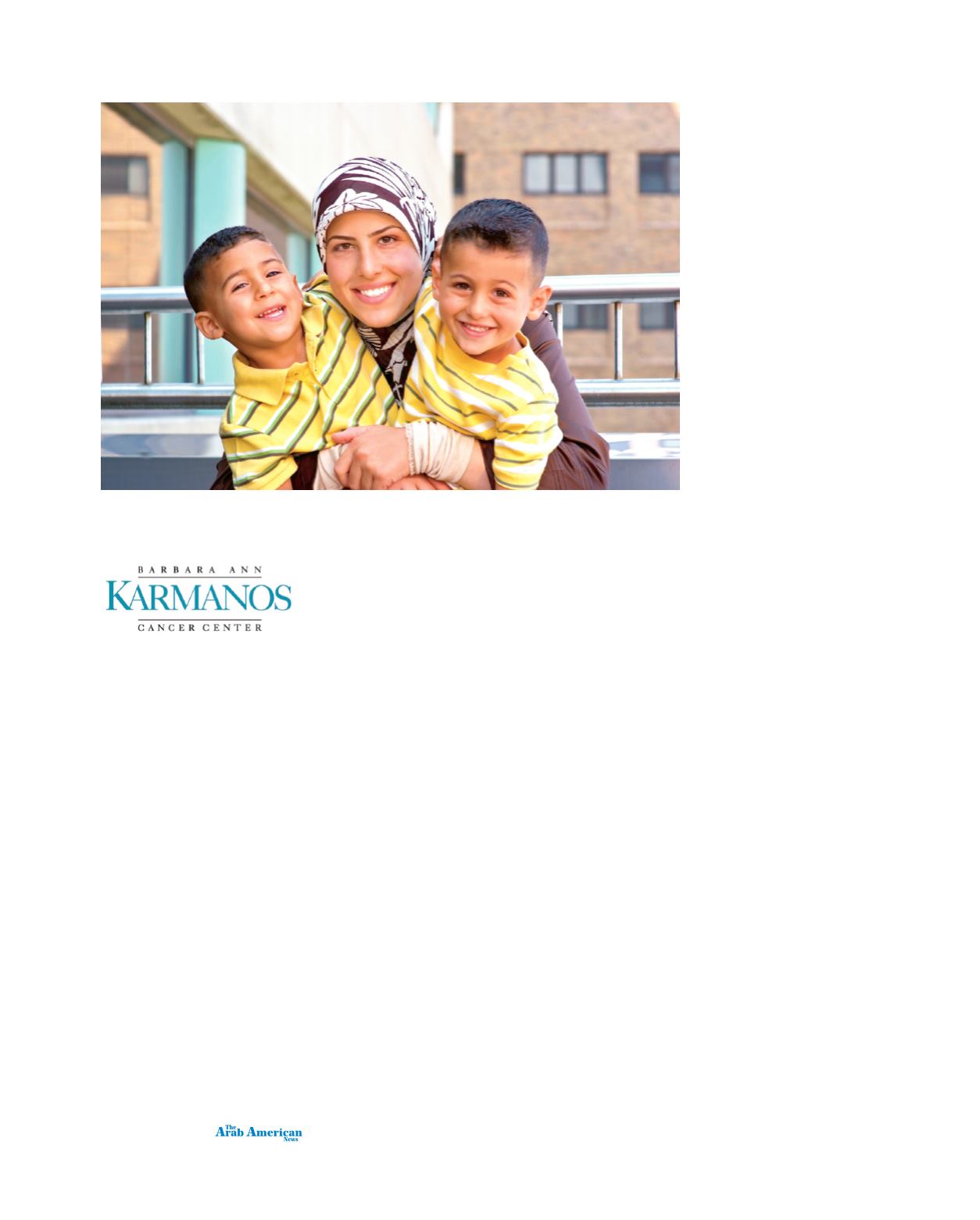
t first,Amal Fawaz – a 25-
year-old Lebanese-American
from Dearborn and single
mother of two young boys –
couldn’t believe what she was hear-
ing. Then the reality of her diagnosis
sunk in.
“The doctors told me I had Stage
IV non-Hodgkin’s lymphoma,” says
Fawaz, who was diagnosed two
years ago.“I knew something was
wrong because I had lost 20 pounds
in a month and felt very fatigued. But
I was also going through a very
stressful period in my life.At my age,
I would never have thought I had
cancer. I worried that I might not be
here for my children.”
Fawaz wasn’t sure where to turn
until a friend recommended she
make an appointment at the Barbara
Ann Karmanos Cancer Center.After
meeting with Carter Bishop, M.D.,
FACP, professor of medicine and
member of the Department of Inter-
nal Medicine, Division of Hematol-
ogy Oncology at Karmanos and
Wayne State University School of
Medicine, Fawaz says she immedi-
ately felt confident she would re-
ceive the best care.
“I trusted Dr. Bishop entirely,”
Fawaz says.“He said he always had
faith in me. He admitted me immedi-
ately and began a very aggressive
round of chemotherapy, which lasted
three months.”
In May 2009, Dr. Bishop told
Fawaz she was cancer free. She at-
tributes her recovery in part to the
sensitive, compassionate care Dr.
Bishop and Karmanos offer.
“Karmanos treats their patients
like human beings, not statistics,”
Fawaz says.“Dr. Bishop was very ac-
commodating and understanding of
my needs and my faith. I am a sur-
vivor because of his support and
care and my faith in God.”
Building Cultural Awareness
Fortunately, Fawaz sought imme-
diate medical attention for her ill-
ness. But some Arab-American
cancer patients are reluctant to seek
care upon diagnosis.Within this cul-
ture, the disease is often associated
with punishment and seen as un-
treatable. Because of these stigmas,
some Arab-Americans aren’t aware
of their treatment options. Language
barriers and a lack of knowledge
about preventive cancer screenings
can also impede some Arab-Ameri-
cans from undergoing routine tests
such as mammography.
Karmanos physicians and staff ac-
commodate all patients, no matter
what their ethnicity, by making cul-
tural sensitivity a top priority. Kar-
manos also partners with
community groups like ACCESS
(Arab Community Center for Eco-
nomic and Social Services) in Dear-
born to help create broader
awareness of cancer screening and
treatment opportunities within the
Arab-American community.
“When working with Arab-Ameri-
cans or patients from any other eth-
nic community that may have
cultural differences, you must not as-
sume that your model of treatment
and interaction is the best way,” says
Lisa Berry-Bobovski, scientific direc-
tor of the Behavioral and Field Re-
search Core at Karmanos. She and
her team study ways to enhance
physician / patient communication.
“At Karmanos, we have formed
an Arab-American research group.
It’s made up of scientists who meet
regularly to share identified health
disparities within the Arab-American
community,” Berry-Bobovski says.
“We can all benefit from increased
knowledge of what our patients
need. It’s about establishing trusting
relationships and making sure
they’re receiving the best cancer
treatment and services.”
Bringing Care to the
Community
Philip Philip, M.D., Ph.D., FRCP,
professor of Medicine and Oncology
at Karmanos Cancer Center and
Wayne State’s medical school, has
treated many Arab-American pa-
tients at Karmanos’ Farmington Hills
location.
“Karmanos provides personalized
care that is sensitive to the cultural
needs of the surrounding commu-
nity,” says Dr. Philip, who is originally
from Iraq.“I have worked with pa-
tients and families of Arabic heritage
who were confused by a cancer di-
agnosis. Sometimes, because of cul-
tural issues and language barriers,
they don’t fully understand their
treatment options. Fortunately, be-
cause I speak Arabic, I can help reas-
sure them and explain the treatment
in their native language.”
Dr. Philip says Karmanos is seeing
an increasing number of Arab-Amer-
ican patients from Farmington Hills
and surrounding communities. Many
of these patients come to the Kar-
manos Cancer Center in Farming-
ton Hills by word-of-mouth referral
from relatives and friends.
“These patients share their expe-
riences within their community,” Dr.
Philip says.“Our Farmington Hills
center is the only health care facility
in that area that deals strictly with
cancer.Arab-American patients find
that our entire staff – from the
concierge to the physicians – is to-
tally dedicated to meeting their
needs.We provide a multidiscipli-
nary approach to cancer treatment,
state-of-the-art equipment, access to
clinical trials and patient support
groups – everything a cancer patient
needs.”
To schedule an appointment at
the Farmington Hills Cancer Center
or Karmanos’ midtown Detroit lo-
cation, call 1-800-KARMANOS.
Destroying cancer stigmas
Karmanos Cancer Center offers
Arab-American patients
sensitive, compassionate care
Amal Fawaz with her two children.


