



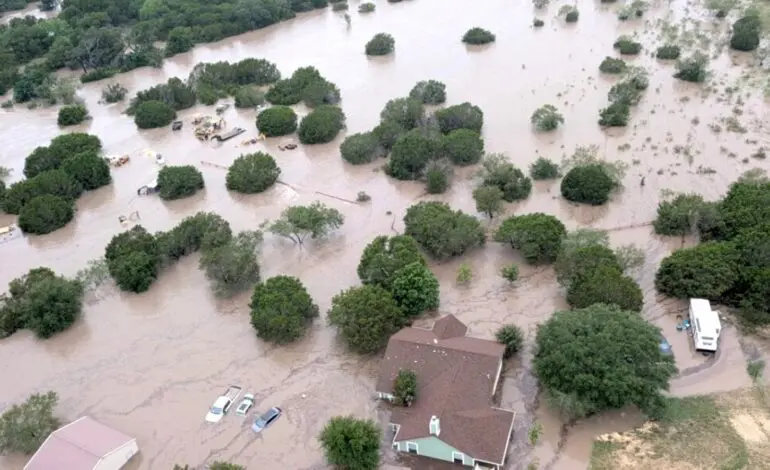

The Federal Emergency Management Agency’s (FEMA) uneven response to the Texas floods — which killed 132 people, including children — has left states wondering whether they can continue to rely on the agency amid an environmental disaster.
“The FEMA director (David Richardson, the agency’s acting administrator) hasn’t even bothered to show up in Texas yet,” said noted environmental activist Bill McKibben, at a July 11 American Community Media news briefing. “And around the country, every state and local official is now in a state of suspense about whether there’ll be FEMA funding as disasters happen in the future.”
The Texas floods are the worst in the state’s history: 100 people were still reported missing as of press time July 15. Several girls enjoying an annual summer camp at Camp Mystic were killed in the disaster, which has also displaced 400 families.
Can states take over?
“The Trump administration has said that they think states should pay for disasters instead of the federal government, but that’s obviously silly,” said McKibben, founder of Third Act, which encourages older people to get involved in environmental issues. “Though there are disasters every year in the United States, there’s not disasters in every state every year. It makes no sense for each state to have its own fully funded, fully prepared disaster core. This is something we should do as a country.
“I think that the most likely outcome, what seems to be happening, is that the president will dispense disaster aid henceforth as a political favor to people in groups and places that he favors and not to places that he doesn’t,” he added. “This sounds strange and un-American, but it seems to be the path that we’re on right now.”
The New York Times first reported that on July 5, as flood waters were receding, FEMA received 3,027 calls from disaster survivors and answered 3,018, or roughly 99.7 percent. Contractors with four call center companies answered the vast majority of the calls.
Budget cuts
That evening, however, FEMA did not renew the contracts with the four companies and hundreds of contractors were fired. The next day, July 6, FEMA received 2,363 calls and answered 846, or roughly 35.8 percent. And on July 7, the agency fielded 16,419 calls and answered 2,613, or around 15.9 percent, as reported by the Times.
President Trump has repeatedly threatened to disband FEMA; the agency has received budget cuts to grant programs since January. But Department of Homeland Secretary Kristi Noem said July 13 that Trump now wants to “remake” the agency, instead of shutting it down. She characterized the New York Times report as “fake news.”
A rapidly warming planet
At the July 11 ACoM news briefing, McKibben noted that floods of the magnitude seen in Texas are becoming a more common occurrence.
“The planet is now warming very rapidly, and we’re seeing the effects around us on a regular basis,” he said. “This kind of flooding now occurs quite often simply because warm air holds more water vapor than cold, loading the dice for increased flood events.
“So we’re very much on a timetable to try and somehow limit the damage from climate change, which would require a very fast phase out of coal, gas and oil.”
Oil and gas combustion create carbon dioxide, a greenhouse gas driving climate change. Fossil fuel combustion also produces particulate matter, which kills 1 out of 5 people globally each year.
The resurgence of solar
Countries around the world — led by China — are rapidly phasing out their dependence on fossil fuels, relying instead on solar energy. However, Trump gave a boost to the fossil fuel industry in the spending and budget bill he signed into law July 4.
“The big, beautiful bill is absolutely stuffed with provisions that are designed quite clearly to slow the transition to renewable energy,” said McKibben, noting the cessation of tax breaks for sun, wind and EV batteries that were part of former President Biden’s Inflation Reduction Act. The credits were supposed to last for a decade, but McKibben said they will mostly phase out by the end of this year, some of them sooner.
The tax credit for electric vehicles expires as early as the end of September, he added, predicting there would be mass layoffs at clean energy companies and the cancellation of renewable energy projects.
Consumers will feel the impact in their energy bills.
“The cheapest way to make power on our planet is to point a sheet of glass at the sun,” McKibben said, noting that families will pay hundreds of dollars more in their utility bills. “That’s why it’s expanded so rapidly in blue states as well as red. Texas actually is expanding renewable energy even faster than California at this point.”
“Sun day”
“So it’s a great paradox that, just at the moment that the rest of the world is moving decisively in the direction of clean energy, the U.S. is trying to move decisively against it,” McKibben said. He pointed to an initiative known as “Sun Day,” which will be held on Sept. 21 — the Fall Equinox.
“It will be a day of all kinds of festivities and protests, all designed to drive home the most important fact: that sun and wind are no longer alternative energy,” he said. “They’re the obvious, straightforward, common sense and cheap way to produce power in this world.”
– Sunita Sohrabji is the Health Editor at American Community Media.
Edited for style.



Leave a Reply