



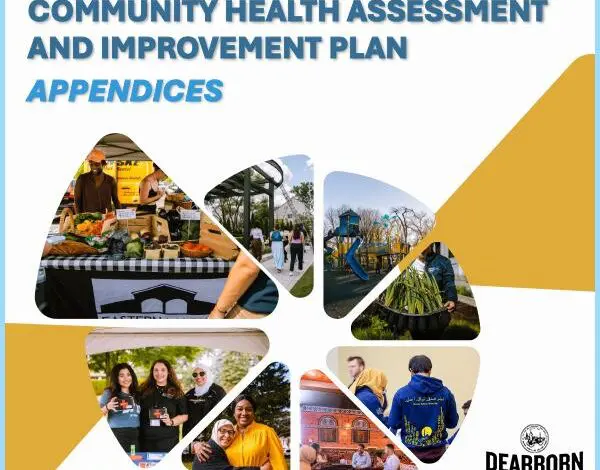

DEARBORN – The Dearborn Public Health Department has released a comprehensive assessment of residents’ needs, priorities, challenges and health experiences. This unprecedented initiative is part of an ambitious vision to embed public health at the core of municipal policy in the only city in Michigan — besides Detroit — to have its own local public health department.
The assessment was based on a representative survey of 1,127 residents, reflecting the city’s demographic and cultural diversity. It was supported by numerous focus group discussions with healthcare providers and community members, and conducted with technical assistance from the Michigan Public Health Institute (MPHI). A steering committee composed of local residents and community partners oversaw the process to ensure the assessment accurately represented the city’s realities and challenges.
Titled “Dearborn Community Health Assessment and Improvement Plan”, the report estimated the city’s population at approximately 106,000 in 2024, nearly evenly split between women (50.3 percent) and men (49.7 percent). Educationally, 84 percent of residents had completed high school, while 34.3 percent held a bachelor’s degree or higher.
Economically, the median household income in Dearborn stood at $65,192 annually, with 24.3 percent of residents living below the federal poverty line. The birth rate was reported at 16.4 per 1,000 residents, and 51.4 percent of households spoke a language other than English at home. Notably, 29.4 percent of Dearborn’s residents were foreign-born.
The report also found that 91.7 percent of residents had access to high-speed Internet, with an average commute time of 21.2 minutes. Housing costs averaged $1,653 per month, and 8.4 percent of residents under age 65 reported having a disability — highlighting the need for enhanced inclusion and health equity efforts in the city.
The evaluation focused on key themes, including environmental health, mental and behavioral health, family structures, cultural and social diversity and income. From these areas, a community health improvement plan was developed, targeting:
-
Mental and behavioral health services and support
-
Maternal and child health
-
Environmental health
-
Better access to community health resources
-
Public education and health literacy initiatives
Environmental health emerged as a major concern. Many residents expressed worries about air quality, pollution and neighborhood cleanliness — particularly in Southend and East Dearborn. Children, people with illnesses and vulnerable populations were identified as most affected by environmental degradation. In the area of mental health, the report noted cultural barriers and social stigmas that often deterred people from seeking care. One in five residents reported feeling poor mental health for more than 14 days at some point.
Dearborn, among the cities with the highest birth rates in Michigan, saw Medicaid covering 64 percent of all births in 2023 — a figure well above the state average of 39 percent. Additionally, one-third of Dearborn’s children live below the federal poverty line.
The Health Department was deliberate in adopting a culturally inclusive approach by incorporating the “Middle Eastern and North African” (MENA) identity category to better reflect Dearborn’s population. Arab Americans, who make up over half the city’s population, are often categorized as “White” in federal data.
Even so, the report noted that white residents (including Arabs) make up over 90 percent of Dearborn’s population, with Black, Asian and other racial and ethnic groups making up less than 10 percent.
Ali Abazeed, director of Public Health for the city of Dearborn, emphasized the significance of this effort.
“This assessment blends data with human stories,” he said. “It’s Dearborn telling its own story — what hurts, what heals and what’s possible when communities, science and government work together.”
“It’s a mirror of our collective life, reflecting our challenges while highlighting our strengths — our shared history, vibrant culture and our will as a city that isn’t afraid to innovate in caring for one another,” he added.
Abazeed noted that since its founding in 2022, the department has worked to embed public health in all city policies, guided by a “health in all policies” approach. This includes expanding culturally responsive mental health programs and ensuring that “our work reflects the humanity and lived experiences of our people.”
“This assessment isn’t just a report — it’s a living blueprint shaped by community voices, backed by data, and born from partnership. It will guide our next phase. We invite residents, activists, workers, students, and visitors to be part of this future effort.”
Mayor Abdullah Hammoud also praised the report.
“This assessment serves as a compass for our health-in-all-policies approach,” Hammoud said. “With this report, we now have real data and clear priorities to inform our decisions and shape our programs. We are closer than ever to making Dearborn a clean, green, and healthy city for all.”
You can view the full report at: https://dearborn.gov under “current news and featured stories.”


Leave a Reply