




By Allison Torres Burtka
To support small-business owners and aspiring entrepreneurs, the Detroit Hispanic Development Corporation (DHDC) offers a social entrepreneurship program. It helps build resilience and intellectual capital in the community, said Lex Zavala, DHDC’s interim executive director.
“Part of our mission is to create generational wealth for our community and to make people empowered to be resilient and be able to stand on their own two feet,” Zavala said. “This is just another way that we’re equipping people with the skill set to be able to build themselves up.”
The program includes a six-week course called Side Hustle to CEO, which covers topics including marketing, budgeting and finance. At the end of the course, participants come out with a finished business plan, Zavala said.
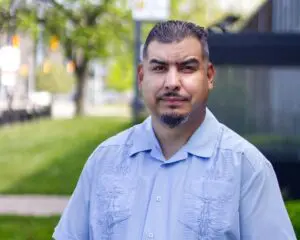
DHDC Interim Executive Director Lex Zavala
The course is both in person and online, and at the end of it, participants can go back and watch past sessions if they need a refresher.
Making a business startup a less daunting experience
The DHDC’s social entrepreneurship program also includes one-on-one coaching on various aspects of being an entrepreneur, such as funding, strategy and branding. People who take the Side Hustle to CEO course sometimes do one-on-one coaching as well, if they want more assistance in a specific area, Zavala said. The course and the coaching are offered in English and Spanish and are provided free of charge.
“We are one of the only programs that take people from concept all the way through brick and mortar” or e-commerce, Zavala said. “We walk people through the entire process of developing their businesses.”
Many challenges can get in the way of opening up or developing a business.
“Entrepreneurs by nature are risk takers and generally go it alone, so being an owner is an isolating experience,” said Anita Zavala, the DHDC’s deputy director. “Resources are challenging to find if you don’t know where to look; and navigating government regulations and procedures are challenging for the most experienced owners, even more so for those who are not native English speakers.”
Other common challenges include access to capital and, for food businesses, access to a commercial kitchen, she said.
“There are not enough community kitchens in Detroit for them to prep their food, and the cost of building a certified commercial kitchen can quickly exceed $150k.”
Growing confidence and know-how
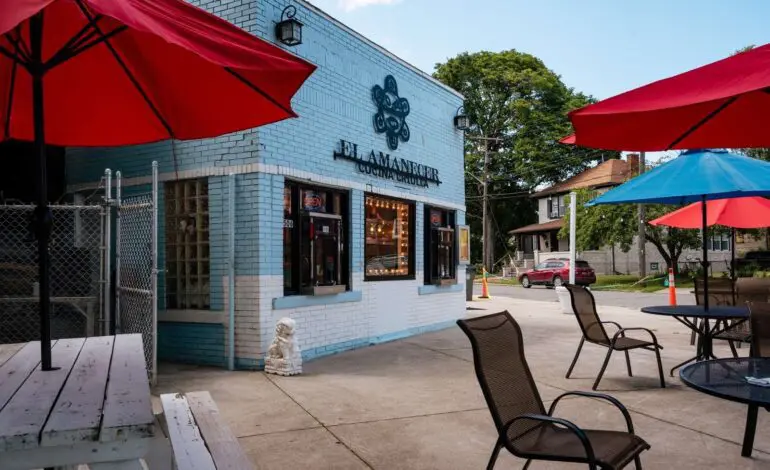
Many entrepreneurs don’t know where to start, said Alberto Ruiz, who recently opened the Puerto Rican restaurant El Amanecer in Ecorse, after a year of coaching through the program.
For example, he said, “I have a dream, I would like to open up X business. What are my options? What are my resources that I have? Who can guide me? What do I need to do? Who should I go to? Who do I need to speak to to ignite and create my dream of opening up a small business?”

Alberto Ruiz, owner of El Amanecer
Ruiz is grateful to his coaches, Anita Zavala and Rachael Hernandez, who helped make his dream a reality. They helped him understand health department requirements and fill out and file applications, among other assistance. But the most important benefit was their help in building his confidence to move forward, he said.
“Especially when you’re a first-time business owner and really don’t know the in and outs, it can become very scary, very difficult, very discouraging,” he said.
The DHDC’s social entrepreneurship program took root during COVID in 2021, “when a lot of people were laid off and were doing side hustles as a way to make ends meet,” Lex Zavala said. “We saw that there was a need for people to be able to build upon their skill set, so that way, they can take their concept to reality.”
Building business savvy through a pop-up market
The DHDC started by creating a pop-up market called Fantazma Market & Café, where people could sell their merchandise and where artists could perform. Then the organization recognized that some of Fantazma’s vendors “needed that extra assistance to build their business savvy up”, so they figured out how to provide that assistance, Zavala said. DHDC started its coaching in 2022 and the course in 2023.
Now, Fantazma is a monthly event at the DHDC. For Fantazma vendors, there’s a fee of $25, or $10 for DHDC members.
Between the market, the course and the coaching, more than 700 businesses have participated in the program. This includes 132 businesses attending the classes and more than 220 people going through one-on-one coaching. They include a wide range of businesses: construction, landscaping, tequila producers, clothing designers, artists, entertainers, real estate investors, event planners, bakers, jewelry makers, app designers and photographers.
“Most of our participants have already started their businesses when they attend the classes and coaching,” Anita Zavala said. “I do have roughly 10 percent who are interested in business, but are not quite ready to commit or haven’t settled on a firm idea yet.”
Learning surprises about business ownership
One of the things the entrepreneurs are surprised to learn is why LLCs are important, she said.
“When I explain the liability protection they offer and by operating it independently from their personal finances, their personal assets are protected from litigation, the light bulbs go on,” Zavala said. “They then understand why it is important to have a business bank account, why they need good bookkeeping practices and why they should never comingle business funds with their personal.”
Along with Ruiz, another success story is an undocumented immigrant who was cleaning residential homes for a few clients when she attended the course, Zavala said.
“Since then, she registered her company using her ITIN, won a contract to clean a fairly large surgery center and now has five employees and is growing.”
(An ITIN is a 9-digit number the IRS issues if a person needs a U.S. taxpayer identification number for federal tax purposes.)
Reaching goals and setting new ones
Like the DHDC, Ruiz has his sights set on community.
“Our goal is to bring our Puerto Rican roots to the metro Detroit area” and show people what Puerto Rican culture is about he said about opening El Amanecer. He aims to build community and economic growth through the food industry, he said.
El Amanecer has had great results so far.
“I’ve gotten so much love and support from the community. My clientele is growing daily, weekly,” Ruiz said. And people enjoy the location, which has a view of the Detroit River and Canada.
Ruiz would like more people to know about the DHDC, and he’d like to see more organizations like it that can guide small businesses.
“Words cannot truly describe my appreciation,” he said. “When you’re on a hundred-mile journey, and a person assists you with directions or even a bottle of water on your journey, they need to be recognized for that.”
– Resilient Neighborhoods is a reporting and engagement series that examines how Detroit residents and community development organizations are working together to strengthen local neighborhoods. This story was originally produced and published by Model D Media and is reprinted in New Michigan Media newspapers through a partnership supported by the Kresge Foundation.
Edited for style.
Photos by Nick Hagen
https://www.modeldmedia.com/features/DHDC-social-entrepreneur-program.aspx



Leave a Reply