


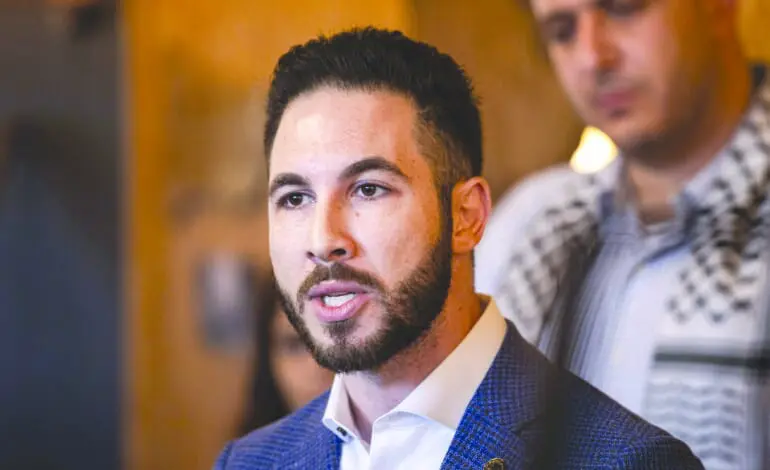

DEARBORN — After a wave of orchestrated criticism exploiting his harsh rebuke of a resident who opposed naming part of Warren Avenue after The Arab American News Publisher Osama Siblani, Dearborn Mayor Abdullah Hammoud pushed back against what he described as a smear and sectarian incitement campaign targeting the city over the past two weeks.
During the City Council meeting on Tuesday evening, Hammoud said Dearborn embodies “the best of America” by bringing together people of all backgrounds, religions and beliefs to live in peace and mutual respect as neighbors, colleagues, business owners and worshippers. He emphasized that Dearborn, which has long been maligned, has never succumbed to divisive attempts aimed at undermining its social fabric.
Hammoud’s comments — delivered as he seeks reelection in November — came at the end of the public comment session, where some attendees — mostly from outside of Dearborn — demanded that he apologize for castigating evangelical activist Ted Barham.
In a previous session, Hammoud had described Barham as a “bigot, racist and Islamophobe” and pledged to organize a parade the day Barham moves out of the city. The sharp exchange stemmed from Barham’s objection to naming a section of Warren Avenue after Siblani, whom Barham accused of sympathizing with resistance groups such as Hezbollah and Hamas, both designated as terrorist organizations by the U.S. State Department.
Barham is a well-known proselytizer and anti-Islam agitator. For years, he has frequented public parks in East Dearborn — particularly Hemlock Park — to preach Christianity to children and hand out gifts.
Right-wing extremists media frenzy
Hammoud’s remarks about Barham quickly made headlines in local and national right-wing media and fueled social media videos and livestreams that highlighted the religious identities of Hammoud (a Muslim) and Barham (a Christian). Many of these posts carried sectarian and Islamophobic undertones.
The controversy, coming in the midst of Dearborn’s election season, also triggered sharp polarization: Critics —mostly not residents of Dearborn — accused Hammoud of rashness and lack of political tact, while supporters praised him for taking a strong principled stand against hate speech and for defending the city’s ethnically and religiously diverse community.
Roots of the controversy
On September 8, Wayne County honored Siblani by unveiling a traffic sign naming part of Warren Avenue after him. The next day, Barham voiced his disapproval, calling the tribute “provocative” and comparing it to naming the street after Hamas or Hezbollah.
Introducing himself as a Christian man of peace, Barham said the Siblani street signs were “extremely provocative.” He cited earlier statements by Siblani in support of Palestinian and Lebanese resistance movements — quotes later shown to have been lifted from videos posted by the Middle East Media Research Institute (MEMRI), a pro-Israel organization that describes its mission as monitoring extremism.
Barham, who said he previously lived in Lebanon and Israel and had visited the Palestinian territories, claimed that Siblani had repeatedly incited violence. Councilman Robert Abraham refuted the claim.
“He (Siblani) is not a violent person,” he said. “Show me where in those quotes he called for violence. Of course you can interpret his words however you like, but I assure you he never intended to incite violence anywhere in the world.”
Council President Mike Sareini added that the city was not responsible for Siblani’s recognition, which was initiated by Wayne County, the jurisdiction that oversees Warren Avenue.
At that point, Hammoud interjected with a fiery response.
“You are not welcome here. The day you move out of this city will be the day I, as mayor, host a parade celebrating your departure — because you are not someone who believes in coexistence.”
He told Barham to avoid Warren Avenue if seeing Siblani’s name offended him, or to close his eyes when passing by. He also told Barham that he is Islamophobic and a bigot.
“It is hypocritical for you to come to this podium while you have YouTube videos standing in front of mosques in this city, saying cruel things about Muslims and Islam,” he said. “You are a bigot, a racist and an Islamophobe.”
Local and national outlets amplified the confrontation, reviving stereotypes of Dearborn as a hub of extremism — including a 2024 Wall Street Journal op-ed by MEMRI director Steven Stalinsky, who had described the city as “the jihad capital of America.”
Siblani’s response
For his part, Osama Siblani rejected Barham’s allegations in several media interviews. Speaking to the Detroit Free Press, he said he did not know Barham personally and he never heard of him.
“He was quoting me in a cheap and out-of-context way, which is exactly what MEMRI does,” he said. “That group was co-founded by a former Israeli intelligence officer.”
Siblani stood firm on his political positions.
“I stand by every word I said. I don’t avoid what I believe in, nor do I say things I don’t believe in. I take full responsibility for my words.”
He noted that some of the statements Barham cited were related to Israeli military assaults on Palestinians in Jenin, in the occupied West Bank, in 2022.
“Under international law, people under occupation have the right to resist by all means. Some may take up arms, while their supporters abroad can protest peacefully in solidarity,” Siblani said. “Here in Michigan, we can raise our fists and call for freedom for Palestine. Yes, I said it. I said ‘Free Palestine.’”
Tuesday’s City Council meeting
At the September 23 meeting, more than an hour of public comments unfolded, with many attendees — including several from outside Dearborn — voicing support for Barham and demanding Hammoud apologize. Others, however, praised Hammoud’s leadership and his contributions to Dearborn’s prosperity and interfaith harmony.
“Christians face repression of free speech around the world,” Barham said, seeking to cast the dispute in religious terms. “In the United States, we are branded as Islamophobes. There is a lot of hatred in our community, but I want to encourage loving those who hate you.”
Several speakers took Barham’s side. One resident insisted Barham “loves Muslims.”
“As mayor, you should unify all groups, not divide them,” the resident told Hammoud. “Some irrational or violent people might interpret your words as an invitation to drive Barham out of Dearborn.”
Another said he had admired Hammoud in the past but believed his personal attack on Barham undermined the multiculturalism that makes Dearborn unique.
“That kind of behavior destroys bridges instead of building them.”
Others defended Hammoud. A Christian woman said his remarks were taken out of context, while another disagreed.
“We need a mayor who does not attack Christians. I don’t ask you to share our beliefs, only to speak respectfully with those who disagree with you.”
Shawn Rief, who came from Garden City, said he was “shocked” that Hammoud once praised former Hezbollah Secretary-General Hassan Nasrallah as “a hero” at an event.
“We have a mayor in the United States who shared a platform with someone who is a terrorist,” he said. “Where is your loyalty? Is it to the United States or to Hezbollah?”
By contrast, Pastor Nathan Hayes of Dearborn’s Solid Rock Church voiced appreciation for Hammoud.
“I want to thank the mayor for his positive role in our city,” he said. “Social media clips misrepresent reality in Dearborn. Last week, videos of Hammoud scolding Barham went viral, but they do not reflect the full truth.”
Council President Sareini also reminded participants that Barham’s right to express his religious views had not been suppressed.
“Freedom of religion is guaranteed at a much higher level than ours,” he said. “No one has restricted that freedom here.”
Hammoud’s closing remarks
Applause and jeers mixed as Hammoud delivered his closing remarks, which did not include an apology to Barham. Instead, he spoke calmly about Dearborn’s identity.
“Dearborn represents the best of America.”
He emphasized that coexistence is the foundation of the city’s strength.
“We practice living together peacefully, with respect, as neighbors, classmates, business partners and believers,” he said. “That is precisely why there are constant attempts to smear Dearborn’s reputation.”
Hammoud recalled past provocations, including Quran burnings by Christian extremists and harassment of Muslim families during the Arab American Festival.
“Those actions never weakened the social spirit of Dearborn,” he said. “Some may feel uncomfortable or even openly bothered seeing church steeples and mosque domes sharing the same skyline, but every time someone tried to tear this city apart, we stood united — hand in hand, shoulder to shoulder. For decades, people tried to divide us, but Dearborn never gave in.”
Local election dynamics
The clash has spilled into electoral politics. Mayoral candidate Nagi Almudhegi, a Yemeni American, seized on the controversy to criticize Hammoud, calling his behavior “unjustified, impolite and wrong by all standards.”
“The United States is built on freedom of speech and freedom of religion,” Almudhegi said when unveiling his campaign program last week. “If I were in Mayor Hammoud’s place, I would not have said anything. Mr. Barham has the right, as an American citizen, to express his opinion — and he did so calmly and respectfully. The mayor should have let him speak instead of resorting to a harsh attack.”
Almudhegi warned that Hammoud’s comment declaring Barham “not welcome” could create the false impression that Christians are unwelcome in Dearborn.
“People may be led to believe that Dearborn is racist, or that Christians have no place here — which I completely reject.”
He declared his full support for Ted Barham.


1 Comment
Joe Mahama
November 12, 2025 at 10:23 pmMultiple members of the council repeatedly interrupted Barham, accusing him of making “false claims” about Lebanon (where Barham lived previously) being a primarily Muslim country, which is in fact TRUE.