



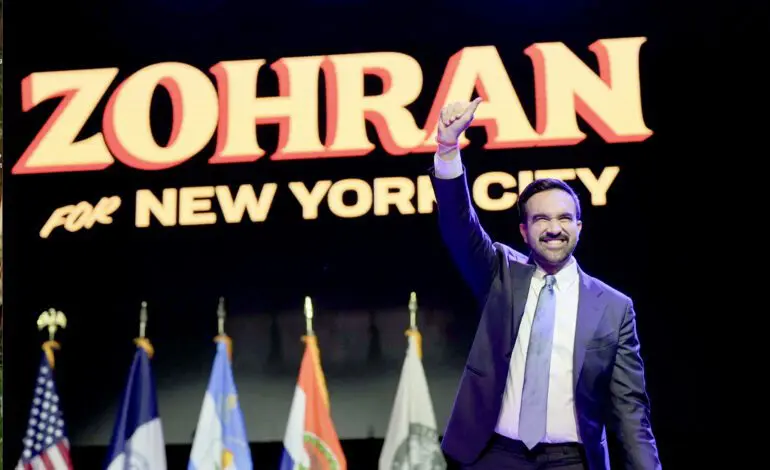

A grassroots revolution in America’s most powerful city challenges the old political order from within
By Ali Mansour
The Arab American News
Zohran Mamdani’s stunning and historical election as mayor of New York City is far more than a change in name or a passing victory for a new progressive figure.
It is a seismic political signal, marking a deeper transformation inside the Democratic Party, at the heart of one of the most influential cities in global politics and media.
A blow to the Party establishment
Mamdani — a young, socialist politician of African and South Asian heritage, rose from a working-class immigrant background without ties to party elites or corporate donors.
He came from the grassroots: students, workers and community organizers in neighborhoods long treated as electoral afterthoughts without an independent voice.
That, precisely, is what shocked the Democratic establishment.
For decades, the New York Democratic machine has chosen its candidates before the voters did — through party financing, media support, union endorsements and a web of political patronage.
But Mamdani’s victory demonstrated that those networks can no longer guarantee control against a mobilized, small-donor, people-powered campaign united by a clear anti-classist message.
It is the same model that Senator Bernie Sanders tried to advance in 2016, but didn’t succeed.
Now, the Sanders project has returned from the bottom up.
The Democratic Party must choose, remain the party of Wall Street and the elites, or return to being the voice of workers and students.
A threat to the old guard
The Democratic establishment does not fear Mamdani as an individual; it fears the movement he represents.
His emergence revives a question long buried by party elites:
Should the Democratic Party remain the party of urban elites, Wall Street financiers and media conglomerates — or return to being the party of workers, students and struggling families?
Mamdani’s platform reopens long-frozen debates that call for taxing the wealthy, curbing corporate influence in elections, expanding social welfare and public health care and loosening the party’s dependence on financial interests.
These ideas are red lines for a political establishment that, since the 1990s, has thrived on a close alliance with the wealthy contributors.
His win signals a struggle over who writes the party’s platforms, and who benefits from them. Is the Democratic Party still governed by elite interests, or can it once again serve the ordinary people?
Mamdani’s victory brings the political debate back to where it belongs, between privilege and fairness, not fear and identity.
A challenge and a warning for Trump
Ironically, Mamdani’s victory presents both an opportunity and a real challenge for Donald Trump.
On one hand, it deepens the ideological split within the Democratic Party — between an entrenched establishment and an energized progressive base that now feels emboldened.
Such division could make it harder for Democrats to present a united message in 2026 and beyond — an opening Trump could exploit.
But on the other hand, Mamdani’s populist, social-justice agenda undermines the very foundation of Trump’s politics.
By shifting the debate from identity and fear to economics and class, Mamdani forces Americans to confront the real divide — not between races or religions, but between the rich who hoard privilege and the poor who fight for fairness.
Trump thrives when politics is reduced to cultural battles, resentment and divisions.
He falters when the conversation becomes about economic justice and the rights of working people.
Mamdani’s calm, inclusive and principled tone pulls the national debate onto ground where both Trump and the Democratic establishment are uncomfortable.
Implications beyond the U.S.
Mamdani’s rise also resonates internationally, including in Lebanon, Palestine and the wider Middle East.
He is openly critical of U.S. policy toward Israel and its genocidal war on the Palestinians in Gaza, supports the right of self-determination for oppressed peoples and calls for reducing military spending in favor of public investment.
If such views gain ground within the Democratic Party, they could begin to erode Washington’s traditional monopoly on Middle East discourse, offering a new vision less biased toward Israel and more responsive to the realities of peoples in the Global South.
That is what truly worries the centers of power in Washington and Tel Aviv, not the winning of one mayor in the very important American city, but a potential shift in the political climate shaping U.S. policy for years to come.
A turning point for the Democratic Party
Mamdani’s victory is not a passing anomaly — it is a turning point in the party’s internal balance of power.
His rise signals the gradual decline of the old establishment’s grip on politics and the return of social justice, equality and wealth redistribution to the forefront of America’s political debate.
At the same time, it is a warning for Trump that the identity-driven populism that fueled his ascent may soon be replaced by a deeper, more authentic populism, one that pits economic privilege against the everyday struggles of workers, average Americans and the younger generation.
A new political question
What is unfolding now inside the Democratic Party is the beginning of a long and fundamental struggle over a single question:
Who has the right to shape American policy?
The privileged elite that writes programs for its own interests? Or the people who live every day with the consequences of those policies?
Mamdani’s triumph does not provide a final answer. But, it sends a clear and powerful message that the old order can no longer claim the future alone.
– Ali Mansour is a contributing writer for The Arab American News. He resides in Dearborn, Michigan


Leave a Reply