



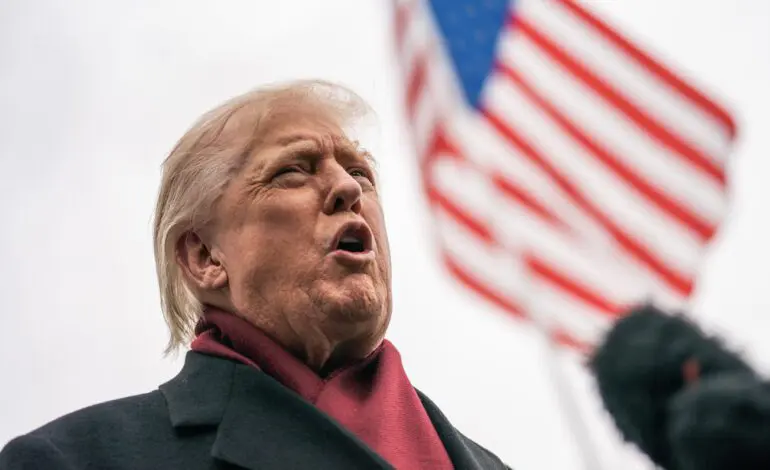

WASHINGTON, D.C. – President Trump has signed an executive order directing his administration to begin the process of formally designating certain branches of the Muslim Brotherhood as foreign terrorist organizations.
Under this executive order, Secretary of State Marco Rubio and Treasury Secretary Scott Bessent must work with Attorney General Pam Bondi and Director of National Intelligence Tulsi Gabbard to submit a report on the group’s branches in countries “such as Lebanon, Egypt and Jordan” and determine whether they meet the criteria for designation as foreign terrorist organizations, according to a White House statement.
Executive order targets Brotherhood affiliates in Egypt, Lebanon and Jordan, raising concerns over political fallout and civil liberties implications in the U.S.
Trump’s move aligns with decisions already taken by countries like Egypt, Saudi Arabia and the United Arab Emirates, which consider the Brotherhood a threat to their national security and a driver of extremism.
The Trump administration claims that Muslim Brotherhood branches in certain countries are involved in supporting or encouraging attacks against Israel and U.S. partners, or in providing material support to Hamas.
The White House argued that the organization’s branches in Jordan, Egypt and Lebanon are “engaging in or facilitating and supporting campaigns of violence and destabilization that harm their regions, U.S. citizens and American interests.”
The U.S. designation of the Brotherhood’s branches as foreign terrorist organizations would allow punitive measures against them, such as freezing any U.S.-based assets and banning their members from entering the country, in addition to the political and security signals that could influence the positions of regional allies and Western nations.
Potential civil liberties concerns
The White House explained that the executive order requires the Departments of State and Treasury to take action within 45 days of the report’s issuance with the aim of “denying these branches the resources, eliminating their capabilities and operations, and ending any threat these branches pose to U.S. citizens and national security.”
A recent detailed study published by the Institute for the Study of Global Anti-Semitism and Policy (ISGAP) concluded that the Muslim Brotherhood follows a “long-term strategy” to influence Western societies from within, by exploiting democratic systems and cultural tolerance in Western nations to advance its political ideology.
Some researchers accuse the organization, founded in Egypt in 1928, of expanding its influence within certain U.S. institutions and supporting pro-Palestine protests and Boycott, Divestment and Sanctions (BDS) campaigns against Israel, describing these efforts as “a multi-generational project to undermine secular democracy using democratic freedoms.”
The president’s move to advance the designation of certain Muslim Brotherhood branches as foreign terrorist organizations reveals a murky shift in Washington’s approach to political Islam, especially given the group’s strong ties with key U.S. allies such as Turkey and Qatar.
Amid domestic and international debate over the potential impact of such a classification on civil liberties and relations with Muslim communities, supporters of Trump’s decision argue that it aligns with a broader counter-extremism strategy and responds to the concerns of Middle East allies.
Texas precedent and legal challenges
Texas had already preceded Trump by designating both the Muslim Brotherhood and the Council on American-Islamic Relations (CAIR) as terrorist organizations through an order issued earlier in November by Governor Greg Abbott, which barred the two groups from purchasing or owning land in the state.
Abbott is smearing us and other American Muslims. Our mission is to defend justice here in America and abroad. – CAIR stated in the lawsuit.
In response to these accusations, CAIR, which Abbott links to the Muslim Brotherhood, filed a lawsuit against the order, stating that “Abbott is smearing us and other American Muslims. Our mission is to defend justice here in America and abroad.”
With a national review now underway, legal and political experts expect significant debate over implications for Muslim civic participation, humanitarian aid operations and U.S. diplomatic relationships across the Middle East.


Leave a Reply