



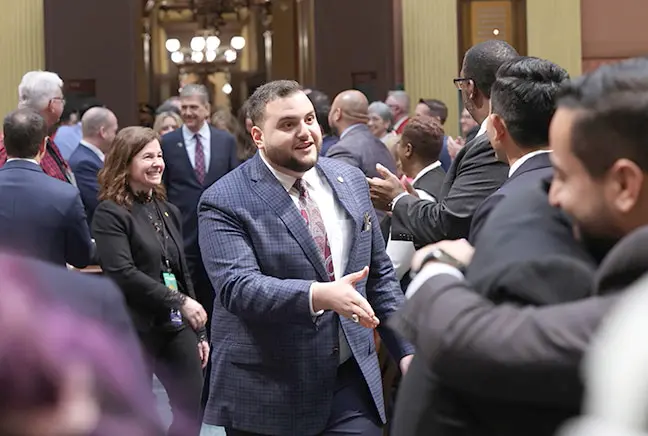

LANSING — State Rep. Alabas Farhat (D-Dearborn) has been named Minority Lawmaker of the Year by the Michigan Information & Research Service Inc. (MIRS), a recognition that highlights his growing influence in the Michigan Legislature and his role as a key bridge between Democrats and Republicans on major policy issues.
The honor was announced during the MIRS Monday podcast and reflects Farhat’s effectiveness in advancing bipartisan solutions on public safety, economic development and infrastructure funding, even as Democrats remain in the minority in the Michigan House.
Farhat, now in his second term, began the year serving as minority vice chair of the House Appropriations Committee. While he remains a member of the committee, his leadership post was stripped in July by House Speaker Matt Hall (R–Richland Township) after Farhat declined to support Republican-backed legislation that would have imposed life-without-parole sentences on minors convicted of particularly violent crimes.
Speaker Hall said he had offered revisions to the proposal, including eliminating consecutive sentencing for multiple charges, in exchange for Farhat’s support. However, Farhat did not agree to the deal, a decision that proved consequential at a time when Republicans were short three votes.
Ranked most effective House Democrat
Despite the loss of his leadership role, Farhat’s standing inside the Capitol strengthened considerably this year. In a MIRS-commissioned survey conducted by EPIC-MRA, nearly 500 legislators, lobbyists and Capitol staff ranked Farhat as the most effective House Democrat.
Sixteen percent of respondents selected Farhat, outpacing Rep. Will Snyder (D-Muskegon) at 10 percent and Rep. Karen Whitsett (D-Detroit) at 9 percent. Other top vote-getters included Rep. Angela Witwer (D-Lansing) and House Minority Leader Ranjeev Puri (D-Canton).
Central role in $1.8 billion road funding deal
Farhat was widely credited as a chief Democratic negotiator behind the $1.8 billion road funding package signed into law by Governor Whitmer in October.
The deal fundamentally restructures how Michigan funds road repairs by directing all state taxes paid at the fuel pump toward transportation infrastructure. Beginning next month, this will amount to a $0.524-per-gallon tax on motor and alternative fuels.
The package also includes a new 24 percent wholesale tax on marijuana and decouples Michigan’s business tax code from certain federal provisions enacted under President Trump, particularly those related to manufacturing and research-and-development deductions retroactive to 2022 and covering all of 2025.
Public safety and local investment
In another bipartisan effort, Farhat worked closely with Hall and the office of Detroit Mayor Mike Duggan to create a Public Safety and Violence Prevention Trust Fund. The initiative established a new category within Michigan’s revenue-sharing framework, dedicating $75 million in Fiscal Year 2025 budget to locally administered violence prevention and public safety programs.
Advocacy for Arab American communities
Representing Dearborn, the nation’s largest Arab American-majority city, Farhat has also emerged as a vocal advocate for Michigan’s Middle Eastern communities. He has spoken out forcefully about civilian casualties in the Israeli war on Gaza and condemned conservative claims accusing Dearborn of enforcing Sharia law, calling such rhetoric false, dangerous and discriminatory.
“He just seems like he’s in the mix on everything,” said Kyle Melinn, editor of MIRS, during the podcast announcement.
Melinn added that Farhat continues to serve as a critical conduit for bipartisan negotiations heading into the new legislative year, particularly on brownfield redevelopment and economic growth initiatives. Among the concepts under discussion are versions of a “HIRE Michigan” framework, which would allow companies to retain income tax revenue generated by new employees, and expansions of the state’s brownfield program to encourage redevelopment of underused sites.
Legislative wins and recognition
Farhat also saw House Bill 4090 signed into law this year, authorizing the state to sell the 96.14-acre Detroit Detention Center property to the city of Detroit for $1, clearing the way for potential redevelopment.
Other nominees for 2025 Minority Lawmaker of the Year included Reps. Dylan Wegela (D-Garden City), Will Snyder and Sen. Jonathan Lindsey (R-Coldwater).
Farhat now joins a notable list of past recipients, which includes lawmakers from both parties such as former Rep. Graham Filler, Senate Minority Leader Aric Nesbitt, Rep. Angela Witwer and Sen. Jeremy Moss, among others.
Source: MIRS.news.
Edited for style.


Leave a Reply