



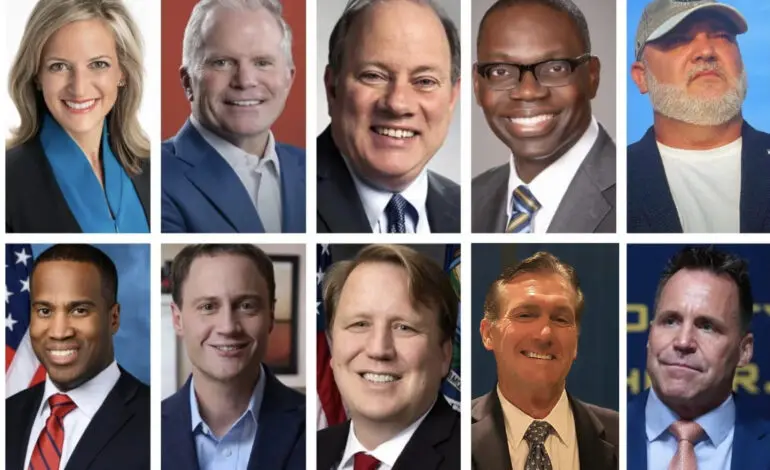

LANSING — With the start of the new year, the state is preparing for a politically charged year, headlined by elections next fall widely expected to be the most expensive in Michigan’s history. That expectation is driven not only by fierce competition for open statewide offices, but also by the elections’ decisive role in shaping the next legislative majority in the U.S. Congress.
Statewide elections
Michigan will witness an unprecedented series of election battles this year, with multiple open races that could reshape the balance of executive, legislative and judicial power in Lansing.
For the first time, the governor’s race is expected to become a three-way contest.
At the top of the ticket is the governor’s race, with party primaries in August to determine the Democratic and Republican nominees. Those nominees will advance to the general election in November, which is expected — for the first time — to become a “three-way race” due to the rising prospects of independent candidate Mike Duggan.
Michigan will also elect a new attorney general and a new secretary of state this year.
These three executive races carry special significance because term limits prevent the current officeholders — Governor Whitmer, Attorney General Dana Nessel and Secretary of State Jocelyn Benson, all Democrats — from seeking a third four-year term.
Unlike the gubernatorial race, party nominees for attorney general and secretary of state will be chosen at the Democratic and Republican Party conventions next summer. The conventions will also nominate candidates for eight statewide education seats, including the Michigan Board of Education and the governing boards of the University of Michigan, Michigan State University and Wayne State University, two seats for each board.
In addition, each party will nominate two candidates for the Michigan Supreme Court, where Democrats currently hold a 5–2 majority.
On the legislative level, Michigan voters will elect all members of the State Senate and House of Representatives. The State Senate consists of 38 members, while the House has 110 members. In districts with multiple candidates from the same party, August primaries will determine which candidates advance to the general election in November.
Democrats currently control the State Senate, whose members serve four-year terms, while Republicans hold the majority in the House, whose members are elected every two years.
Congressional races
At the federal level, Michigan carries exceptional national importance this year, as voters in the state could determine control of both chambers of the U.S. Congress.
Michigan is home to at least four of roughly 20 competitive congressional districts nationwide — districts that are expected to be decisive in determining which party controls the 435-member U.S. House of Representatives.
Michigan voters could determine control of both chambers of the U.S. Congress.
Although Michigan has 13 congressional districts, competition is expected to be especially fierce in five: District 3 (Grand Rapids), District 4 (Holland–Benton Harbor), District 7 (Lansing–Brighton), District 8 (Flint–Saginaw Bay) and District 10 (Macomb County).
In another high-stakes race, voters will elect a new U.S. senator to fill one of its two Senate seats, replacing Democratic Senator Gary Peters, who has announced he will not seek re-election. Should Democrats lose Peters’ seat, their chances of regaining control of the U.S. Senate would be nearly nonexistent.
The U.S. Senate consists of 100 members, with two senators per state regardless of population. Senators serve six-year terms, with one-third of the chamber elected every two years. By contrast, all members of the U.S. House are elected every two years.
Republicans control slim majorities in both chambers, while Democrats are seeking to strip President Trump of legislative power and turn him into a “lame duck” after the November elections by winning control of at least one chamber.
Trump had a warning for Republicans on Tuesday: If they don’t keep control of Congress in this year’s midterm elections, Democrats will impeach him again.
“You got to win the midterms, because if we don’t win the midterms, it’s just going to be, I mean, they’ll find a reason to impeach me,” Trump said in a speech at a House Republican policy retreat. “I’ll get impeached.”
Polling indicates that most voters feel the country is on the wrong track, with the economy a top concern, less than a year before the midterm elections. All members of the House and a third of senators are up for re-election in November, which could determine whether Republicans are able to continue carrying out their agenda in the final two years of Trump’s second term.
A constitutional convention?
If the races above were not enough to capture political attention, Michigan voters will also decide whether to convene a constitutional convention, a vote held every 16 years.
Voters will be asked whether they want to rewrite the state constitution. Since the current Michigan Constitution was adopted in 1963, voters have rejected the idea three times. Observers are now questioning whether the outcome could be different this time, given the current political climate in the country.
If approved, a constitutional convention could reopen debate on reforms previously approved by voters, including independent redistricting and abortion rights.
Record-breaking spending expected
The 2026 election cycle is expected to see record-breaking campaign spending in Michigan, particularly due to the number of competitive congressional districts that will attract national political money.
The elections next fall are widely expected to be the most expensive in Michigan’s history.
Neil Thanedar, executive director of Michigan’s campaign finance network, said the state contains four of the nation’s 18 most competitive House districts, as well as one of the three most competitive U.S. Senate seats in the country.
While experts estimate campaign spending in Michigan could approach $1 billion in the 2026 elections, Thanedar expects most of that money to be spent on traditional television political advertising, which continues to inundate voters every election cycle.

Leave a Reply