


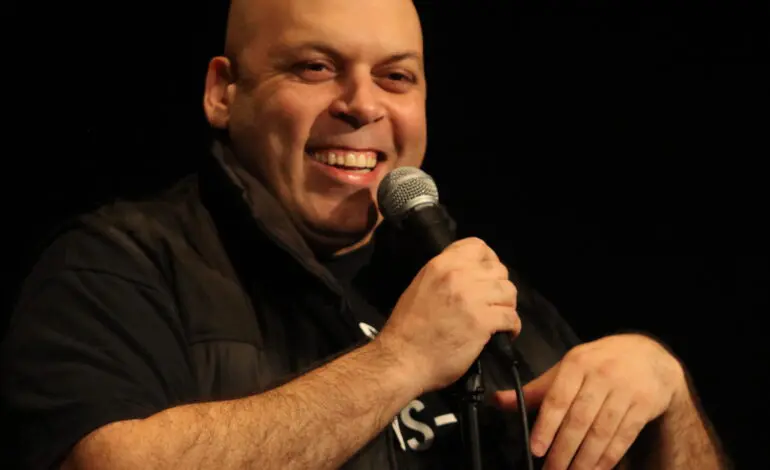

DETROIT / NAZARETH — Amer Zahr did not expect to be questioned about laughter. It never crossed his mind that a joke — one he had delivered on the same stages for years — would be treated that night as if it were a document requiring interpretation, or a position warranting investigation. He arrived in Nazareth carrying what he always brings: a satirical script shaped by a long personal experience and a simple desire to make people laugh about a reality they know all too well — not to escape it, but to ease its weight.
He did not expect to be questioned about laughter.
After he returned safely from occupied Palestine, The Arab American News spoke with Zahr — a writer, law professor, stand-up comedian and elected member of the Dearborn Board of Education — following his detention by Israeli police during one of his comedy performances in Nazareth.
Zahr said the evening of December 26 showed no signs that it would differ from dozens of previous performances. The venue was a small cultural space in the Old City, accommodating about 100 people. The audience knew him and knew the city. Three consecutive shows had been scheduled for 5, 7, and 9 p.m. Nothing in the atmosphere suggested that laughter would soon become grounds for questioning, or that the stage would lead anywhere other than applause.
Zahr noted that the presence of Israeli police before the first show did not initially draw his attention. Their presence, he said, was discreet and did not include any request to stop or alter the performance. They spoke with the venue owner and asked general questions about the nature of the event. Based on his long experience and frequent visits to the occupied territories, Zahr said he was accustomed to such inquiries passing without consequence.
The show began, and so did the laughter. Zahr told The Arab American News that everything on stage felt entirely normal and that the audience’s reaction was genuine, as it always is. There were no direct political speeches, no slogans and no attempt to provoke anyone. The comedy, as he described it, reflected lived human experience — presented through satire that allows people to laugh at themselves and their reality at the same time.
During the first performance, he noticed the venue owner briefly leave the hall and then return without comment. He did not dwell on it, assuming it was a routine administrative matter. The first show ended with applause and audience members began entering for the second performance. That’s when everything suddenly changed.
Zahr said Israeli police approached him after the first show and asked him to accompany them “for a few minutes.” He asked whether the matter could wait until after the event ended. The response was clear and final: “No. Now.”
“No. Now.”
That single phrase, he said, was enough to make him realize the decision was no longer his.
He walked outside with them as the audience continued to enter for the next show. The moment weighed heavily on him — not out of fear of what might happen, but because the audience was waiting for him without knowing why he had suddenly disappeared. For the first time that night, he felt that the laughter he had just delivered had become a source of concern, for the Israeli police at least.
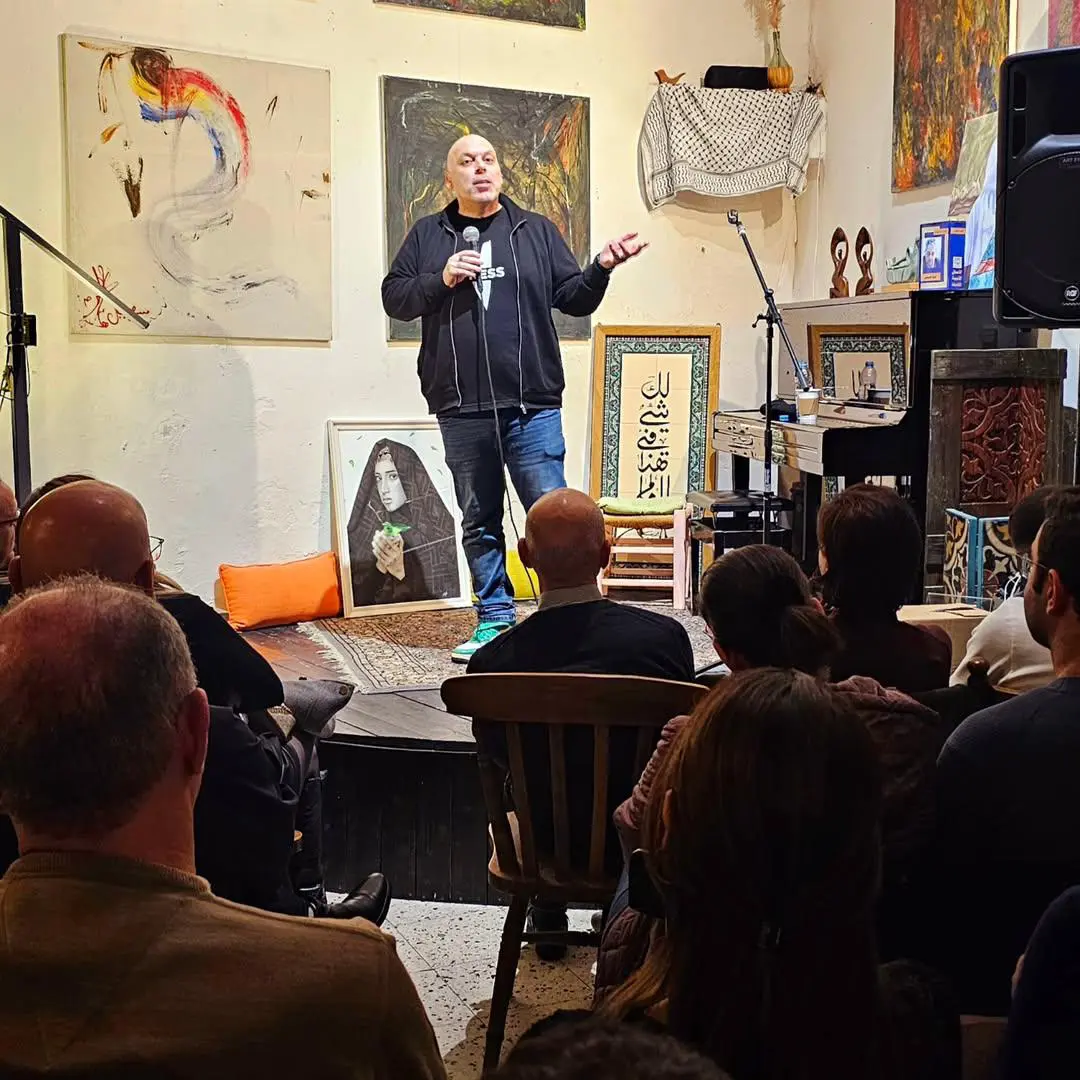
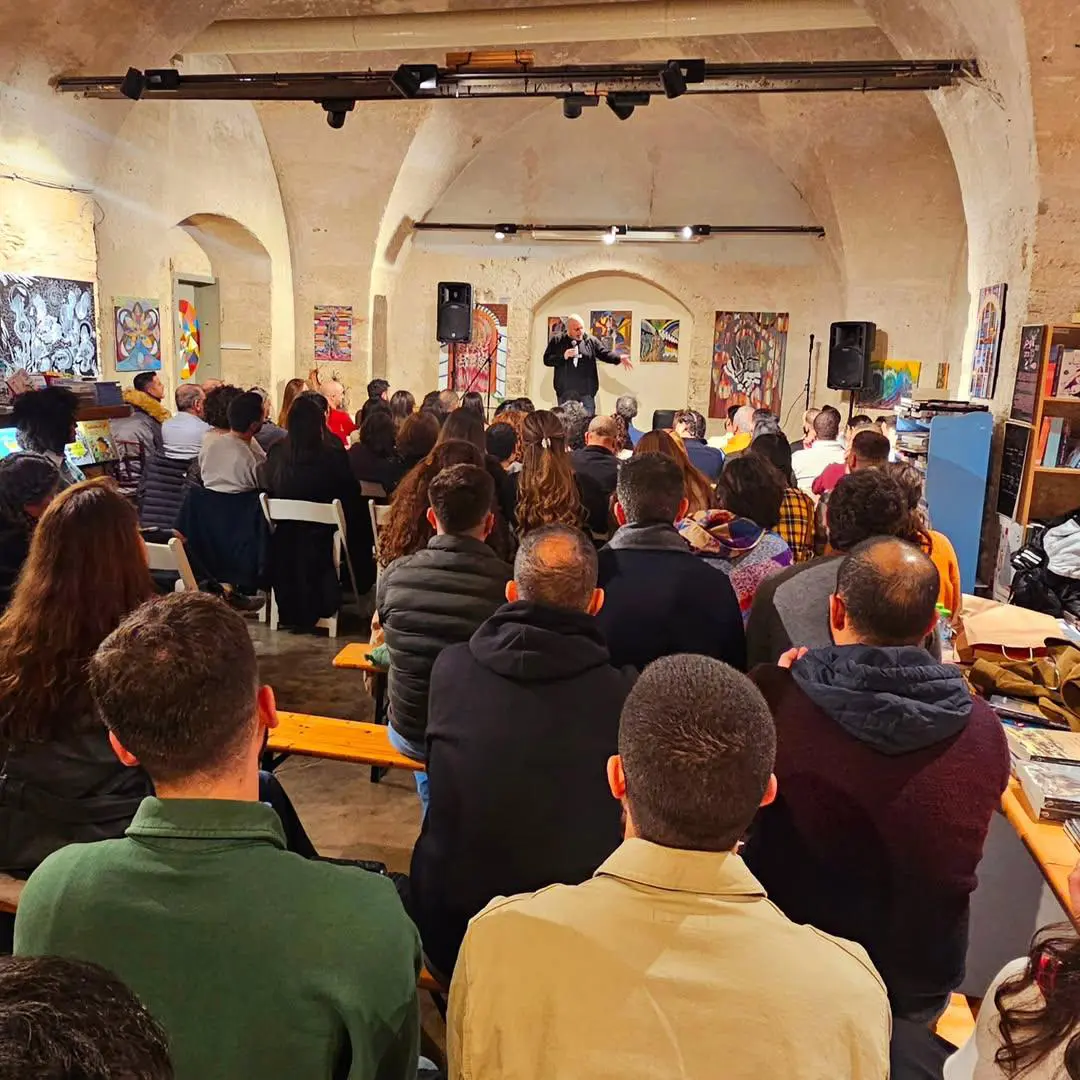
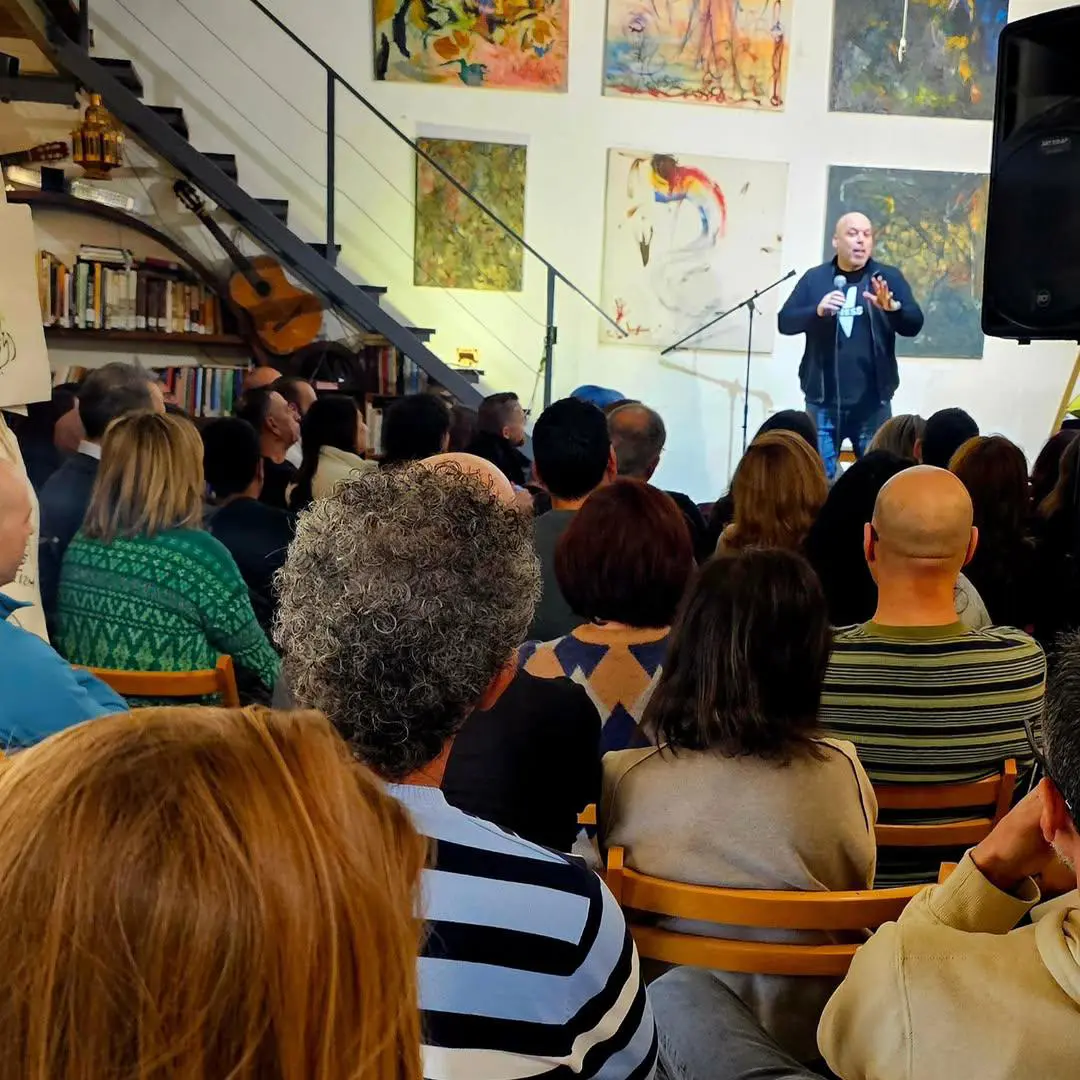
All of this took place in Nazareth, inside the 1948 territories, where no Palestinian authority exists — only Israeli police — despite the city being Arab and Palestinian.
At the police station, the lawyer who accompanied Zahr — an audience member who had come to enjoy the show — was barred from entering. Zahr said this was the first real indication that what was happening was not routine.
The lawyer was told that what was taking place was “not an official investigation”, a description that raised more questions than answers. Zahr said the ambiguity itself was part of the pressure. From the outset, the questions were not about a specific incident, but about intentions and meanings.
Zahr explained that the first question posed to him was about his profession. He answered that he was a comedian. That response appeared insufficient — or perhaps incomprehensible. He was asked to explain what he does, how and why.
Inside the room were armed plainclothes security personnel. It was unclear whether they were regular police, intelligence officers or members of the Shin Bet. An Arab investigator was brought in, as Zahr does not speak or understand Hebrew.
The questioning began with a seemingly simple question: “What do you do?”
“I’m a comedian,” he replied.
“What is that?” the interrogator responded, puzzled.
“Google my name,” Zahr said.
The interrogator spent nearly half an hour at the computer. Then the real questions began.
The focus shifted to the content of the show: Did it contain incitement? Could it be interpreted as a call against the State of Israel? Drawing on his legal background, Zahr stressed that incitement, by definition, means calling for violence — something he neither did nor intended. He tried to explain that comedy relies on exaggeration and satire, not incitement.
He told The Arab American News that he was asked whether he was “with the state or against it.” He refused to answer, saying he did not see himself as obligated to declare a political position in exchange for his right to perform art. To him, the question marked a complete departure from both art and law and an attempt at forced classification.
There is something called administrative detention.
Then came what he described as the heaviest statement. It was not framed as a direct threat, but as a cold fact:
“There is something called administrative detention.”
Six months or more without charges or trial. Zahr said that moment changed everything.
“They didn’t say they would do it,” he said, “but they made it clear that they could”, especially after learning he holds both U.S. and Israeli citizenship.
Zahr emphasized that the goal was not to extract a confession or press charges, but to deliver a message: You are not accused now, but the space you operate in is not as open as you think. He added that such messages do not need to be carried out to be effective.
In his full account of the detention, Zahr provided additional details illustrating how art became framed as a threat. He said the document presented to him for his signature was written in Hebrew. He refused to sign it because he could not understand its contents, particularly after being denied access to the lawyer accompanying him.
“I told them clearly that I don’t read Hebrew,” he said. “I’m a licensed attorney in the United States, and I cannot sign a document I don’t understand.”
When they again refused to admit the lawyer, he wrote on the paper in English, “I do not understand Hebrew” and signed his name.
Zahr said the detention lasted about an hour and a half, without charges or explanation, before he was told he could leave. Upon exiting, he was surprised to find journalists and community members waiting after news of his detention spread.
He said the first thing he asked upon his release was not about the interrogation, but about the audience.
“I immediately asked about the 7 p.m. show. When I learned people were still waiting, I went straight back and performed the remaining two shows.”
The audience had not left — they waited in solidarity.
The following day, Zahr performed two additional shows in Haifa, and on December 29, he delivered another performance in Ramallah, attended by approximately 800 people.
Zahr told The Arab American News that what deepened the experience was his awareness of the broader context. He is not a newcomer. He has performed more than 100 comedy shows in Palestine over the years — in Nazareth, Haifa, Jaffa and Ramallah — without ever being summoned for questioning. His style has not changed, nor has his material. What has changed, he said, is the heightened sensitivity toward words, even when delivered through humor.
Zahr said the incident will not push him to “change course or soften his tone.” He sees no room for compromise in art and believes that any change under pressure would amount to an implicit acknowledgment that intimidation works.
“If I changed,” he said, “people would know why. That’s not a victory I’m willing to give them.”
He added that, despite its weight, what he experienced does not compare to what Palestinians endure daily. He acknowledged that he was “protected by factors others don’t have”, yet still felt how narrow the space for expression has become — even when it comes in laughter.
“If I changed, people would know why. That’s not a victory I’m willing to give them.” – Amer Zahr
Zahr said he received no diplomatic support and did not expect any from the U.S. Embassy, “especially given the presence of representatives known for extreme pro-Zionist positions.”
He stressed that “real protection came from the people, not governments.” As for freedom of expression, his assessment was blunt:
“There is no freedom of expression for non-Jews. Since October 7, several Palestinian artists have been arrested or investigated. I am not the first, and I will not be the last.”
In closing, Zahr thanked the Arab American community in Michigan, “which mobilized immediately and spread the story through local media and social platforms,” affirming that “this popular solidarity is what defeats any attempt to silence us.”

Leave a Reply