



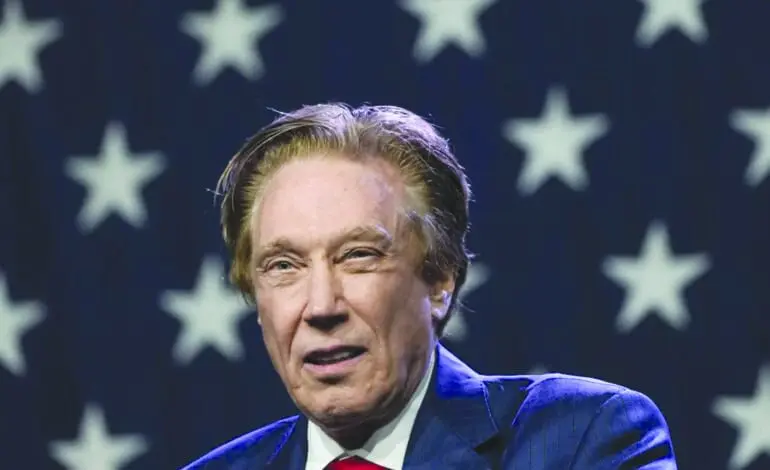

BIRMINGHAM — Wealthy businessman Perry Johnson has joined a growing field of Republican candidates seeking Michigan’s governorship, pledging to spend heavily on a campaign centered on eliminating the state income tax, fixing schools and making state government more efficient.
Launching his campaign Monday at a restaurant in downtown Birmingham, Johnson said he plans to spend $9 million of his own money over the next 60 days to boost his visibility among Republican voters through social media, television, digital advertising and direct mail.
Johnson, who was disqualified from Michigan’s 2022 gubernatorial race after his campaign failed to submit enough valid petition signatures, said his decades-long experience in quality improvement gives him a competitive edge over other Republican contenders heading into the party’s primary in August.
The Republican field currently includes former Michigan Attorney General Mike Cox, former State House Speaker Tom Leonard, State Senate Minority Leader Aric Nesbitt and U.S. Rep. John James, who is widely viewed as the front-runner based on recent polling.
Johnson, 78, told his supporters it’s unrealistic to expect someone without his background to deliver efficiency and quality in large institutions.
“Very few people have the experience needed to bring quality and efficiency to an organization this large,” Johnson said, likening Michigan’s $81 billion budget to an overgrown company that needs restructuring.
“Very few people have the experience needed to bring quality and efficiency to an organization this large,” Johnson said, likening Michigan’s $81 billion budget to an overgrown company that needs restructuring.
Johnson spent about $8 million of his own money on his 2022 campaign but failed to make the ballot after the Michigan Bureau of Elections determined that thousands of signatures submitted by his campaign were invalid and forged by a vendor hired to collect them.
Looking ahead to this year’s race, Johnson said he will personally verify signatures using a reliable database to ensure their legitimacy, adding that he is not setting a spending cap for his campaign.
“We’ll have to see what happens,” he said, noting the difficulty of predicting total expenditures — especially since the Republican nominee will face not only the Democratic nominee, but also former Detroit Mayor Mike Duggan, who is running as an independent.
I’m paying for everything myself. I won’t be doing fundraising during the first two months, I’ll be busy getting my message out. – Perry Johnson
Johnson, who built his fortune by helping companies improve product quality and operational efficiency, said he is self-funding the campaign and will not conduct fundraising during the first two months.
“I’m paying for everything myself,” he said. “I won’t be doing fundraising during the first two months. I’ll be busy getting my message out.”
Born in the Chicago area and holding a degree in mathematics, Johnson founded his first company in 1983 and now owns three firms specializing in quality improvement. He said his business background distinguishes him from candidates in both parties.
Johnson’s platform calls for cutting state spending by 2 percent and eliminating Michigan’s income tax. He pointed to Tennessee’s lack of a state income tax as a factor in securing a $5.6 billion Ford Motor Company investment to build a new manufacturing campus known as BlueOval City.
“I think you’re better at spending your money than the government is,” he told supporters in Birmingham.
Johnson also pledged to improve Michigan’s struggling public education system, though he did not outline specific policy proposals. He noted that Michigan ranks among the top 10 states in education spending but performs poorly on standardized test results, saying he hopes to give students stronger incentives to remain in the state after graduation.
“There are 550,000 students within 50 miles of greater Detroit,” he said. “But we lose 40 percent of them within five years of graduation.” He argued that Michigan needs a fundamental change in direction.
Despite being the oldest candidate in the race, Johnson said he maintains a demanding work schedule.
“Very few people work like I do,” he said. “I love what I do, and I’m the kind of person who works long hours — 14 or 15 hours a day.”
Over the past two decades, wealthy Republican candidates have had mixed success in Michigan gubernatorial races. In 2006, Dick DeVos lost despite spending $35.5 million of his own money. Former Governor Rick Snyder spent about $6 million personally to win the office in 2010.
On the Democratic side, the gubernatorial race includes Secretary of State Jocelyn Benson, Genesee County Sheriff Chris Swanson and Marni Sawicki, a former mayor of Cape Coral, Florida, who later relocated to Michigan. Lieutenant Gov. Garlin Gilchrist II recently exited the governor’s race and instead entered the contest for secretary of state.
Gov. Whitmer, a Democrat, is barred from seeking a third four-year term under Michigan’s constitutional term limits.


Leave a Reply