



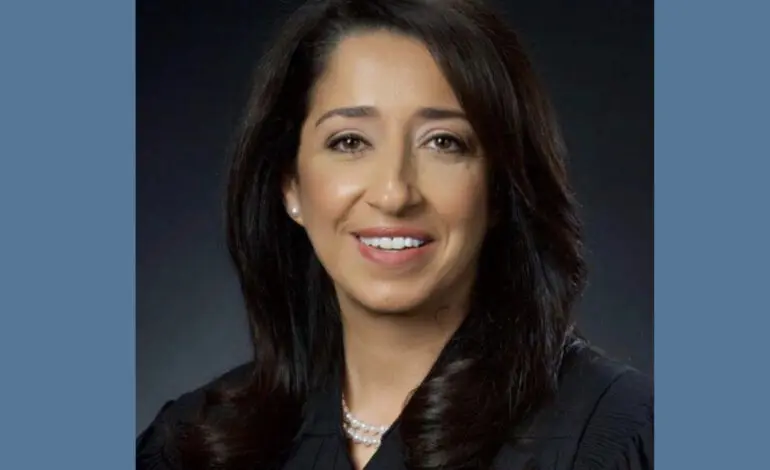

LANSING — On Tuesday, U.S. District Judge Hala Yalda Jarbou of the Western District of Michigan dismissed a lawsuit filed by the U.S. Department of Justice seeking the complete list of Michigan’s registered voters — including millions of voters’ personal data — ruling that such disclosure would violate federal law.
Judge Jarbou, who was appointed by President Trump in 2020, stated that several federal statutes prohibit the release of sensitive personal information such as full dates of birth, driver’s license numbers, Social Security numbers and state identification numbers.
In her 23-page opinion, Jarbou wrote, “Providing personal information can establish a person’s identity because that information belongs solely to that individual; if everyone has access to it, it can no longer serve to verify that person’s identity.”
DOJ request and state response
On July 21, the Justice Department under the Trump administration sent a letter to Michigan Secretary of State Jocelyn Benson, requesting a complete electronic copy of the state’s voter registration list, including associated personal data.
Benson, Michigan’s chief election official, agreed only to provide the public version of the voter file — excluding personal identifying information — prompting the Trump administration to file suit against her in federal court in Lansing, part of the Western District of Michigan, where Judge Jarbou presides.
The Department of Justice has filed similar lawsuits in other states, including California, Minnesota and New York.
U.S. Attorney General Pam Bondi said the department sought access to voter rolls to ensure the accuracy of records and the integrity of elections.
Court rejects federal legal arguments
Judge Jarbou dismissed the DOJ’s claims, which were based on the Help America Vote Act (HAVA), the National Voter Registration Act and the Civil Rights Act, ruling that none of those laws require Michigan to provide a complete voter list containing sensitive personal data.
Her opinion made clear that while transparency in elections is important, federal law does not mandate disclosure of private voter information to federal authorities.
Benson: “States must stand firm”
Benson, who is running for governor, argued that her office had already provided the Justice Department with everything it was legally entitled to receive — the public version of Michigan’s Qualified Voter File.
“States can — and must — stand their ground,” Benson said, emphasizing that access to voters’ personal information is restricted to state and local election officials, not the president, the Department of Justice or any other federal agency.
Although the Justice Department may appeal the ruling, Benson described the court’s decision as “a victory for the people of Michigan and the rule of law.”
Attorney General Dana Nessel responds
Michigan Attorney General Dana Nessel, also a Democrat, said the Trump administration had attempted to unlawfully compel Michigan to surrender sensitive private information about millions of voters without any legal basis.
“I am relieved that the court rejected this case,” Nessel said.


Leave a Reply