



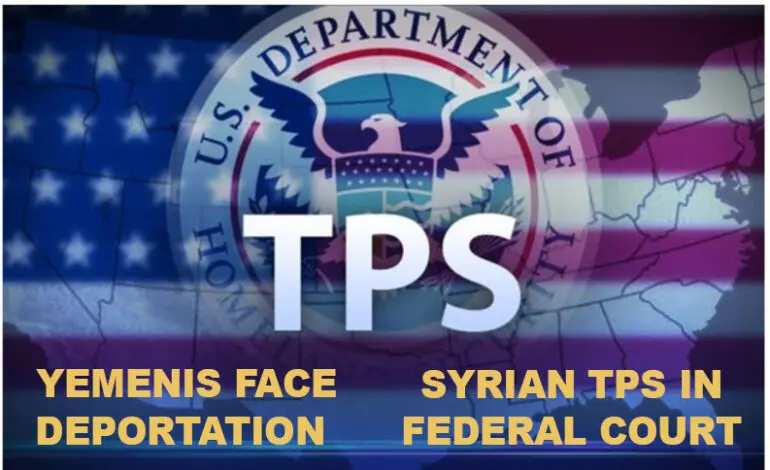

DETROIT — Thousands of Yemeni and Syrian nationals who have built their lives in the United States under Temporary Protected Status (TPS) now face legal uncertainty after the Trump administration moved to terminate their protections, citing improved conditions in their home countries.
For Yemeni TPS holders, the deadline is fast approaching. For Syrians, the fight has shifted to federal court.
Yemen TPS terminated
On February 13, the U.S. Department of Homeland Security (DHS) announced it would terminate TPS for Yemen, affecting more than 1,380 beneficiaries nationwide — including more than 125 residents in the Detroit area.
Yemenis covered under the program, which applied to individuals present in the United States since September 2015 due to war and humanitarian collapse, have been given 60 days to leave voluntarily. The deadline to depart is April 14, after which they may face arrest and deportation.
Since 2015, Yemen’s TPS designation had been extended multiple times — in 2017, 2018, 2020, 2021, 2023 and 2024 — because of continued armed conflict, economic breakdown and widespread food insecurity. The designation had been scheduled to expire March 3, and this time the administration declined to renew it.
“After reviewing the conditions in their country and consulting with appropriate U.S. government agencies, I have determined that Yemen no longer meets the statutory requirements for Temporary Protected Status,” DHS Secretary Kristi Noem said in a statement.
“Allowing TPS beneficiaries from Yemen to remain temporarily in the United States is contrary to our national interests,” Noem added, describing the decision as putting “America first.”
DHS said Yemenis who lack another lawful basis to remain must depart within 60 days or face detention and removal. Those who leave voluntarily will receive a free airline ticket and a $2,600 stipend.
Critics argue the move ignores Yemen’s ongoing humanitarian crisis. The U.S. State Department continues to warn Americans not to travel to Yemen due to terrorism, civil unrest, crime, kidnapping, land mines and severe health risks.
U.S. Rep. Rashida Tlaib, whose district includes Detroit and Dearborn, coordinated with fellow lawmakers to urge DHS and the State Department to extend protections.
She warned of the “severe consequences” of forcing approximately 125 Yemeni residents in her district to return to a country still devastated by war and economic collapse.
Michigan State Rep. Alabas Farhat of Dearborn echoed those concerns, describing Yemeni TPS holders as “an integral part of the Detroit-area community.”
“Yemen continues to suffer from one of the world’s gravest humanitarian emergencies,” Farhat said. He warned that threatening deportation would “create fear and instability among families who have no safe option for return.”
Legal advocates expect challenges to the Yemen decision may soon move into federal court.
Syrian TPS blocked by federal courts
The situation for Syrians differs — at least for now.
On September 22, 2025, DHS published a notice in the Federal Register terminating TPS protections for approximately 6,130 Syrians nationwide. The termination was scheduled to take effect November 21.
But on November 19, U.S. District Judge Katherine Polk Failla of the Southern District of New York issued an injunction blocking the termination in Dalia Doe (pseudonym) v. Noem, a class-action lawsuit filed by seven Syrian plaintiffs on behalf of all Syrian TPS holders.
Approximately 1,770 Syrian TPS beneficiaries live in Michigan.
The injunction was later upheld by the U.S. Court of Appeals for the Second Circuit, preventing immigration authorities from initiating deportation proceedings unless the Trump administration secures a ruling from the U.S. Supreme Court.
The administration has recently prevailed in similar cases involving TPS holders from Venezuela, Nepal, Honduras and Nicaragua, allowing deportation processes to move forward in those instances.
The Syrian case is being led by the International Refugee Assistance Project (IRAP), which argues the termination violates the Administrative Procedure Act and was politically motivated rather than based on objective analysis of conditions in Syria.
DHS contends that conditions in Syria have improved sufficiently, citing the fall of the Assad regime in late 2024.
Attorney Nargis Aslami, legal fellow at Muslim Advocates, called the appellate ruling a major victory.
“The decision to uphold the postponement of the termination date is a critical win for the Syrian community, whose lives are not game pieces for the Trump administration to play with,” Aslami said.
“The court sends a strong message: the systematic gutting of TPS across the board is unlawful and a product of politics, rather than compliance with the procedural mandates of the TPS statute. We will continue to fight for the dignity and protection of Syrians and all TPS holders targeted by the administration’s racist and anti-immigrant agenda.”
Lupe Aguirre, senior litigation attorney at IRAP, said the court recognized the danger facing Syrian immigrants.
“The courts yet again recognized the immediate danger facing thousands of Syrian immigrants if the Trump administration’s racist and unlawful attempt to terminate TPS for Syria is allowed to go into effect,” Aguirre said.
“The court order protecting thousands of Syrian community members from an immediate and catastrophic loss of legal status remains in effect and we will continue to fight this illegal termination in court along with the Trump administration’s other biased and illegal actions,” she added.
Broader immigration impact
In addition to ending TPS for Yemen and attempting to terminate it for Syria, the federal government has added both countries to an expanded travel ban list and suspended pending immigration applications for their nationals, including permanent residents, refugees and TPS beneficiaries.
For now, Syrian TPS holders remain protected under court order. Yemeni TPS beneficiaries, however, face an April 14 deadline unless Congress or the courts intervene.



Leave a Reply