



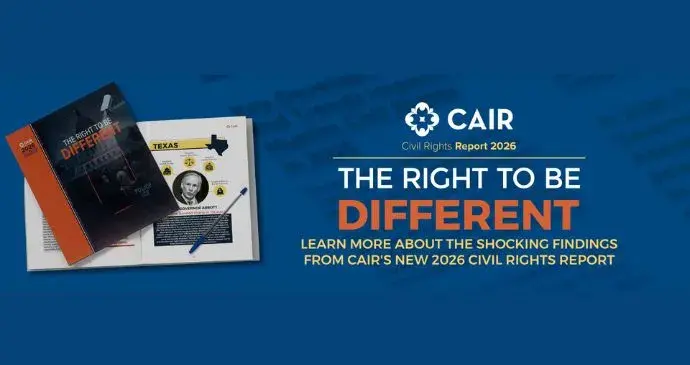

WASHINGTON, D.C. — Under the title “The Right to be Different”, the Council on American-Islamic Relations (CAIR) released its 2026 annual civil rights report on Tuesday, documenting what it described as an unprecedented rise in Islamophobia in the United States, fueled in part by the strict immigration and protest policies adopted by President Trump’s administration.
The report provides a comprehensive overview of what CAIR describes as the erosion of constitutional protections and systematic targeting of minorities, while also highlighting the growing role of civil society and the courts as a final line of defense for the fundamental freedoms of American Muslims.
The civil rights group cites Trump policies, anti-Palestinian protest crackdowns and institutional discrimination
The 122-page report documented 8,683 discrimination complaints involving Muslims in the United States during 2025, the highest number recorded since CAIR began tracking such incidents in 1996.
The figure slightly exceeds the 8,658 complaints reported in 2024, representing a 0.3 percent increase.
According to the report, the data reveal a troubling institutional pattern in which government officials allegedly use their authority “to narrow the definition of American identity and impose political control over what citizens can say or believe.”
Discrimination across multiple sectors
CAIR’s data for 2025 show that the violations were not limited to isolated incidents but also involved institutional and systematic practices.
Employment discrimination topped the list of complaints with 1,101 cases, followed by 568 immigration and asylum-related complaints and 555 direct hate incidents.
The report also recorded 505 violations related to prisoners’ rights and 488 complaints involving government watchlists and travel restrictions.
In addition, the report documented 33 incidents targeting Islamic institutions in 2025, including mosques, community centers, airport prayer rooms and spaces designated for Friday and Eid prayers.
The report noted that the statistics rely on objective monitoring standards based on publicly available information and social media data.
According to CAIR, the attacks on Muslim spaces demonstrated clear Islamophobic motives aimed at undermining the safety of public areas where Muslims gather and adding a dangerous dimension to efforts to marginalize religious expression in American public life.
Escalating trends identified
CAIR researchers identified five major trends behind the surge in complaints.
Complaints concentrated in specific states
The states with the highest levels of reported discrimination in 2025 included Florida, Illinois, Minnesota, Oklahoma and Texas.
CAIR’s Minnesota chapter recorded a 96 percent increase in complaints, totaling 693 cases, with 23 percent of them reported in December alone.
Meanwhile, the Chicago office documented 877 complaints, marking a 65 percent increase compared with 2024.
Resurgence of anti-Muslim rhetoric
The report notes a resurgence of political rhetoric portraying Muslim religious beliefs as a threat to American national security.
This trend coincided with the introduction of five federal legislative proposals seeking either to restrict Islamic religious practices or limit Muslim entry into the United States.
One of the most prominent proposals was House Bill H.R. 5512, the No Sharia Act, which would restrict courts from enforcing any judgment, decree or arbitration that relies on Islamic law or any foreign system that violates constitutional rights.
The report also cited a campaign launched by Texas Governor Greg Abbott in February 2025 advocating a ban on Sharia law.
In addition, Texas Republican U.S. Representatives Keith Self and Chip Roy founded the congressional group “American Without Sharia”, which had grown to 45 members in Congress by February.
CAIR researchers said the rhetoric extended beyond legislative debates into executive leadership circles.
They pointed to remarks by Director of National Intelligence Tulsi Gabbard during a speech at the Turning Point U.S.A. conference, where she falsely cited the cities of Paterson, New Jersey, and Houston, Texas, as examples of what she described as the alleged expansion of Sharia law.
Targeting specific ethnic and religious communities
The report also documented what it described as the use of collective punishment policies against Muslim citizens and residents deemed “undesirable.”
Afghans, Somalis and Syrians were identified as the most frequently targeted communities, facing intensified discrimination through sanctions and exclusionary policies.
CAIR said the Trump administration had justified the arrest of activists supporting Palestinian rights by framing pro-Palestinian speech as a national security threat.
According to the report, this led to the detention of a journalist and at least three students, though the allegations against them failed to stand up in court.
The report also highlighted a landmark federal ruling issued in September 2025 in a case filed by the American Association of University Professors (AAUP) and the Middle East Studies Association (MESA).
In that case, the judge concluded that government officials had deliberately coordinated between two federal agencies to undermine the organizations’ members’ rights to free speech and peaceful assembly.
Expansion of executive authority
The report noted a significant increase in the use of emergency orders, immigration laws, regulatory measures and funding restrictions to pursue political objectives.
According to CAIR, many of these measures ultimately fail when subjected to judicial scrutiny or traditional standards of evidence.
However, the reliance on executive discretion rather than constitutional safeguards has narrowed the space for civil liberties and limited the ability of citizens and residents to exercise their rights freely and safely.
Decline in constitutional protections
The report argues that access to fundamental rights has increasingly become conditional on political affiliation, silence or the financial ability to pursue legal challenges.
Equal access to opportunities — including education, travel, employment, civic participation and nonprofit work — has also faced growing restrictions.
As a result, the constitutional guarantee of equal protection has increasingly depended on court rulings rather than neutral government administration.
Civil society and courts remain key defenders of rights
Despite the challenges, CAIR’s report highlights several initiatives by civil society organizations aimed at defending civil liberties.
American Muslims and allied institutions have pursued legal challenges, public advocacy campaigns and institutional engagement to push back against discrimination.
The report notes that litigation has proven to be a relatively effective tool in defining constitutional boundaries.
Courts have rejected attempts in several cases to impose censorship or discrimination based on political viewpoints and have upheld certain privacy protections.
However, the report cautions that these judicial interventions often come after harm has already occurred, making them reactive rather than preventive solutions.
CAIR officials warn of dangerous trends
During a press conference in Washington on Tuesday, CAIR Director of Research and Advocacy Corey Saylor said 2025 marked the highest number of discrimination complaints recorded in the organization’s nearly three-decade history.
He warned of dangerous trends among some American officials seeking to make constitutional freedoms conditional on political loyalty or ideological conformity.
“Protecting your right to be different and to dissent is not a privilege granted to one community,” Saylor said. “It is the essential operating system of any free country.”
CAIR legal counsel Lena Masri said the report revealed a systematic pattern of collective punishment targeting American Muslims, particularly through the portrayal of pro-Palestinian speech as a security threat.
She said authorities had expanded the use of federal investigations and immigration procedures to silence dissent, effectively turning Muslim civic participation into one conditioned by political approval.
“Muslims are being treated as if their participation in public life depends on what they say and whether their views are acceptable to those in power,” Masri said.
Masri added that the American judicial system remains the strongest tool to curb abuses, arguing that attempts to label Islamic institutions as terrorist organizations or restrict religious practice are unlikely to withstand neutral legal scrutiny.
“In the United States, the government does not have the authority to decide which speech is acceptable, which religion is legitimate or who deserves to exercise their civil rights,” she said.
CAIR, founded in 1994, is the largest Muslim civil rights and advocacy organization in the United States.
However, the group itself faced government pressure last year when the states of Texas and Florida designated CAIR as a terrorist organization and barred it from owning property within their jurisdictions.

Leave a Reply