


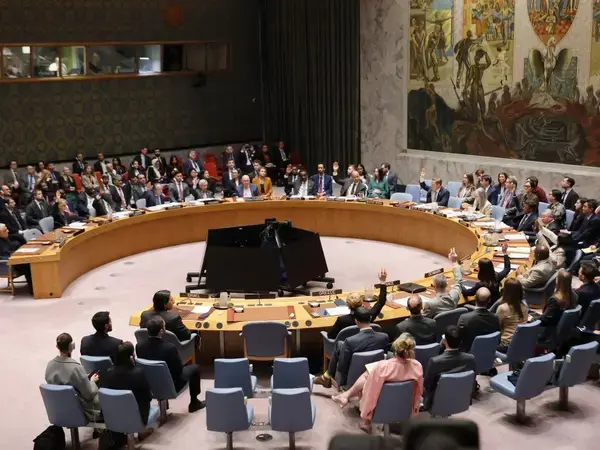

The United Nations Security Council has adopted a resolution condemning Iranian missile and drone attacks on several Gulf states as the rapidly escalating war between Iran, Israel and the United States spreads across the Middle East, raising fears of a broader regional confrontation and a global economic shock.
The resolution — adopted this week by a vote of 13 in favor, none against, with Russia and China abstaining — demands that Iran immediately halt its attacks on neighboring countries and cease threats to international shipping through the strategic Strait of Hormuz.
The vote comes amid intensifying military operations across the region and a dramatic leadership transition in Tehran following the killing of Iran’s longtime Supreme Leader Ayatollah Ali Khamenei.
Following the assassination of Khamenei by surprise Israeli and U.S. attacks on Iran, the country’s powerful Assembly of Experts appointed his son, Ayatollah Mojtaba Khamenei, as Iran’s new supreme leader, signaling what many analysts believe will be a continuation — and possibly an escalation — of Iran’s confrontation with Washington and Israel.
Security Council condemns Iranian strikes
The Security Council resolution was introduced by Bahrain on behalf of the Gulf Cooperation Council and Jordan after Iran launched waves of missiles and drones targeting regional states hosting U.S. military installations.
The resolution condemns attacks against Bahrain, Saudi Arabia, Qatar, Kuwait, Oman, the United Arab Emirates and Jordan, while demanding that Tehran immediately cease military operations against those countries.
It also warns Iran against interfering with international shipping through the Strait of Hormuz, the narrow waterway through which roughly 20 percent of the world’s oil supply flows each day.
The measure reflects growing international alarm that the conflict could spread across the entire Gulf region and disrupt global energy markets.
Despite broad support for the resolution, the abstentions by Russia and China revealed significant divisions among the world’s major powers over how to interpret the conflict.
Russia and China abstain, citing unbalanced resolution
Both Russia and China argued that the resolution focused almost entirely on Iranian retaliation while ignoring what they described as the root cause of the crisis — the Israeli and U.S. military strikes on Iranian territory that triggered the current escalation.
Diplomats familiar with the negotiations said Moscow and Beijing proposed amendments that would have condemned attacks by all parties and called for an immediate ceasefire.
When those amendments were not included in the final text, both countries chose to abstain.
Their decision highlights a widening geopolitical divide over the Middle East war and the role of international institutions in addressing it.
The resolution condemns Iranian retaliation but fails to acknowledge the military strikes that triggered the conflict. – A diplomat involved in the negotiations said.
The abstentions underscore the growing rift between Western powers and a bloc of countries that argue the crisis cannot be resolved without addressing the initial Israeli and U.S. military actions against Iran.
Iran rejects Security Council’s resolution
Tehran sharply criticized the resolution, accusing the Security Council of ignoring what it described as “aggression against Iranian sovereignty.”
Iranian officials maintain that their missile and drone attacks are part of a broader retaliation for the airstrikes that killed several Iranian leaders and destroyed key military and nuclear facilities.
Iran also insists that many of its attacks targeted U.S. military bases in the region, rather than the Gulf states themselves.
Nevertheless, the widening conflict has drawn several regional countries into the confrontation, raising fears that the war could spiral into a broader Middle East conflict.
War spreads across multiple fronts
Fighting has intensified across several theaters since the first Israeli and U.S. strikes on Iranian targets in late February.
Israeli forces have conducted extensive airstrikes across Iran, including attacks targeting checkpoints run by Iran’s Basij paramilitary forces — a key component of the government’s internal security system.
Israeli Prime Minister Benjamin Netanyahu has suggested the campaign aims not only to weaken Iran’s military capabilities but also to undermine the country’s internal political structure.
Meanwhile Iran and allied groups have launched waves of missiles and drones targeting Israeli territory and U.S. military installations across the region.
The conflict has also spread to Lebanon, where heavy fighting between Israeli forces and Hezbollah has intensified.
According to international reports, hundreds of people have been killed in Lebanon since the escalation began, including women and children.
The humanitarian consequences of the war are mounting rapidly.
Millions of civilians across Iran, Lebanon and neighboring countries have been displaced by the fighting, while critical infrastructure and historic sites have suffered significant damage.
Global economic shockwaves
The war is also sending shockwaves through the global economy.
Oil prices have surged above $100 per barrel, reflecting fears that fighting in the Persian Gulf could disrupt energy supplies and international shipping routes.
Analysts warn that any sustained disruption in the Strait of Hormuz could trigger a major global energy crisis.
Iran has repeatedly hinted that it may restrict shipping through the waterway if attacks against its territory continue.
Control of the Strait of Hormuz has become one of Tehran’s most powerful strategic tools in this confrontation. – A regional security analyst said.
Such a move could dramatically raise oil prices and place enormous pressure on Western governments to seek a diplomatic resolution.
SIDEBAR
Mojtaba Khamenei emerges as Iran’s new supreme leader
The war has coincided with a dramatic political transition inside Iran.
Following the assassination of longtime Supreme Leader Sayyed Ali Khamenei during surprise Israeli and U.S. attacks on Iran, the country’s powerful Assembly of Experts appointed his son, Ayatollah Mojtaba Khamenei, as Iran’s new supreme leader.
The decision marks the first time leadership of the Islamic Republic has effectively passed from father to son, raising questions among analysts about the emergence of a dynastic element within Iran’s political system.
Mojtaba Khamenei, believed to be in his mid-50s, had long been regarded as one of the most influential figures behind the scenes in Tehran, particularly because of his close ties to the Islamic Revolutionary Guard Corps.
First statement signals defiance
In his first public statement since assuming power, Sayyed Mojtaba Khamenei vowed that Iran would continue retaliatory attacks against its adversaries.
He warned that Tehran could keep the Strait of Hormuz closed if the United States and Israel continue military operations against Iran.
He also declared that Iran would maintain what he called a “file of revenge” against those responsible for the deaths of Iranian leaders and civilians during the conflict.
The statement suggests that Iran’s leadership transition is unlikely to soften Tehran’s stance.
Instead, analysts believe the new supreme leader may adopt an even more assertive posture as the conflict unfolds.
A dangerous new phase
Despite the Security Council vote, few diplomats believe the resolution will immediately halt the fighting.
The abstentions by Russia and China demonstrate that the international community remains deeply divided over the causes and potential solutions to the conflict.
With military operations intensifying, global energy markets under pressure and Iran’s new leadership signaling defiance, the Middle East appears to be entering a dangerous and unpredictable new phase.
Whether diplomacy can prevent the war from expanding further may depend on decisions made not only in Washington, Tehran and Tel Aviv — but also in Moscow, Beijing and the halls of the United Nations.
Leave a Reply