



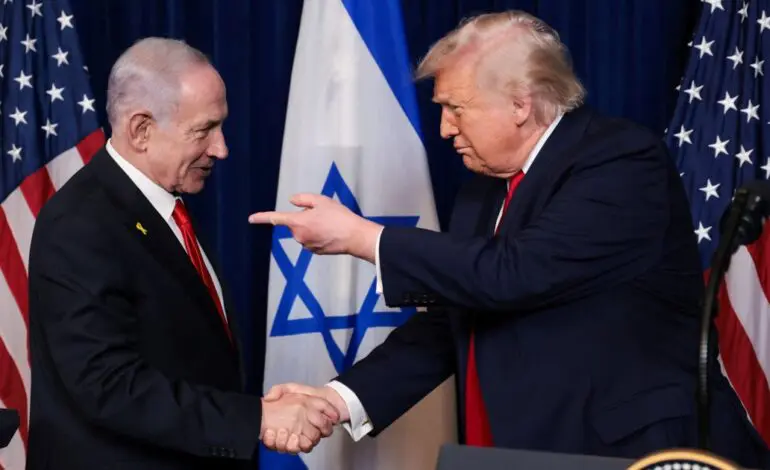

WASHINGTON, D.C. — After nearly three weeks of intense military confrontation with Iran, early signs of divergence between President Trump and Israeli Prime Minister Benjamin Netanyahu are beginning to surface, raising critical questions about the trajectory of the war, its broader regional consequences and the absence of a clear endgame.
Conflicting priorities over energy targets, regime change and military strategy expose early cracks in U.S.–Israeli coordination as experts warn of prolonged instability and global economic fallout.
What began as a closely coordinated U.S.–Israeli campaign targeting Iran’s missile infrastructure, naval capabilities and nuclear facilities has gradually evolved into a more complex and potentially volatile conflict — one now shaped by differing strategic priorities and escalating economic risks.
Flashpoint: The South Pars strike
The most visible point of tension between Washington and Tel Aviv emerged following Israel’s unilateral strike on Iran’s South Pars gas field — the largest natural gas reserve in the world and a cornerstone of Iran’s economy.
The attack marked a significant escalation, shifting the conflict into the realm of energy warfare — a move that immediately triggered Iranian retaliation targeting energy infrastructure across the Gulf.
The consequences were swift. Global oil and gas prices surged, regional markets reacted with volatility and Gulf allies — increasingly vulnerable to economic spillover — urged Washington to restrain Israel’s military actions.
Trump publicly distanced himself from the strike, signaling unease with the escalation.
“I told him, ‘Don’t do that,’” Trump said during an Oval Office meeting with Japanese Prime Minister Sanae Takaichi. While emphasizing continued coordination, the president acknowledged that Netanyahu occasionally acts independently.
The statement was notable not only for its content, but for its timing — representing the clearest public indication yet that the two leaders are not fully aligned on all aspects of the war.
Netanyahu, meanwhile, insisted that Israel “acted alone” but sought to minimize any perception of discord, reaffirming his alignment with Washington.
“I don’t think any two leaders have been as coordinated as President Trump and I,” Netanyahu said, adding that the United States remains the leading force in the alliance.
Different war objectives
Behind the diplomatic messaging, however, U.S. intelligence assessments point to a more substantive divide.
Director of National Intelligence Tulsi Gabbard confirmed that Washington and Tel Aviv are pursuing distinct objectives in the conflict, a distinction with potentially far-reaching implications.
While the Trump administration has consistently framed its primary goal as preventing Iran from acquiring nuclear weapons, Israel’s right wing government has adopted a broader and more ambitious vision — weakening, if not dismantling, Iran’s ruling system.
The U.S. military campaign has therefore focused on degrading Iran’s missile capabilities, targeting nuclear facilities and limiting its naval reach.
Israel, by contrast, has intensified its campaign of targeted assassinations, systematically eliminating senior Iranian military and political figures in an effort to destabilize the country’s leadership structure.
Prime Minister Netanyahu has openly described the war as an opportunity to reshape the Middle East by paving the way for a new government in Tehran — one less hostile to Israel and aligned with Western interests.
Trump’s evolving position
Trump’s own rhetoric has evolved notably since the start of the war.
In its early days, the president suggested that Iranian citizens might seize the moment to overthrow the country’s clerical leadership. But in recent weeks, his tone has become more measured and cautious.
In a Fox News Radio interview, Trump acknowledged the significant obstacles facing any potential uprising, particularly the role of Iran’s powerful Basij paramilitary forces, which have historically suppressed domestic dissent.
“I think that’s a very big hurdle,” Trump said, expressing skepticism that internal opposition could quickly translate into regime change.
The shift reflects a broader re-calibration within the administration — one that prioritizes achievable military objectives over more speculative political outcomes.
Energy warfare and global repercussions
The strike on South Pars has underscored the growing economic dimension of the conflict.
Iran’s retaliatory actions, including threats to disrupt shipping through the Strait of Hormuz — a critical artery for global energy supplies — have heightened fears of prolonged market instability.
The potential for wider regional involvement has also increased, as Gulf states balance their security concerns with the economic risks posed by sustained conflict.
Unlike Israel, which remains primarily focused on military objectives, the United States must weigh the global consequences of prolonged disruption to energy markets — a factor that could influence Washington’s appetite for escalation.
The limits of targeted killings
Israel’s strategy of “leadership decapitation” has become a defining feature of the war, with senior Iranian figures eliminated in rapid succession.
While such operations can deliver immediate tactical gains, experts warn that their long-term effectiveness is far from certain.
Historical precedent suggests that militant organizations and state structures alike often adapt quickly, replacing leaders and continuing operations with little sustained disruption.
From Hezbollah in Lebanon to Hamas in Gaza — and even transnational groups like Al-Qaeda and ISIS — targeted killings have rarely proven decisive on their own.
In Iran’s case, the system’s resilience may be even more pronounced.
Despite the killing of Supreme Leader Ayatollah Ali Khamenei early in the conflict, his successor — Mojtaba Khamenei — is widely viewed as more hardline, not less. Meanwhile, Iran’s Revolutionary Guard has continued missile operations, demonstrating the durability of its military infrastructure.
Analysts caution that such tactics can also backfire, hardening public sentiment, elevating more extreme figures and fueling cycles of retaliation.
A war without a clear endgame
Despite emerging differences, most analysts agree that the U.S.–Israel alliance remains fundamentally intact.
Joel Rubin, a former State Department official, notes that Netanyahu has long sought U.S. backing for aggressive action against Iran — support he has now largely secured under Trump.
Still, as the conflict continues, the potential for deeper divisions remains.
Domestic political pressures, rising economic costs and the absence of a clearly defined exit strategy could all shape the next phase of the war.
“When the war ends,” Rubin noted, “it will likely be Trump’s decision — and that moment will require both sides to reconcile their differences on what success actually looks like.”
The bigger picture
At its core, the conflict reflects a broader tension between military ambition and political reality.
Israel’s strategy seeks decisive transformation. The United States, while deeply involved, appears increasingly focused on containment.
Whether those approaches can remain aligned — or whether they will ultimately diverge more sharply — may determine not only the outcome of the war, but the future stability of the Middle East.



Leave a Reply