



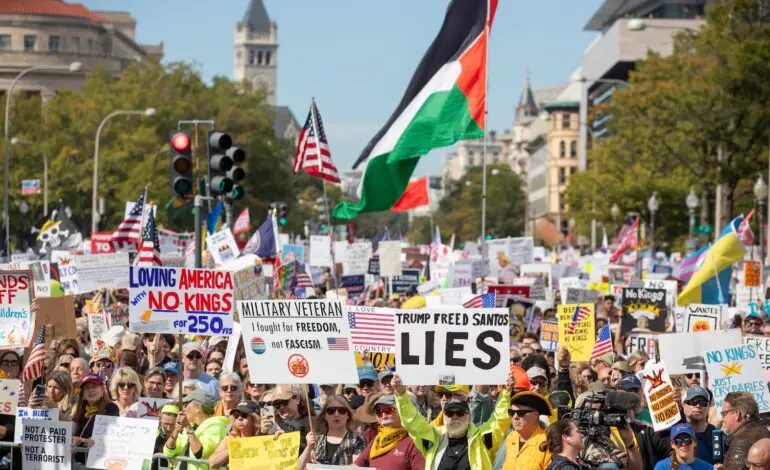

DETROIT — The United States witnessed its largest wave of protests against Donald Trump since his return to the White House on the final Saturday of March, as more than 3,200 demonstrations took place nationwide, including roughly 100 marches across Michigan alone. More than 8 million people turned out at the “No Kings” protests across all 50 states on Saturday — officially the largest single-day demonstration in U.S. history.
The mobilization came as part of the third round of the “No Kings” protests, which far exceeded the scale of the previous two rounds and served as a direct political indicator of expanding popular opposition to Trump.
While immigration had been the primary driver of earlier protests, the war on Iran dominated demonstrators’ slogans this past Saturday — a notable shift reflecting the movement of public opposition from domestic concerns to a sensitive foreign policy issue. Protesters voiced growing fears of the United States sliding into an open-ended war with significant economic and political costs.
Strong turnout across Michigan
The third wave of “No Kings” protests drew tens of thousands of demonstrators across Michigan. The largest marches were held in Ferndale, Wyandotte, Detroit and Lansing, alongside smaller demonstrations in dozens of other cities, including Dearborn.
In Romulus, hundreds protested a Department of Homeland Security plan to establish a detention center for undocumented immigrants within city limits.
Across the marches, protesters expressed concern over challenges facing the country, accusing President Trump of undermining democratic institutions and exceeding constitutional authority.
A nationwide political signal
According to U.S. media reports, the third round of “No Kings” protests was the largest nationwide since the movement against Trump began last year. Saturday’s demonstrations represented the most significant on-the-ground test of the president’s popularity.
Notably, participation surged in traditionally conservative states and politically competitive suburban areas, giving the protests broader implications that extend beyond street-level anger to upcoming electoral calculations, according to Reuters.
Major protests across key cities
The largest demonstrations took place in Minnesota, where tens of thousands gathered outside the State Capitol in St. Paul to protest federal immigration enforcement policies and restrictions on civil liberties.
Addressing the crowd, Sen. Bernie Sanders (I-VT) declared that Americans would not allow the country to slide into authoritarianism.
In New York, tens of thousands filled central Manhattan, while in Washington, D.C., marches extended from the Lincoln Memorial to the National Mall.
In Los Angeles, authorities used tear gas near a federal detention center after protesters refused to disperse. The Department of Homeland Security reported that two law enforcement officers were injured.
In Dallas, limited clashes were reported between protesters and counter-groups, including supporters of far-right organizations, with several arrests made.
Expansion into conservative states
The most notable development was the expansion of protests into conservative states such as Idaho, Wyoming, Montana and Utah, where smaller communities saw significant participation in “No Kings” demonstrations for the first time.
According to organizers, two-thirds of the protests took place outside major urban centers, marking an increase of nearly 40 percent in participation across smaller communities compared to the movement’s first round.
Organizers also reported new participants in key battleground states such as Pennsylvania, Georgia and Arizona — states considered critical in determining control of Congress in the November elections.
Trump’s declining approval ratings
A Reuters/Ipsos poll shows Trump’s approval rating has dropped to 36 percent — the lowest level since his return to the White House.
This decline provides Democratic opponents with strong political momentum in the months ahead and offers the protest movement a more solid political foundation.
White House response
White House spokesperson Abigail Jackson dismissed the protests as actions driven by left-wing funding networks.
Meanwhile, the Republican National Committee characterized the gatherings as representing “the most extreme elements of the left.”


Leave a Reply