




Arab and Muslim Americans move from the margins to the heart of political power
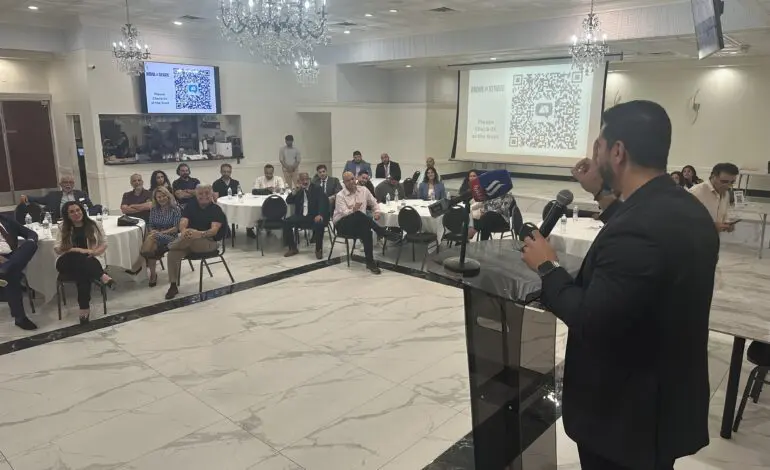
DEARBORN — The sweeping victory of Muslim American candidate Zohran Mamdani in New York City’s Democratic mayoral primary reverberated with excitement and optimism at a fundraising event held Monday evening in Dearborn to support Abdul El-Sayed’s campaign for the U.S. Senate in 2026.
The fundraiser, held at LaPita Restaurant, drew a prominent crowd of community leaders and elected officials, including Wayne County Executive Warren Evans, Deputy Executive Assad Turfe, County Commissioner Sam Baydoun, Dearborn Mayor Abdullah Hammoud and others. The event marked a notable show of support — both official and grassroots — for El-Sayed, a leading progressive in the Democratic Party who made history in 2018 as the first Muslim to run for governor in Michigan.
Speakers at the event voiced strong confidence in El-Sayed’s chances of securing the Democratic nomination in the August 2026 primary and ultimately winning the general election in November, potentially making him the first Arab American Muslim to serve in the U.S. Senate. He would succeed incumbent Democratic Senator Gary Peters, who announced he would not seek a third term.
Osama Siblani, publisher of The Arab American News, emphasized that El-Sayed’s path to the Senate had become more viable in light of Mamdani’s historic win in New York.
“This time, we as an Arab and Muslim community have a real opportunity to make this happen,” he said. “If Mamdani can win the Democratic primary in New York City, home to over 8.5 million people, then Abdul El-Sayed can certainly win in Michigan, which has a population of about 10 million.”
Progressive platform with broad support
Like Mamdani, the 41-year-old El-Sayed enjoys robust backing from progressive circles within the Democratic Party, including the endorsement of Senator Bernie Sanders (I-VT), and is running under the slogan, “It shouldn’t be this hard to get by. And it doesn’t have to be.” A physician, El-Sayed left the medical profession to pursue a political career focused on building “a government that works for people, not billionaires like Elon Musk and Donald Trump,” according to his campaign website.
El-Sayed is running in a crowded Democratic field that currently includes State Senator Mallory McMorrow, U.S. Rep. Haley Stevens, former Michigan House Speaker Joe Tate and candidate Rachel Howard. On the Republican side, candidates include former U.S. Rep. Mike Rogers, former gubernatorial candidate Tudor Dixon and Frederick Hertibise, Kent Benham and Genevieve Scott.
A new spirit in Arab and Muslim political campaigns
Hammoud highlighted a new spirit defining Arab and Muslim American political campaigns across the country.
“We no longer have to abandon our values and beliefs to run and win elections,” he said, referencing Mamdani’s strong pro-Palestine stance and opposition to Israel’s war on Gaza.
He praised El-Sayed’s pride in his principles, urging Arab and Muslim voters to not only support him through the primary but also carry him through to victory in November. He also stressed the need for more volunteers, citing Mamdani’s success, which was driven by a surge of 50,000 volunteers in grassroots support.
Chief Judge Sam Salamey of the 19th District Court in Dearborn noted that Arab and Muslim Americans share core values with the broader American public — justice, freedom and democracy — and called on the community to support El-Sayed with both votes and donations.
“He has shown through his career that he has the competence and commitment for public service,” Salamey said.
Former Deputy Michigan Attorney General Fadwa Hammoud praised the lasting impression El-Sayed left with his 2018 gubernatorial campaign.
“Your campaign introduced America to our community,” she said. “Now, more than ever, you are the best candidate to represent Michigan in the U.S. Senate.”
Although he lost the 2018 primary, El-Sayed earned more than 342,000 votes — more than 30 percent of the total — finishing second behind Governor Whitmer, who won with roughly 52 percent.
Evans commended El-Sayed’s leadership during his tenure as director of public health for the county from March 2023 to April 2025.
“We lost a talented leader when he stepped down to run for Senate,” Evans said, “but we gained a capable candidate who will represent Michigan well in Washington.”
Turfe echoed that sentiment.
“When you ran in 2018, I didn’t support you because I didn’t know you,” he said. “Now, after working with you, I’m confident that your values and skills make you the best candidate.”
Siblani urged attendees to donate generously, reminding them that electoral success depends on “money and votes.”
“We failed to raise enough money for Abdul’s governor race,” he said. “That’s on us. This time, we must lead the way.”
From the margins to the center of political power
In an interview with The Arab American News, El-Sayed pointed to the growing role of Arab and Muslim Americans in Michigan politics, referencing the impact of the “uncommitted” vote in last year’s presidential primary. He said Michigan’s Arab and Muslim communities are at a critical juncture, reflecting deep frustration with current U.S. policies.
“Voters across Michigan are tired of being forced to choose between their well-being and decisions made by politicians,” he said. “The uncommitted campaign was an honest expression of outrage over the use of our tax dollars to drop bombs abroad instead of investing in our schools, infrastructure and healthcare.”
He said Michigan’s Arab and Muslim communities face a double burden — neglect at home, from crumbling roads and schools, and pain abroad, from U.S.-made bombs killing loved ones.
“Many are saying clearly: We don’t want to be forced to choose between our values and our future anymore.”
Inspired by Mamdani’s victory
El-Sayed described Mamdani’s recent win as a turning point.
“People want honesty and authenticity. They want hope,” he said. “Mamdani showed that we can run campaigns based on the future we want — not on the past we inherited.”
As a Muslim son of Egyptian immigrants, El-Sayed said his identity is not a liability but a strength.
“I’ve run a statewide campaign before, and I’m honored to do it again,” he said. “Everywhere I go, I meet people who say my gubernatorial campaign inspired them.
“This country welcomed my parents more than four decades ago. Most Americans are warm and generous — but they want to know what you stand for. When you visit their homes and unions and communities, they welcome you — especially if you listen before you speak. That’s what our campaign is built on.”
On the role of Arab and Muslim communities, El-Sayed said that for years, they felt like outsiders in the political process.
“But this campaign proves our issues — food prices, healthcare, misuse of tax dollars — are central issues across Michigan.”
He cautioned against apathy.
“We complain, but we don’t always vote. Now we have a real chance to make an impact. Our numbers are enough to make a difference. We can choose the kind of representation we want — not just for our community but for our state and our country.”
He concluded by underscoring the link between foreign policy and domestic priorities.
“If we want to stop dropping bombs abroad and instead fund schools and healthcare at home, we must say so at the ballot box. Every dollar wasted on bombs is a dollar not spent on American children. That’s the truth — and we must carry that truth with us on Election Day.”
Personal background
Abdulrahman “Abdul” El-Sayed was born in Detroit in 1984 to Egyptian immigrant parents. He graduated in 2003 from Andover High School in Bloomfield Hills and later earned degrees in biology and political science from the University of Michigan. He delivered the student commencement address before former President Clinton in 2007.
A lacrosse standout, El-Sayed received a full medical scholarship to the University of Michigan, but chose a different path, completing a master’s degree in public health at Oxford in 2011 and earning a doctorate in medicine from Columbia University in 2014 through the Soros Fellowship for New Americans. He did not complete a medical residency and is not licensed to practice medicine.
El-Sayed worked in public health and epidemiology before being appointed director of public health for the city of Detroit from 2015 to 2017. He resigned to run for governor and later founded Southpaw, a progressive political action committee.
He became director of public health for Wayne County in early 2023 and held the position until this April, when he resigned to launch his U.S. Senate campaign.

Leave a Reply