



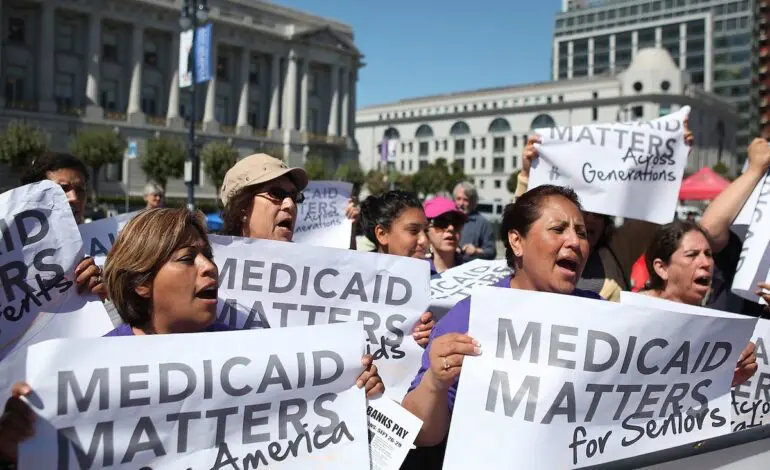

The newly passed federal legislation dubbed by Republicans as the “Big, Beautiful Bill” is poised to trigger a seismic shift in the U.S. healthcare and fiscal landscape.
Marketed as a tax cut package, the new law also constitutes the most substantial rollback of health coverage since the Affordable Care Act was enacted in 2010. It threatens to leave up to 16 million Americans uninsured while increasing the federal deficit by as much as $4 trillion over the next decade.
“This bill wasn’t framed as healthcare reform,” said Larry Levitt, executive vice president for health policy at KFF, at a July 11 American Community Media news briefing. “But it is effectively a partial repeal of the ACA. It will reduce federal support for health coverage more than any legislation in history.”
Initial estimates from the Congressional Budget Office suggest the law will reduce federal health spending by more than $1 trillion, largely by cutting Medicaid and health insurance subsidies. About 11.8 million people are expected to lose coverage due to provisions in the bill. And as tax credits for health premiums expire at the end of this year, that number is expected to climb to 16 million.
This isn’t just a bill. It’s a redefinition of who gets to be protected in America and who gets left behind. — Natasha Sarin, president of the Yale Budget Lab.
Healthcare access cut for millions
Among the most controversial provisions is a new Medicaid work requirement for adults who became eligible under ACA expansion. While 90 percent of these individuals are working or would qualify for an exemption, bureaucratic red tape is expected to cause 4.8 million people to lose coverage simply by failing to navigate the reporting process.
Other changes include:
- Requiring re-enrollment in Medicaid every six months, rather than annually.
- Imposing optional co-pays of up to $35 for individuals above the poverty line.
- Restricting how states fund their share of Medicaid, likely forcing cuts to provider payments.
The cuts are expected to hit rural hospitals especially hard, where margins are already thin. A one-time $50 billion rural health fund was included in the bill to offset some of these impacts, but it is temporary, while the Medicaid cuts are permanent.
“Some hospitals may not close immediately, but they’re looking down the road,” Levitt predicted. “If they see a steady decline in payments, closures will accelerate.”
Many residents of America could simply lose all access to health care, he said.
About 11.8 million people are expected to lose coverage due to provisions in the bill. That number is expected to climb to 16 million.
ACA changes and immigrant exclusions
The ACA’s insurance marketplace also faces major upheaval. New income verification procedures will make it harder to enroll and eliminate automatic renewals. A particularly contentious provision removes eligibility for ACA coverage from many lawfully present immigrants, including refugees, asylees and those under Temporary Protected Status. Medicaid and Medicare eligibility for these populations is also curtailed.
“This isn’t about undocumented immigrants, who have never qualified for federal health coverage,” Levitt said. “These are legal residents, and now they’re being cut off.”
Stark health and mortality consequences
Yale professor Natasha Sarin, president of the Yale Budget Lab, said the bill will likely lead to a sharp increase in preventable deaths.
“Estimates show about 28,000 lives were saved over a decade due to those expansions,” Sarin said at the July 11 ACoM press briefing. “Reversing them, plus letting the ACA tax credits expire, could result in over 100,000 and possibly as many as 200,000 excess deaths over the next 10 years.
“These cuts are especially harmful to vulnerable groups: the elderly, the sick and immigrant communities, who are already on the edge of the healthcare system,” she added.
Exploding the federal debt
Despite Republican claims that the bill reduces government waste and improves efficiency, its fiscal implications tell a different story. Sarin warned that the bill’s tax cuts, paired with temporary gimmicks, are likely to explode the federal debt.
“If you remove the sunsets and assume the tax provisions become permanent — as lawmakers almost always try to do — this package will increase the debt-to-GDP ratio from 100 percent today to 135 percent by 2035,” she said. “That’s an additional $4 trillion in deficits.”
Rising deficits will have broader economic consequences.
“Higher borrowing costs for the government will push up interest rates across the board — mortgages, car loans, student loans and small business lending will all get more expensive,” Sarin predicted. “It’s a drag on the economy, and it will shrink GDP over time.”
Regressive economic effects
While wealthy households will see significant benefits — especially from extended Trump-era tax cuts and new deductions for tip and overtime income — lower-income Americans face cuts to Medicaid, SNAP and other safety net programs.
“We’ve done the distributional math,” Sarin said. “The bottom 40 percent of earners are worse off after this bill. They’re losing around $700 in after-tax, after-transfer income. Meanwhile, the top 1 percent gains $30,000 a year, and the top 0.1 percent gains even more.”
She described the bill as “reverse Robin Hood” policy.
“We’re taking from those with the least and giving to those with the most.”
Republicans have touted benefits such as a tax cut for seniors. But Sarin said the cut amounts to only a modest increase in the standard deduction and is temporary. And the expanded child tax credit, increased from $2,000 to $2,200, does not benefit low-income families who don’t earn enough to receive the benefit.
Rural hospitals
Though many of the healthcare changes are backloaded to roll out after the 2026 midterm elections, their effects will be keenly felt in the coming years. In communities like Bakersfield, California — where over 60 percent of residents rely on Medicaid — local hospitals could be pushed to the brink and possibly shut down.
“We’re already seeing closures,” Levitt said, citing a clinic in Nebraska that shut down citing this legislation. “And while not every closure will be traceable to the bill, many will be.”
“This isn’t just a bill. It’s a redefinition of who gets to be protected in America and who gets left behind,” said Sarin.
– Sunita Sohrabji is the health editor at American Community Media.
Edited for style.



Leave a Reply