



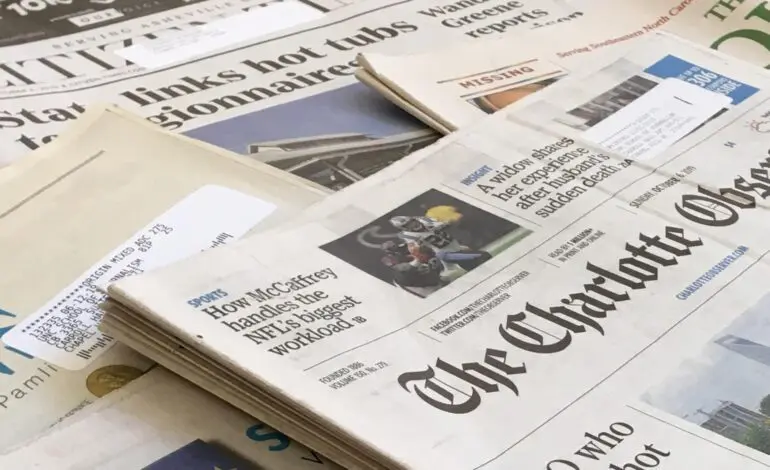

At the Local News Crisis Summit in Detroit, journalists, media executives, scholars and philanthropists gathered to address the loss of local journalism, along with the democratic foundations it helps sustain.
Local journalism is an essential bridge for civic engagement; it is the medium through which communities receive trusted news about their neighborhoods, hold power accountable, and stay connected to one another.
Now, in an era of industry-wide monopolization and rising misinformation, local news is disappearing, and people are disengaging from their communities. Instead, attention has shifted to national narratives and polarized digital landscapes, often driven by outrage, profit and spectacle.
“This isn’t just an industry crisis,” said Tim Franklin, senior associate dean at Northwestern University’s Medill School of Journalism. “It’s a crisis for our communities.”
Adding to the urgency, Congress recently approved the defunding of public broadcasting, a decision expected to severely impact small and rural news outlets that rely heavily on federal support. At the same time, longstanding FCC regulations are being reconsidered, potentially opening the door for further media consolidation.
“Even in major markets like Detroit and Houston, there’s no longer enough revenue to support all local broadcast stations,” said Catherine Badalamente, CEO of Graham Media Group.
The summit highlighted how these shifts are creating spaces where fewer voices serve more people, and local accountability is lost in the process.

Detroit summit on the local news crisis.
Local news deserts
Franklin presented data showing that more than 200 U.S. counties have no local news outlet — no paper, no radio, no public broadcast. More than 1,550 counties have only one, and in total, more than 50 million Americans have little to no access to verified local information.
The results are more than a matter of inconvenience. Research shows that communities with weakened or absent local news see lower voter turnout, increased polarization, higher government borrowing costs and rising corruption.
“We’ve lost a third of U.S. newspapers in 20 years,” Franklin said. “This is about civic infrastructure.”
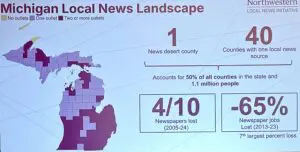
Michigan local news landscape.
Tim Vos, director of Michigan State University’s School of Journalism, narrowed the lens to Michigan, where 40 counties now rely on a single local news source. The loss is especially stark in rural and aging areas, where news deserts overlap with vulnerable populations.
“When journalism disappears, people become more susceptible to disinformation, and more disconnected from each other,” he warned.
Meeting people where they are
Amidst the crisis, journalists are committed to sustaining the industry and increasing engagement in their localities.
To achieve this, Badalamente emphasized the importance of redefining how journalism is produced.
“We need fewer ‘inside cats’ — journalists at their desks — and more ‘outside cats’ reporting from kitchens, sidewalks and block club meetings.”
As trust in media erodes, local newsrooms are finding that proximity builds credibility. By engaging with residents’ daily lives, journalists can deliver news that feels relevant and responsive. This “hyperlocal” approach is essential to restoring civic trust and rebuilding democratic infrastructure.
One such entry point is weather.
“Weather is arguably the most trusted piece of local news; it’s something people check everyday,” said Nicole Avery Nichols, executive director of the Detroit Free Press. “If we can get them on weather, then we can also connect them to our investigations, our art coverage — to deeper reporting and their community overall.”
While investigations may grab headlines, speakers emphasized that most journalism is service, not spectacle.
“It’s about how we help you live your life,” said Wendy Turner of Michigan Public. That includes community calendars, podcasts, “ethical influencers” — trusted voices who reflect the communities they serve.
“There’s no story too small in 2025,” Nichols said. “If people need it to live their lives, we need to cover it.”
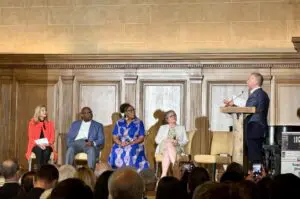
Summit CEO panel (from left to right): Catherine Badalamente, Hiram Jackson, Nicole Avery Nichols and Wendy Turner.
Rebuilding with integrity
Sustaining that trust means protecting credibility.
“We had to find ways to create new income streams without prostituting the brand,” said Hiram Jackson of the Michigan Chronicle, pointing to events like Pancakes & Politics. “Our audience — especially Detroit’s Black community — has trusted us for 90 years. That trust is non-negotiable.”
For many, collaboration emerged as the clearest path forward.
“We’re not frenemies anymore, we’re allies in a bunker,” said Chuck Todd, former moderator of Meet the Press.
As the pandemic gutted revenue and forced layoffs, Detroit’s media outlets came together to serve their communities. Badalamente echoed the shift.
“The future of media is collaboration. We have to amplify each other and not compete into extinction.”
At the summit, local journalism showed its commitment to saving the industry in an ethical way, all pointing to strategies that move beyond extracting the local person, and instead serving the communities that trust them.
Ultimately, in an era where distant national media fuels division, local journalism remains one of the few shared spaces where neighbors can find common ground.


Leave a Reply