



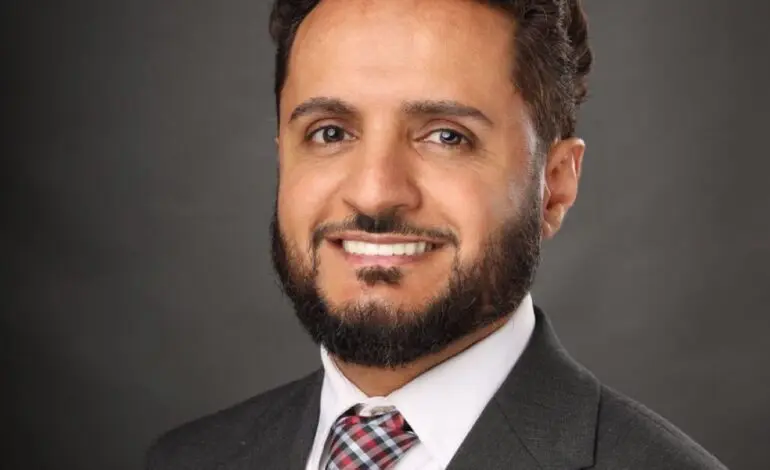

Arab American candidate Adam Alharbi finished the Hamtramck mayoral primary on Tuesday, August 5, with a decisive victory, far ahead of his closest challenger, City Councilman Muhith Mahmood, with both advancing to the November 4 general election.
According to unofficial results from both absentee and in-person ballots, Alharbi, who is of Yemeni descent, topped the primary with 1,931 votes, representing 53.6 percent of the total vote. He was followed by Mahmood, a Bangladeshi American, with 1,039 votes (28.9 percent). Khan Hossain and Mister Bangladesh, both also of Bangladeshi descent, earned 470 votes (13 percent) and 102 votes (2.8 percent), respectively.

Alharbi outperformed his three political rivals in both absentee and in-person voting. He received 1,215 absentee votes and 716 on election day, compared to Mahmood’s 743 absentee votes and 296 in-person votes, according to preliminary figures from the Hamtramck City Clerk’s Office. The total number of voters participating in the primary was 3,829 across the city’s five precincts, with no turnout percentage provided.
Alharbi, 44, said his sweeping primary victory was clear evidence that his candidacy is not aimed at representing only one group — namely the Yemeni American community, which forms the largest segment of residents in Michigan’s most ethnically diverse city — but rather to represent all Hamtramck residents regardless of ethnic or religious background.
This victory is not a personal accomplishment, but a triumph for everyone who believes in the possibility of positive change and collective action for a better future. – Adam Alharbi
In remarks to The Arab American News, Alharbi thanked all voters who support his bid to succeed Mayor Amer Ghalib, who didn’t to seek another four-year term after being nominated by President Trump to be U.S. ambassador to Kuwait.
“I thank the people of Hamtramck for their invaluable trust,” Alharbi said. “This primary victory is the first step toward achieving a clear vision for our city — one based on transparency, accountability and sustainable development.”
He reiterated his pledge that, if elected in November, “Hamtramck will make headlines for positive achievements and community initiatives, not for internal conflicts.”
“This victory is not a personal accomplishment,” he added, “but a triumph for everyone who believes in the possibility of positive change and collective action for a better future — based on the principle that local governments are tools to serve citizens, not a burden upon them.”

City Council race
In the Hamtramck City Council primary, 12 candidates competed for three full-term, four-year seats that will become vacant at the start of next year, when the terms of current members Khalil Refai, Abu A. Musa and mayoral candidate Muhith Mahmood expire.
According to unofficial results, voters re-elected Musa, who led the field with 1,129 votes (12.5 percent). He was followed by candidates Nayeem L. Chowdhury with 1,053 votes (11.7 percent) and Yousef Said with 909 votes (10.07 percent).
In fourth, fifth and sixth place were Motahar Fadel with 900 votes (9.97 percent), Abdulmalik Kassim with 814 votes (9 percent),and Luqman Saleh with 812 votes (9 percent).
These six candidates will advance to the November general election, where three will be elected to serve full four-year terms.
Those eliminated from the race — which, at present, has all six Council seats held by Muslims — were Dianne Elizabeth Frkan (8.3 percent), Joseph A. Strzalka (8 percent), Rezaul Chowdhury (7.24 percent), Russ Gordon (7.03 percent), Khaled Al Qassimi (4.51 percent) and Mahfuzur Rahman (2.47 percent).
With the defeat of all non-Muslim candidates in the primary, Muslims will occupy all six Council seats for the second consecutive term. Under Hamtramck’s city charter, the mayor also chairs the council — meaning that regardless of whether Adam Alharbi or Muhith Mahmood wins the mayoral race, all Council members will be Muslim.



Leave a Reply