



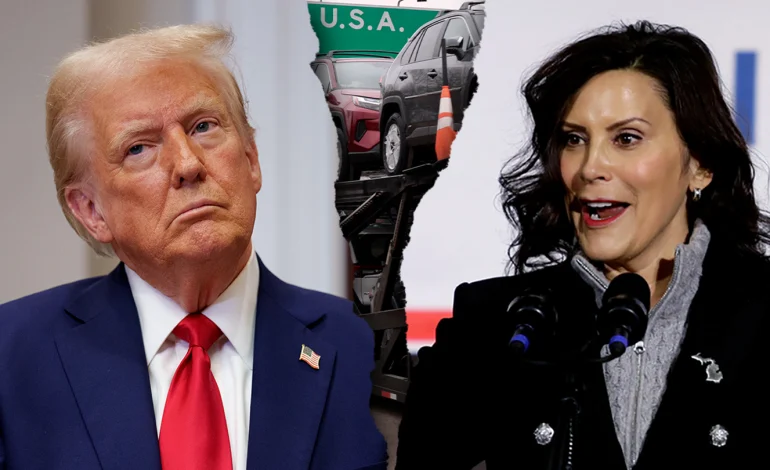

WASHINGTON, D.C. – In her third meeting with President Trump since his return to the White House for a second term, Governor Whitmer urged the Republican president to reconsider his tariff policy due to the severe harm it is causing to the automotive industry — the very sector Trump says he wants to save.
In a private Oval Office meeting, the Democratic governor gave a visual presentation to outline her concerns about tariffs, which she said are inflicting major damage on Michigan’s economy, built primarily on the auto industry and related manufacturing.
According to the Associated Press, Whitmer’s repeated visits to the White House reflect a distinctive dynamic for the Michigan governor, who is considered a strong contender for the Democratic presidential nomination in the 2028 election. Unlike many other Democratic governors, Whitmer has chosen to keep lines of communication open with the Trump administration in an effort to protect the state’s interests — without abandoning her public opposition to the Republican president’s agenda.
“The fact that Whitmer has the opportunity to make direct private appeals to Trump seems unique in this political moment,” the AP quoted Matt Grossmann, a political science professor at Michigan State University, as saying.
Whitmer’s latest meeting with Trump at the White House on August 5 was her third since he took office in January. However, it was far less public than their April meeting, when Whitmer — unintentionally and without prior notice — ended up attending a Trump press conference, an incident that embarrassed her to the point where she covered her face with a folder as photographers captured the moment.
While Whitmer’s previous meetings with Trump yielded gains for Michigan — such as upgrades to the Selfridge Air National Guard Base in Macomb County — persuading him to roll back tariffs will be a much tougher request. Still, Trump has been willing to engage positively with Michigan’s governor despite the sharp disputes between them during the COVID-19 pandemic era.
Trump’s tariffs
Whitmer is not alone in warning of the potentially devastating consequences of tariffs for the auto industry — including factory job losses, reduced profits and higher prices in the future. Trump, however, argues the tariffs will be the economic salvation of American manufacturing.
White House spokesperson Kush Desai told the AP that no other president has shown “more interest in restoring the dominance of the American auto industry than President Trump.” He added that trade frameworks negotiated by the administration would open Japanese, Korean and European markets to vehicles assembled in Michigan.
Under a series of executive orders, Trump’s tariffs impose:
-
50 percent import tax on steel and aluminum
-
30 percent on auto parts from China
-
25 percent on goods from Canada and Mexico not covered by the 2020 trade agreement
This puts U.S. automakers and parts suppliers at a disadvantage compared to German, Japanese and South Korean automakers, whose vehicles face only a 15 percent import tax — negotiated by Trump last month.
Furthermore, Trump threatened last week to impose a 100 percent tariff on semiconductor chips — a critical component in cars and trucks — though companies producing chips domestically would be exempt.
Auto industry struggles
During their latest meeting, Whitmer detailed the negative impact of tariffs on automakers and highlighted the enormous economic benefits of trade with Canada and Mexico, noting that Michigan has attracted about $23.2 billion in investments since 2020.
According to the AP, Whitmer also explained how tariffs on auto parts would add costs for U.S. manufacturers, reducing profitability and slowing production.
General Motors, Ford and Stellantis (formerly Chrysler) operate 50 plants statewide and support more than 4,000 auto parts suppliers. The sector provides about 600,000 manufacturing jobs, forming the backbone of Michigan’s economy.
The CEOs of the three automakers have repeatedly warned the administration that tariffs will reduce profits and undermine global competitiveness. Their efforts only secured a temporary one-month suspension to help companies adjust — a delay that did little to offset financial damage.
In the second quarter alone, Ford reported $800 million in tariff-related costs, while General Motors said import taxes cost it $1.1 billion. These expenses could hinder reinvestment in new domestic plants — the opposite of Trump’s stated goal.
“We expect tariffs to be a net headwind of about $2 billion this year, and we will continue to monitor developments closely and engage with policymakers to ensure U.S. autoworkers and customers are not harmed by changes in policy,” Ford CEO Jim Farley said in the company’s earnings release.
Budget crisis
Beyond tariffs and the auto industry, Whitmer also used her most recent meeting with Trump to request federal aid for recovery efforts after an ice storm hit northern Michigan earlier this year. She also sought to delay changes to the Medicaid program under Trump’s “Big Beautiful Act”, which could leave a massive budget shortfall for the state’s next fiscal year.
According to AP sources, Trump did not make any specific commitments to Whitmer, who faces a constitutional deadline at the start of October to sign the state budget and avoid a potential government shutdown, amid a divided legislature in Lansing — a Republican-controlled House and a Democratic-controlled Senate.
Whitmer is term-limited and cannot seek a third term in next year’s gubernatorial election under Michigan’s constitution.
On Monday, Whitmer said she was optimistic the state could avoid a shutdown, noting there was still “plenty of time” as budget talks resume in Lansing.
During a tour of the Gerald R. Ford Academic Center in Grand Rapids, Whitmer told reporters she believes an agreement will be reached in time, but said her administration is also preparing for a possible shutdown.
While the state still has a month and a half to approve the budget for the next fiscal year, the failure to pass a public school budget so far has created uncertainty for school districts preparing to start the academic year without a clear idea of their available funding.



Leave a Reply