



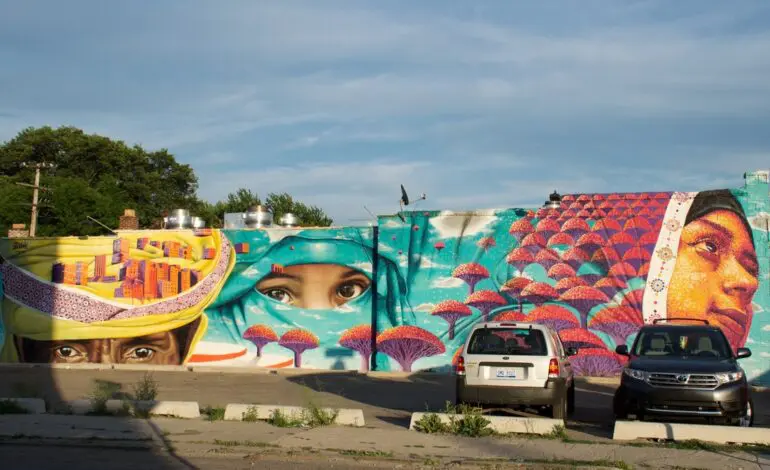

HAMTRAMCK – At its upcoming meeting on August 26, the Hamtramck City Council will decide the fate of a massive mural on Joseph Campau Street that celebrates Yemeni culture. A neighboring property owner has advanced plans to build a new structure on an adjacent vacant lot, a move that would block the mural from view.
The mural, informally known as the “Yemeni Mural”, adorns the side wall of Sheeba Restaurant and depicts Yemen’s Socotra Island in the Arabian Sea, famed for its unique landscape and dragon blood trees, along with intricate details of Yemeni architecture and cultural heritage.
Created by Chilean-born New York–based artist Dasic Fernández, the mural took nearly two years to complete at a cost of about $20,000. It was commissioned in 2013 by the nonprofit One Hamtramck, led by then–Executive Director Bill Meyer, to reflect the city’s growing Yemeni population and highlight its cultural identity after years of marginalization.
“We felt that some of the city’s ethnic communities had been neglected and excluded from government, downtown and nearly every sphere of life,” Meyer told the Detroit News. “They were completely isolated, so we felt it was time to bring attention to this part of the community.”
Over the years, the mural has become an “internationally known” landmark, drawing attention to Hamtramck from across the country. Advocates note it remains the only mural in the U.S. dedicated to Yemeni culture.
Threat of development
Now, however, the mural’s future is uncertain. The owner of the adjacent vacant lot has proposed building a new two-story commercial property that would completely obscure the artwork. Since commercial buildings on Joseph Campau typically share walls, construction approval would effectively end any chance of preserving the mural.
A similar plan emerged in 2020, but was blocked after community groups, including One Hamtramck and Save the Mural (both now defunct), negotiated a lease of the property to the Islamic Center of Hamtramck for the creation of a small public space called “Yemen Park.” The park never materialized, and the owner terminated the lease last year.
Hamtramck City Councilman Mohammed Alsomiri, who owns the Sheeba Restaurant building that carries the mural, said he is exploring ways to save it, but did not share specifics.
Options under discussion include reviving the previous lease agreement, finding another entity willing to rent the land or urging the Council to deny the building plan by recognizing the mural as a protected cultural landmark.
Meyer added that supporters hope to find a compromise that won’t unfairly restrict the property owner’s rights.
“It’s a beautiful work of art, deeply meaningful to Yemeni residents who make up a majority of the city. That alone is a powerful reason to try to save it.”
If the Council approves the development, the only remaining option may be to preserve the mural through high-resolution photography and display reproductions across the city.
Community voices
Christopher Schneider, director of Hamtramck Hatch Art Gallery, called the mural a testament to the city’s diversity.
“It especially honors Yemeni and Bangladeshi residents for their vital role in Hamtramck’s revival,” he said. “Years ago the city was filled with abandoned properties — today, thanks to these communities, the city has been brought back to life. The mural is a way of recognizing them and celebrating the beauty of their culture.”
According to the latest estimates, Hamtramck’s population stands at about 28,000, with a majority of Yemeni and Bangladeshi origin. The city once peaked at over 55,000 residents in the mid-20th century, when it was heavily Polish and Eastern European. Economic decline and population loss in the late 20th century dropped the number to around 18,000 by the 1990s before waves of Middle Eastern and South Asian immigration revitalized the city.



Leave a Reply