



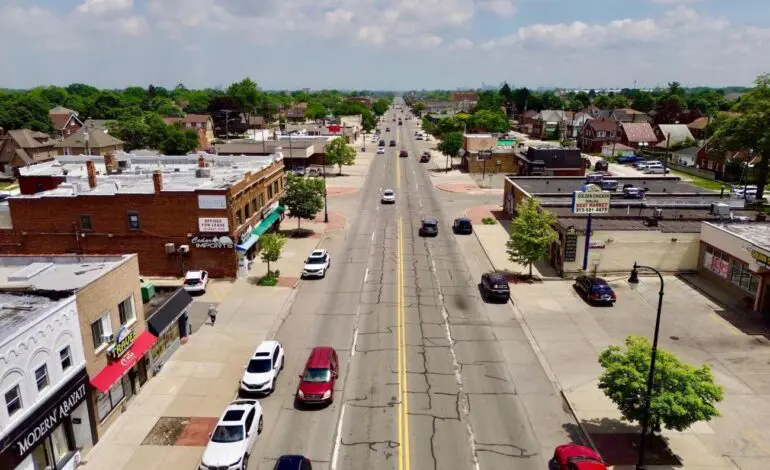

DEARBORN – In the presence of representatives from engineering firms, business owners and local residents, the city of Dearborn held its final public meeting on Tuesday to discuss the proposed engineering designs for the redevelopment of Warren Avenue. The city aims to select a preliminary plan by this winter, make adjustments and release the final version by next fall. Next year will also see the selection of contractors to carry out the $31 million project, which was officially launched earlier this year.
The redevelopment of this vital corridor — stretching from Wyoming Avenue to Greenfield Road — is part of Dearborn’s efforts to comprehensively improve the city’s busiest commercial artery in the east end. The project seeks to reduce traffic congestion, ease commercial movement, create safe and dedicated lanes for pedestrians and cyclists, expand green spaces and tree plantings, enhance public lighting to improve safety at night and modernize storefronts to highlight both the aesthetic and cultural character of a street that has undergone profound transformations in recent decades. Today, Warren Avenue has become a central destination for the local community and visitors from across Michigan and beyond.
Federal and local funding
Dearborn secured nearly $25 million through the U.S. Department of Transportation Safe Streets and Roads for All program to redevelop Warren Avenue, described by city officials as both the busiest commercial street in Dearborn and “the most accident-prone in Wayne County.” The city itself will contribute about $7 million toward the project, particularly to expand green spaces and provide grants of up to $200,000 per building to help property owners renovate their storefronts.
Public engagement
Tuesday’s meeting was held at Byblos Banquet Center at Warren Ave. and Chase Road. Dearborn Mayor Abdullah Hammoud emphasized his administration’s commitment to involving residents and business owners in shaping the redesign. Over the past year the city has hosted three public sessions to gather community input for the corridor, which consists of several segments: between Greenfield Road and Chase Road, between Chase Road and Schaefer Road, between Schaefer Road and Oakman Blvd and finally between Oakman Blvd and Wyoming Ave.
Hammoud stressed that community dialogue was the city’s first priority in its efforts to create “a plan that ensures comfort and happiness for everyone.” He also noted the importance of tackling traffic safety issues that have caused tragic accidents at multiple intersections.
Four design proposals
During the meeting, Adam Jayden, deputy project manager at OHM Advisors, the consulting firm contracted by the city, presented four potential design concepts. Jayden explained the pros and cons of each option in detail, noting that all proposals are aimed at calming traffic, improving safety and supporting the business community while maintaining mobility for residents. He also highlighted the need to accommodate heavy visitor traffic on Fridays, when worshipers crowd into the Al-Huda Mosque near the Wyoming intersection, often causing significant congestion.
Jayden assured participants that the final design would integrate community concerns and suggestions but within a broader engineering vision designed to achieve the project’s main goals: making Warren Avenue a safer, more prosperous corridor for residents and visitors alike.
The four preliminary proposals are:
-
Proposal One: Replace the current four lanes with three lanes — one in each direction plus a central turning lane — and use the reclaimed space for wider sidewalks, outdoor cafés and tree plantings. This would calm traffic, reduce speeds and allow more efficient turning opportunities.
-
Proposal Two: Reduce the road to two lanes (one in each direction) with multiple roundabouts at major intersections, adding landscaped islands and larger pedestrian spaces on both sides of the street.
-
Proposal Three: Introduce interior service lanes providing access to local businesses and neighborhoods, with side lanes for parking and loading. The outer lanes would maintain slower, steadier traffic flow, while also being adaptable for events or community activities.
-
Proposal Four: Retain the current four-lane configuration but improve safety by adding new crosswalks, median islands and redesigned intersections to provide safer pedestrian crossings and reduce rear-end and side collisions.
Community feedback
Throughout the meeting, OHM Advisors staff answered questions in both English and Arabic, with translators on hand for non-English speakers. Residents and business owners suggested additional improvements, such as pedestrian-activated traffic lights, stricter enforcement of traffic rules and more police patrols along the corridor.
The city has also created a dedicated website, www.transformwarrenave.com, where residents and stakeholders can submit feedback and ideas for the corridor’s future.



Leave a Reply