



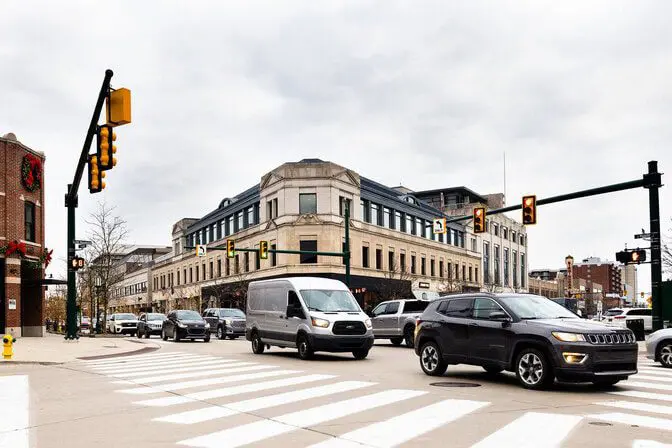

ANN ARBOR – Artificial intelligence may soon be managing traffic flow on major roads, as the University of Michigan prepares to deploy an innovative system that will adjust traffic lights at 40 key intersections across the Metro Detroit region in the coming months.
The new system uses AI technology and GPS data to determine and update traffic-signal timing in real time, helping ease congestion, reduce gridlock and improve overall traffic efficiency.
AI-driven traffic signals could reduce gridlock across Metro Detroit.
Transportation officials expect the new technology to also enhance road safety, smooth traffic movement, and potentially reduce taxpayer costs in the long term.
If the pilot program succeeds, the system could be expanded to thousands of intersections statewide across Michigan.
While the University of Michigan works to refine its own AI-powered platform, a small number of groups nationwide are racing to develop similar technology, creating a highly competitive push toward the most effective solution.
So far, one real-world test of the University of the Michigan system has yielded promising results. The technology was installed at 34 intersections in Birmingham for an 18-month pilot beginning in 2023. During that period, traffic stops decreased by 20 to 30 percent, according to researchers.
Early results show traffic stops dropped by up to 30 percent during the Birmingham pilot.
Researchers at the University of Michigan note that updating signal timing to align with changing traffic patterns is extremely challenging. Re-evaluating signal timing typically takes two to six months and costs approximately $4,500 per intersection, which often deters municipalities from updating outdated systems.
Typically, most traffic signals operate based on preset timing plans, morning, afternoon, evening and late-night cycles, rather than real-time traffic conditions.
This is where the new system, partially funded by a $1.4 million grant from the Michigan Department of Transportation, offers a major advantage. By adjusting signals according to real-time traffic patterns, the system can reduce the amount of time vehicles spend idling, which in turn lowers fuel consumption and air pollution.
The system developed by University of Michigan engineers uses GPS data from 5 to 10 percent of vehicles and re-calibrates signals continuously by interpreting information sent directly from vehicles, allowing for ongoing, adaptive updates.
The data is collected from navigation systems and road-assistance apps, including drivers using mobile phones for directions and ride-share drivers working with platforms like Uber and Lyft.
“Remote vehicle data gives us opportunities that didn’t exist before to evaluate signal performance across entire traffic networks,” Zachary Jerome, of the University of Michigan Transportation Research Institute, said.
Remote vehicle data gives us opportunities that didn’t exist before. — Zachary Jerome
He noted that the system identifies issues proactively, eliminating the need to install costly roadside detection equipment at every intersection.
Using GPS, the AI system can determine whether a tracked vehicle has stopped roughly 100 feet from an intersection, suggesting that three or four vehicles are queued ahead, and can trigger a green light when no opposing traffic is present.
Henry Liu, director of the University of Michigan Transportation Research Institute (UMTRI), and director of Mcity, U of M’s public-private research partnership focused on transforming mobility, explained that the system does not rely on infrastructure-mounted sensors. Instead, it allows drivers to “save travel time and reduce costs” by avoiding unnecessary stops.
Researchers pointed out that although adaptive traffic signals have existed since the 1970s, installing the sensors required to detect vehicles and adjust signal timing in real time can cost up to $50,000 per intersection. In contrast, U of M’s new technology costs only about $2,500 per intersection.
In the most recent trial of the low-cost system, the technology was installed at 13 intersections along Eight Mile and 12 Mile Roads.
On the Eight Mile corridor alone, data showed a 30 percent reduction in delays and a 40 percent decrease in stops.
On the 12 Mile corridor, delays and stops both fell by 20 percent across nine intersections.
With plans to install the system at more intersections across Metro Detroit in the coming months, project leaders intend to move to the next phase: testing the technology at 4,000 intersections in Southeast Michigan.
If successful, the system could pave the way for a national and global rollout. The university announced that it will soon begin selling the hardware through a new startup, Connected Traffic Intelligence, though additional details have not yet been released.



Leave a Reply