



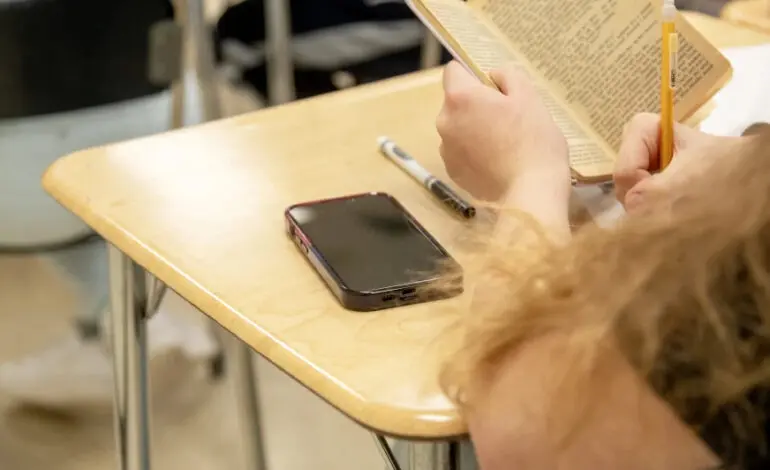

LANSING — Seeking to reduce student distractions and improve academic performance, the Michigan legislature has approved a statewide ban on the use of smartphones during instructional hours in all schools across the state, with limited exceptions and enforcement authority left to local school districts.
The State House passed the bill by an overwhelming 99–10 vote, approving a revised version of earlier legislation that faced unified Democratic opposition last year. The measure was then sent to the State Senate, where it passed 43–1, with only one Republican senator voting against it. The bill is now headed to Gov. Whitmer’s desk for signature and would become binding law for all public and charter schools statewide — from kindergarten through 12th grade — beginning at the start of the next school year.
Under the revised legislation, students would be allowed to use smartphones during non-instructional periods such as lunch and passing time between classes. The bill also includes exceptions for medical needs and for academic lessons that require the use of smart devices, including smartphones and tablets.
The ban does not apply to basic phones that cannot download apps or access web browsers.
The legislation requires every school district in Michigan to adopt and enforce a cellphone policy. However, the specific enforcement mechanisms and disciplinary consequences for violations would be determined by local school boards. Districts would also have the authority to impose stricter rules if they choose.
Republican Rep. Mark Tisdel of Rochester Hills, the bill’s sponsor, said smartphones have become a major distraction for students and that districts may not be able to solve the issue on their own.
“Every school currently has its own cellphone policy,” Tisdel told reporters after the House vote, “but it’s really about whether they can enforce it.” He said districts often hesitate to implement stronger restrictions if they anticipate pushback from parents, preferring to avoid legal disputes. “That’s why it was necessary to establish a statewide standard,” he added.
Tisdel’s revised proposal comes after a similar bill failed last year, when every Democratic member of the House — along with one Republican — voted against it. Opponents at the time argued that such legislation would infringe on local district authority and that legitimate exceptions were needed for phone use in schools.
While some critics say the new changes weakened the bill’s effectiveness, Rep. Regina Weiss, a Democrat from Oak Park, praised lawmakers for reaching a compromise.
Weiss, who is also a teacher, said she has personally seen how smartphones — especially social media apps — can trigger conflicts among students.
“Often, kids would argue over Snapchat,” she said, “and those arguments would escalate into physical fights during the school day.
“This law will help limit that problem,” Weiss added, “and it will also help address the addictive nature of smartphones.”



Leave a Reply