


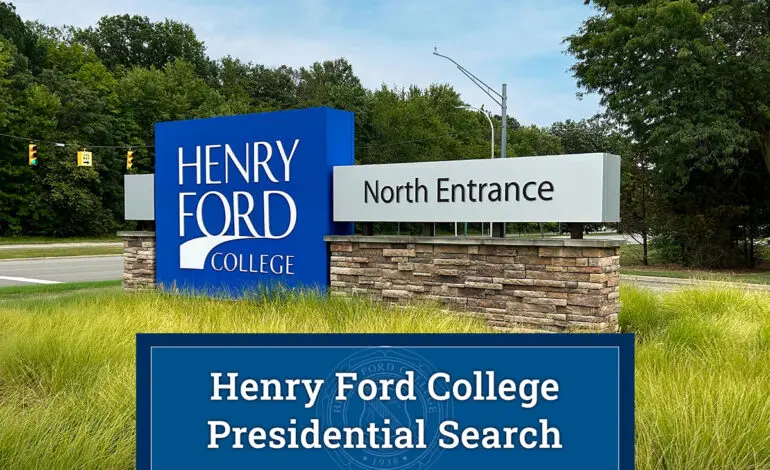

Serious questions about transparency and selection procedures have emerged after the advisory selection committee charged with recommending a permanent president for Henry Ford College narrowed its field to 10 candidates from more than 120 applicants, without including a single Arab American, despite more than a dozen Arab American candidates — some highly qualified — having applied.
The decision followed a three-and-a-half-hour Zoom meeting on Wednesday and has sparked widespread concern, particularly because Arab American students make up roughly one-third of the college’s approximately 12,000-student population.
According to sources speaking to The Arab American News, the preliminary list includes interim college president Lori Gonko, Wayne County commissioner David Knezek, Casandra Ulbrich, Trae Robinson Cooper, Reginald Best, Anthony Perry, Howard Spearman, Mickey McLoud, Pakou Yang and Gary Roberts.
The shortlist was selected through a secret-ballot vote by the 24-member advisory committee, which represents the college’s Board of Trustees, community members, students, administrative staff, the teachers’ union, the mayor of Dearborn, faculty from both Henry Ford College and Dearborn Public Schools, as well as a subcommittee from the Dearborn Board of Education. That subcommittee included Board President Jamal Aljahmi, along with trustees Pat D’Ambrosio and Mary Petlichkoff.
Applications for the presidency closed Friday, Jan. 30. Committee members were then sent thousands of pages of application materials early the following week and were asked to review them and cast their votes by Wednesday — giving them less than 72 hours to evaluate the credentials of 120 candidates.
Some participants told The Arab American News the compressed timeline placed the integrity of the entire process in doubt, raising concerns about whether members could realistically assess each applicant’s qualifications in such a short period. The rushed schedule also fueled questions about why the process was accelerated, especially after The Arab American News learned that required criteria were relaxed and altered “overnight”, allowing some candidates to advance despite lacking the academic and administrative credentials typically expected to lead an institution like Henry Ford College, founded in 1938.
The official evaluation framework reportedly consisted of 13 criteria focused primarily on educational experience, student services, academic integrity and empathetic leadership. Demographics, however, were treated as a secondary factor — a point of contention given that Henry Ford College serves one of Michigan’s most diverse communities, with students from minority and ethnic backgrounds accounting for about 55 percent of total enrollment.
Critics also pointed to the role of the Dearborn Board of Education subcommittee, arguing that it failed to elevate demographic representation within the evaluation standards and, directly or indirectly, contributed to excluding Arab American candidates — many of whom possess strong administrative qualifications, political experience and deep understanding of the local community. This has prompted pointed questions about whether the subcommittee helped sideline candidates capable of bridging the gap between college leadership and the broader community.
Despite the controversy, the advisory committee still has an opportunity to address the issue by adding one or more Arab American candidates to the preliminary list ahead of intensive interviews expected in the coming weeks. The process is slated to produce a final shortlist of three to four candidates by mid-March, after which the Dearborn Board of Education will vote to select the next president.
Community leaders have pointed to a recent precedent: Former Henry Ford College president Russell Kavalhuna was not initially included on the shortlist during the previous search. He was later added at the recommendation of The Arab American News Publisher Osama Siblani, among others, who served on the advisory committee at the time. Kavalhuna went on to lead the college successfully beginning in 2018 before being appointed last summer as president of Western Michigan University in Kalamazoo — reinforcing the view that initial shortlists do not always reflect the strongest candidates.
Some observers now contend that excluding Arab Americans from the current preliminary list may have been intentional, aimed at blocking what would have been a historic appointment of an Arab American president at Henry Ford College. These concerns are heightened by the composition of the Dearborn Board of Education — which oversees both Henry Ford College and Dearborn Public Schools — and currently includes five Arab American members among its seven trustees: Jamal Aljahmi, Amer Zahr, Adel Mozip, Ali Bazzi and Nasri Sobh, alongside Pat D’Ambrosio and Mary Petlichkoff.
The committee’s reliance on secret balloting has also drawn criticism for undermining accountability in a decision of such public importance. Community members argue that shielding individual votes weakens public trust and opens the door to speculation about behind-the-scenes alliances favoring specific candidates — a practice many view as incompatible with democratic governance of public institutions.
As the search moves forward, many in Dearborn are urging decision-makers to reassess the preliminary list and ensure that Henry Ford College’s next leader reflects both merit and the diversity of the community the institution serves.
Leave a Reply