



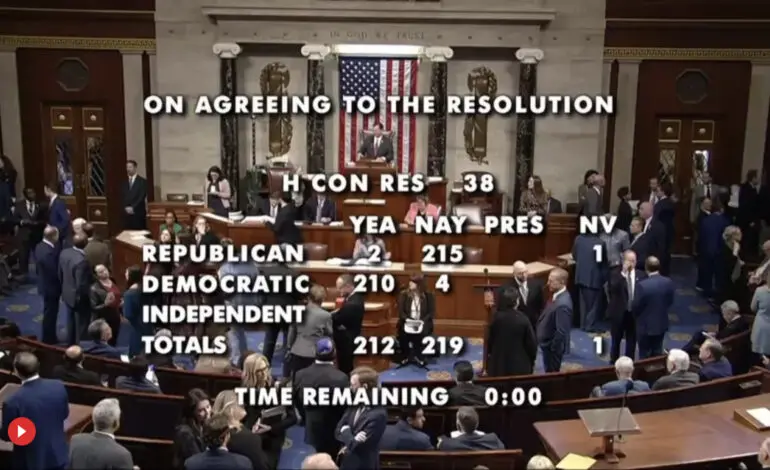

WASHINGTON, D.C. — The U.S. House of Representatives narrowly rejected a resolution Thursday that would have forced President Trump to halt military operations against Iran without congressional authorization, highlighting deep divisions in Washington as the conflict threatens to expand across the Middle East.
The measure failed 219–212, marking the second defeat for congressional efforts to limit the president’s war powers within two days. On Wednesday, the Senate also rejected a similar proposal in a 53-47 vote, largely along party lines.
The votes reveal mounting unease among lawmakers about a rapidly escalating conflict that has already claimed American lives, disrupted regional stability and reignited debates over Congress’ constitutional authority to declare war.
“Donald Trump is not a king, and if he believes the war with Iran is in our national interest, then he must come to Congress and make the case,” said Rep. Gregory Meeks (D-NY), the ranking Democrat on the House Foreign Affairs Committee.
The House also passed a separate symbolic measure reaffirming that Iran is the world’s largest state sponsor of terrorism, a statement widely supported by Republicans.
Republicans back Trump’s military action
Most Republicans rallied behind Trump’s decision to launch military strikes against Iran, framing the campaign as a necessary response to threats posed by Tehran.
Rep. Brian Mast (R-FL), chairman of the House Foreign Affairs Committee and a U.S. Army veteran, defended the president’s actions, arguing that the resolution would effectively prevent Trump from responding to an “imminent threat.”
Republican leaders also suggested the operation could weaken Iran’s ruling system following the reported killing of Iran’s Supreme Leader Ayatollah Ali Khamenei, an event that some lawmakers believe could open the door to regime change.
However, others have warned that removing Iran’s leadership could create a dangerous power vacuum in one of the Middle East’s most volatile regions.
According to Reuters, analysts have cautioned that the collapse of Iran’s central authority could trigger widespread instability, intensifying conflicts involving regional actors such as Hezbollah and other allied groups.
Democrats warn of another “forever war”
Most Democrats opposed the war, arguing that Trump bypassed Congress and risks dragging the United States into another prolonged Middle Eastern conflict.
Rep. Jamie Raskin (D-MD) said the Constitution is clear that only Congress has the authority to declare war.
“The framers weren’t fooling around,” Raskin said. “It’s up to Congress to decide matters of war and peace.”
Several lawmakers drew parallels with the U.S. invasions of Iraq and Afghanistan, which began more than two decades ago and cost trillions of dollars while claiming thousands of American lives.
A small group of lawmakers crossed party lines during the vote. Two Republicans joined most Democrats in supporting the resolution, while four Democrats sided with Republicans to defeat it.
Americans caught in the widening conflict
As Washington debates the war, Americans in the region are increasingly caught in its fallout.
The Pentagon confirmed that six U.S. service members were killed in a drone attack in Kuwait over the weekend, an incident that underscores the risks facing American troops stationed throughout the Middle East.
Meanwhile, thousands of Americans have attempted to leave the region amid rising fears of further escalation, according to Associated Press reporting, overwhelming U.S. embassy hotlines and congressional offices with requests for assistance.
Defense Secretary Pete Hegseth told lawmakers the military campaign could last up to eight weeks, longer than the timeline initially suggested by Trump.
The conflict has so far involved extensive U.S. and Israeli airstrikes targeting Iranian military infrastructure, including ballistic missile sites believed to protect Iran’s nuclear program.
Iranian officials say more than 1,200 people have been killed in the strikes.
Administration offers shifting justification
The Trump administration has offered multiple explanations for the military campaign.
Officials initially said the strikes were intended to eliminate threats to U.S. forces and allies, particularly Iran’s missile capabilities. Later statements emphasized the goal of preventing Tehran from advancing its nuclear program.
Administration officials also told lawmakers that Israel was prepared to launch strikes regardless and that U.S. bases could face retaliation if Washington failed to act.
According to Defense Department statements cited by Reuters, the U.S. Navy recently sank an Iranian warship near Sri Lanka, further expanding the geographic scope of the confrontation.
Some lawmakers have criticized what they describe as a lack of clarity.
“This administration can’t even give us a straight answer as to why we launched this preemptive war,” said Rep. Thomas Massie (R-KY), one of the few Republicans who voted to limit the president’s authority.
Massie introduced the war powers resolution alongside Rep. Ro Khanna (D-CA), arguing that Congress must reclaim its constitutional role.
Constitutional battle over war powers
House Speaker Mike Johnson (R-LA) warned that limiting presidential authority during an active military conflict could undermine national security.
“Congress must stand with the president,” said Rep. Michael McCaul (R-TX), another senior Republican on foreign policy matters.
Yet critics argue that allowing presidents to initiate wars without congressional approval sets a dangerous precedent.
Rep. Yassamin Ansari (D-AZ), the daughter of Iranian immigrants, said the consequences of war extend far beyond Washington.
“War carries profound and deadly consequences for our troops, for the American people and for the entire world,” she said.
Senate debate underscores political divide
The Senate vote earlier this week revealed similar divisions.
Senate Minority Leader Chuck Schumer (D-NY) framed the issue starkly during the debate.
“Do you stand with the American people who are exhausted with forever wars in the Middle East,” he asked, “or with an administration pushing us headfirst into another one?”
Republicans countered that Democrats were undermining efforts to neutralize Iran’s nuclear ambitions.
“Democrats would rather obstruct Donald Trump than obliterate Iran’s nuclear program,” said Sen. John Barrasso (R-WY), a member of Senate Republican leadership.
A conflict with uncertain consequences
Despite the failed resolutions, the congressional debate suggests that political support for the war remains fragile.
Some lawmakers have proposed a compromise that would allow Trump to continue military operations for 30 days before requiring congressional authorization, though that proposal has not yet come to a vote.
For now, the United States remains engaged in a rapidly evolving conflict that could reshape regional alliances and test the limits of presidential war powers.
As the fighting continues, Congress faces a familiar question that has shadowed American foreign policy for decades: who ultimately decides when the United States goes to war.
Congress quests to control war declaration
While Congress has the constitutional authority to declare war, the last time that happened was the Second World War. The War Powers Resolution, passed amid the undeclared Vietnam war, is aimed at forcing the U.S. president to essentially check in after a few days, and to potentially have sustained military engagement called off after two to three months. It’s been brought to a vote numerous times during previous administrations, including several instances under Trump during his two terms, but to no effect.



Leave a Reply