



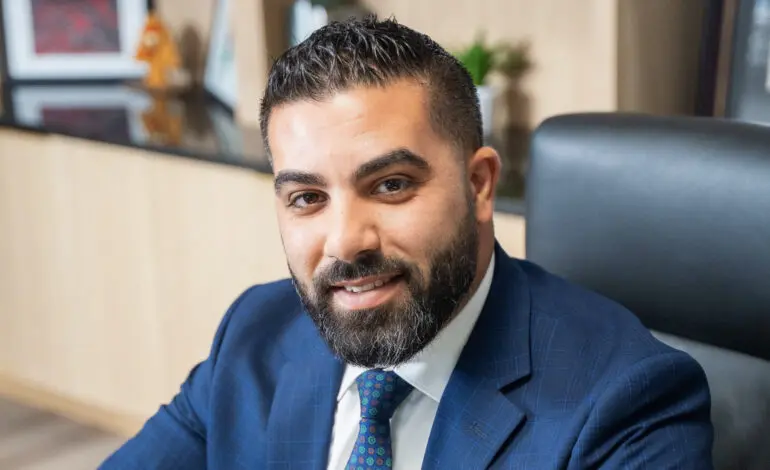

Local attorney Amir Makled hopes to make history as the first Arab and Muslim American to serve on the University of Michigan Board of Regents, saying his decision to run is driven not by personal ambition but by his belief in the importance of equal representation within public institutions.
The Lebanese American lawyer is seeking the Democratic Party’s nomination at the Michigan Democratic Party convention on April 19 at Huntington Place in downtown Detroit, ahead of the November general election for two open seats on the governing board of the University of Michigan.
The university serves approximately 69,000 students across its three campuses in Ann Arbor, Dearborn and Flint.
Makled, a prominent attorney in civil rights and criminal defense, is campaigning on a platform centered on affordability, greater accessibility and protection of free speech.
In short, he said, “representation matters.”
In an interview with The Arab American News, Makled — who represented pro-Palestinian students arrested and disciplined at U of M — emphasized that serving on the Board of Regents is far from symbolic.
He pointed to the significant authority held by the eight-member board, including oversight of a university budget that exceeds $15 billion annually.
The board also sets tuition levels, approves major contracts, appoints executive leadership and oversees Michigan Medicine, the university’s healthcare system, which includes 11 hospitals and hundreds of clinics across Michigan.
Makled stressed that the board’s decisions directly affect students, faculty, staff, patients, investments and disciplinary policies.
“Influence without real authority inside institutions is limited,” he said. “If we want our institutions to reflect our values, we cannot remain outside them.”
The first challenge
Makled said the Michigan Democratic Party convention will be decisive in determining whether his campaign advances to the general election.
He is urging party delegates to participate in large numbers and vote.
He explained to The Arab American News that participation requires registering with the Democratic Party at least 30 days before the convention.
“There is no voting by mail, no online voting and no proxy voting,” he said. “If you are not in the room on voting day, you do not have a vote.”
Makled, who grew up in a working-class union household, noted that previous convention races were decided by extremely narrow margins.
He cited the 2024 Democratic convention, where Palestinian American activist Huwaida Arraf narrowly lost the party’s endorsement for the Board of Regents by fewer than 40 votes, preventing her from advancing in the race.
According to Makled, Arab Americans represent roughly 10 percent of the convention’s voting delegates, but that presence will only matter if it is organized.
To illustrate the impact of community mobilization, he pointed to the 2012 victory of Brian Mosallam, who won the Democratic nomination for the Michigan State University Board of Trustees and later won the seat.
Why run as a Democrat?
He said he is running as a Democrat because he believes strongly in workers’ rights and civil rights, values shaped by his upbringing in a union household.
His father worked at the Ford Rouge Complex in Dearborn and was a proud member of UAW Local 600.
He said his father’s union card remains preserved in the family home.
“It wasn’t just a piece of paper,” he said. “It symbolized hard work and solidarity.”
However, he emphasized that party affiliation does not mean blind loyalty or the absence of accountability.
Makled pointed out that when pro-Palestinian students were arrested last year, the confrontation was not with a Republican-dominated governing body but with a board that includes a strong Democratic majority and a Democratic Michigan attorney general involved in the legal proceedings.
Although the criminal charges were eventually dropped, university disciplinary measures remained in place.
He said the Democratic Party is at its best when it stands with workers, students and marginalized communities, rather than simply managing crises from the top down.
A first-generation law graduate
Makled was born in the United States to immigrant parents from Lebanon who arrived in the 1970s seeking dignity and stability.
He grew up in Dearborn with his brother and two sisters in a household where Arabic school on weekends complemented public school during the week.
Education was expected, not optional.
So was giving back to the community.
The family later moved to Northville, where he completed high school.
After the September 11 attacks, he experienced a moment that remains vivid in his memory.
During a high school football game, where he served as team captain, a teammate told him he did not have to listen to a “terrorist.”
For Makled, the incident was not merely a personal insult — it was a moment that revealed how quickly political and media narratives can distort identity.
“That’s when I learned that belonging can be fragile,” he said. “And silence does not protect you.”
Born in January 1987, he later became the first member of his family to graduate from law school.
He filled out his FAFSA financial aid forms on his own, navigating the bureaucracy without guidance.
That experience gave him firsthand understanding of the challenges faced by first-generation college students.
Student activism
At the University of Michigan-Dearborn, where he earned a bachelor’s degree in finance in 2009, Makled participated in protests against the Iraq War and studied the Patriot Act, whose expanded surveillance powers he says enabled government monitoring of Arab and Muslim communities under the banner of national security.
He said recent expansions of surveillance and tougher immigration policies under President Trump remind him of that period.
He was also active in student organizing, challenging what he described as unfair administrative policies.
He helped launch initiatives aimed at easing students’ financial burdens, including the textbook exchange platform UMD-BookSwap.
During that period, the Dearborn campus became the first educational institution in the United States where a student government formally passed a Boycott, Divestment and Sanctions (BDS) resolution targeting Israel.
Regardless of one’s stance on the resolution, Makled said it demonstrated the power of organized student voices.
He also praised Osama Siblani, publisher of The Arab American News, for giving the student movement “a broader platform and media coverage.”
Beginning of his legal career
When he enrolled at Wayne State University Law School, one phrase caught his attention.
It was a quote from Judge Damon Keith (1922–2019) engraved at the Damon J. Keith Center for Civil Rights:
“Democracies die behind closed doors.”
Makled, who graduated in 2012, said the phrase became the guiding principle of his legal career.
He initially practiced civil litigation and personal injury law before shifting toward civil rights cases after witnessing how institutions operate internally.
He has represented students, workers and marginalized communities, challenging what he describes as abuses of authority.
He is a member of the National Lawyers Guild and was recognized as a “Rising Star” by Super Lawyers from 2014 through 2022.
He is also a partner at the Dearborn law firm Hall Makled.
Over time, he concluded that winning cases in court is not enough.
“You can win a case,” he said, “but the policies that caused the problem can remain.”
That realization convinced him that working inside institutions matters as much as challenging them from the outside.
University protests
During the student protests against the war in Gaza, students at U of M established a solidarity encampment and organized events supporting Palestinian rights.
The protests on the Ann Arbor campus were met with arrests and disciplinary action.
Makled represented several of the students and said they never incited violence.
“They simply asked their elected representatives to meet and reconsider the university’s investments tied to Israel,” he said.
Although criminal charges were eventually dropped, the university maintained disciplinary sanctions.
He also stood alongside Rep. Rashida Tlaib outside the office of interim university president Domenico Grasso, demanding a meeting with the students and the dismissal of disciplinary measures.
He said neither request was granted.
He also said the line should be clear: no violence, no threats and no disruption of emergency services.
“But discomfort is not danger,” he said. “Criticism is not a security threat.”
He added that some faculty and healthcare workers in the university system have told him privately that they fear speaking publicly due to possible professional consequences.
For a major academic institution like U of M, he said, a climate of fear should not be ignored.
A defining moment
Makled recalled being detained at Detroit Metropolitan Airport after representing U of M students.
He was separated from his wife and twin daughters, questioned for hours and asked to unlock his phone and surrender privileged legal communications — which he refused.
What affected him most was seeing the look in his daughters’ eyes.
“That moment reminded me that principles are not tested in speeches,” he said. “They are tested in real life.”
He said he believes institutions erode gradually — each time someone’s rights are violated and others remain silent.
That experience reinforced his conviction that participating inside institutions is not optional — it is necessary.
At the conclusion of the interview, Makled said his campaign is about more than a single seat. It is about the direction of a public institution during a critical political moment.
The real question, he said, is moral as much as administrative:
“Do we leave things as they are, or do we demand accountability from within?”
He has made his decision.
Now, he said, it is up to the community to decide whether it wants real representation inside public institutions — or to remain outside commenting from afar.

Leave a Reply