



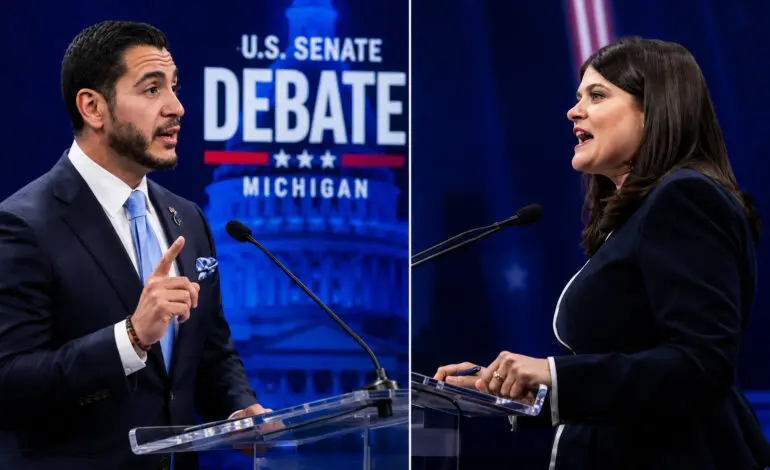

GRAND RAPIDS — Accusations of political corruption, corporate influence and loyalty to special interests dominated the only televised debate Tuesday night between Democratic U.S. Senate candidates U.S. Rep. Haley Stevens and Dr. Abdul El-Sayed ahead of Michigan’s Aug. 4 primary election.
Hosted by WOOD-TV 8, the ABC affiliate in Grand Rapids, the debate came just two days after State Sen. Mallory McMorrow suspended her campaign, leaving Stevens and El-Sayed to compete head-to-head for the Democratic nomination to succeed retiring U.S. Sen. Gary Peters.
While the candidates debated inflation, health care, immigration and foreign policy, the evening was largely defined by repeated clashes over campaign finance, corporate donations and the influence of the American Israel Public Affairs Committee (AIPAC).
Campaign money takes center stage
Throughout the nearly 50-minute debate, El-Sayed repeatedly challenged Stevens to disclose what political commitments she had made to major corporate political action committees and AIPAC, which has spent heavily to support her campaign.
El-Sayed argued that Stevens has benefited from tens of millions of dollars in outside spending, pointing specifically to contributions connected to AIPAC and other corporate-backed groups.
The progressive candidate also criticized Stevens for accepting campaign contributions from DTE Energy, linking those donations to what he described as a lack of congressional accountability for the utility company’s repeated power outages, including the widespread blackouts that left hundreds of thousands of Michiganders without electricity following last week’s severe storms.
El-Sayed reminded Michigan voters that he is the only candidate in the race who refuses to accept campaign donations from corporations or corporate political action committees, presenting his campaign as an alternative to what he called “politics bought by special interests.”
Stevens responded by saying she has fully disclosed her tax records and financial information, but she did not directly answer El-Sayed’s repeated requests for additional details regarding campaign funding and outside support.
Instead, Stevens criticized El-Sayed for delaying the release of his own tax returns and financial disclosures, suggesting voters deserved greater transparency regarding his personal finances. She also questioned reports indicating his personal wealth exceeds $1 million.
El-Sayed rejected the criticism, noting that he had received the same legal filing extension that Stevens herself had used in previous election cycles. He then turned the issue back on Stevens by questioning a trip she and her mother took to Portugal that was reportedly financed by the bipartisan advocacy organization Center Forward.
Stevens, who repeatedly described herself during the debate as a “workhorse”, also claimed Republican political organizations are indirectly helping El-Sayed because they view him as a weaker general election candidate against Republican Mike Rogers, who is backed by President Trump.
Competing visions for November
Stevens argued that her legislative record makes her the strongest Democratic candidate to win the general election in November.
She highlighted her role in passing the CHIPS and Science Act of 2022, designed to strengthen domestic semiconductor manufacturing and compete with China, along with support for the United States-Mexico-Canada Agreement (USMCA).
El-Sayed sharply criticized the USMCA, arguing that the agreement continued policies that weakened Michigan’s manufacturing sector and harmed autoworkers throughout the industrial Midwest.
He countered that Democrats will prevail in November only by offering voters a genuine alternative to establishment politics, arguing that his campaign is uniquely positioned to energize grassroots voters and defeat Rogers.
Inflation and cost of living
Addressing inflation and rising living costs, El-Sayed proposed a structural economic agenda centered on Medicare for All, stronger enforcement against monopolies, higher wages and expanded investments in schools and infrastructure.
He argued those priorities could be financed by eliminating political corruption and reducing the influence of special interests.
Stevens pointed instead to legislation she has already supported in Congress, promising continued efforts to lower utility bills, reduce grocery costs and strengthen Michigan’s economy.
Child care also emerged as a major issue after audience members submitted questions during the debate.
Stevens said she worked during the COVID-19 pandemic to secure federal funding that kept child care centers open, while acknowledging that costs have continued to rise under both the Biden and Trump administrations. She proposed expanding community block grants and state assistance programs.
Speaking from personal experience as the father of two daughters, El-Sayed described child care costs as one of the greatest financial burdens facing working families.
He proposed making child care universally free by imposing an 8-percent tax on billionaire wealth, arguing that the issue is ultimately about political priorities rather than available resources.
El-Sayed calls for abolishing ICE
The candidates also offered sharply different visions for the future of U.S. Immigration and Customs Enforcement (ICE).
During the debate, moderated by Rick Albin and News 8 anchor Amber Krycka, El-Sayed called for dismantling ICE entirely, citing what he described as serious abuses he witnessed during recent immigration enforcement operations in Minneapolis.
He argued that ICE has evolved into an agency that normalizes militarized policing in American communities and cannot be reformed through incremental changes.
“This doesn’t mean we abandon border security or immigration enforcement,” El-Sayed said. “It means we stop enforcing immigration laws in ways that threaten and violate the Constitution itself.”
Stevens rejected abolishing the agency, saying ICE should instead be reformed while maintaining secure borders. She also criticized immigration enforcement practices under the Trump administration, calling many of them “completely out of control.”
Middle East policy sparks heated exchange
The debate concluded with one of its most contentious exchanges after the candidates were asked about continued U.S. involvement alongside Israel in the conflict with Iran.
Stevens criticized Israel for drawing the United States deeper into the conflict and accused President Trump of prolonging the war.
El-Sayed questioned why the United States entered the conflict in the first place, arguing that Israeli Prime Minister Benjamin Netanyahu had been its principal advocate.
He further blamed AIPAC’s influence in American politics, saying the organization had spent tens of millions of dollars attacking his campaign while promoting what he called misleading advertising supporting Stevens.
“They clearly have a preferred candidate,” El-Sayed said. “And it isn’t me.”
Stevens responded by again asserting that Republican interests would prefer El-Sayed as the Democratic nominee because they consider him easier to defeat in November.
“I don’t intend to make anything easier for Republicans or Mike Rogers,” Stevens said. “I’m fighting for Michigan, and I’m going to win.”
El-Sayed answered that AIPAC would ultimately benefit regardless of whether Stevens or Rogers wins the election.
“They’re comfortable with both of my opponents,” he said. “They know they’ll have a reliable voice in the U.S. Senate.”
He urged Democratic voters to support a campaign focused on investing in schools, infrastructure and health care rather than what he described as endless foreign wars and policies driven by Israeli interests.

Leave a Reply