



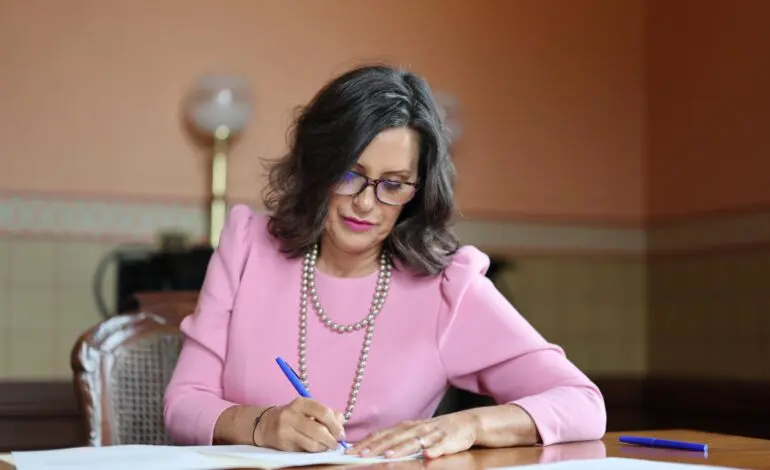

LANSING — On Tuesday, Governor Whitmer signed her eighth and final state budget into law, approving an $85 billion spending plan that includes nearly $23 billion for education and marks the final budget of her administration.
The budget was approved after marathon bipartisan negotiations earlier this month before being sent to the Democratic governor for her signature.
Facing pressure from Republicans, the Whitmer administration agreed to significant reductions in funding for several state departments while redirecting additional revenue toward road repairs and offsetting reductions in federal support for social service and health care programs.
Lawmakers were also required to address declining federal funding for the Supplemental Nutrition Assistance Program (SNAP), commonly known as food stamps, along with new federal oversight requirements for public assistance benefits and changes to Medicaid funding.
Earlier this year, State Budget Director Jen Flood warned that Michigan faced a projected $1.8 billion budget shortfall.
Overall, 10 state departments will receive less funding than they did last year. Spending also was reduced for several programs, including arts and culture initiatives, the Pure Michigan tourism marketing campaign and the Michigan Global Office, which works to integrate immigrant talent into the state’s workforce.
The budget also includes approximately $125 million for legislator-requested local projects, significantly less than similar appropriations approved in recent years.
According to the governor’s office, the new fiscal year budget, which takes effect on October 1, focuses on lowering costs for Michigan families, protecting access to health care, investing in road repairs and supporting small businesses across the state.
“At a time when families continue to face rising costs, this budget puts money back in their pockets,” Whitmer said.
She noted that the budget continues funding the state’s Working Families Tax Credit, providing average tax savings of approximately $3,900 for nearly 665,000 Michigan households.
The spending plan also fully eliminates Michigan’s retirement tax, saving approximately 500,000 retirees an average of $1,000 annually, while preserving tax exemptions on tips, overtime pay and Social Security benefits.
Senate Majority Leader Winnie Brinks (D-Grand Rapids,) welcomed the bipartisan agreement.
“This budget reflects our continued commitment to protecting access to food assistance and quality health care while investing in affordable housing, safe drinking water and reliable child care,” Brinks said.
House Speaker Matt Hall (R-Richland Township) said the budget shifts money away from what Republicans consider unnecessary spending and directs it toward higher priorities such as roads, schools and public safety.
“This plan delivers better value for taxpayers, and I’m pleased we were able to get it done together,” Hall said.
The budget also sets aside hundreds of millions of dollars to help offset federal reductions in health care and food assistance programs.
For transportation, lawmakers approved an additional $343 million for local road projects, bringing total road funding to $3.1 billion. State officials estimate the investment will support nearly 30,500 construction jobs annually.
Another $68.5 million was allocated to strengthen small businesses, entrepreneurship and community development across Michigan.
House Democratic Leader Ranjeev Puri said Democratic lawmakers fought to preserve programs that are most important to working families.
“We want Michigan to be a place where both families and businesses can thrive,” Puri said. “That begins with lowering costs, expanding access to affordable health care and maintaining world-class schools.”
Housing affordability
Whitmer also signed a package of bills designed to expand affordable housing across Michigan.
The legislation includes the creation of the Michigan Housing Opportunity Tax Credit, which will complement the federal Low-Income Housing Tax Credit to encourage the construction of more affordable housing developments.
State Rep. Stephen Wooden (D-Grand Rapids) said the legislation represents a major step toward addressing Michigan’s housing shortage.
“Today we are taking decisive action to build more homes, invest in affordable housing and protect the American dream,” Wooden said.
He added that updating Michigan’s building codes through reforms that allow smarter stairway designs will once again make smaller residential buildings more feasible, paving the way for thousands of new housing units in neighborhoods and commercial districts statewide.
Additional legislation signed by Whitmer updates state construction and building codes to provide greater flexibility for housing development while maintaining public safety standards.
Education budget
During a separate event in Southfield on Tuesday, Whitmer signed her administration’s eighth and final education budget into law.
The governor highlighted continued funding for free school meals for every student, universal pre-kindergarten, tuition-free community college programs and what she described as a historic investment in student literacy.
Michigan’s education budget totals approximately $22.9 billion, covering K-12 public schools, career and technical education programs, community colleges and public universities.
Public schools received $19.8 billion, including an increase in the per-pupil foundation allowance to $10,300 per student, continuing the state’s effort to strengthen classroom funding and improve educational outcomes.



Leave a Reply