



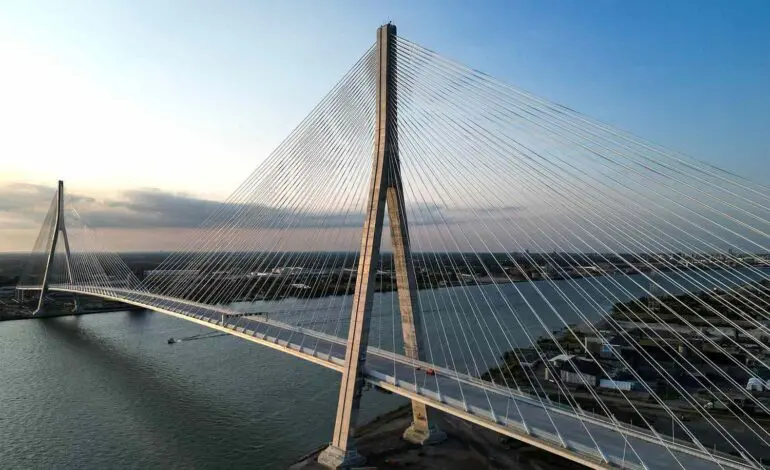

DETROIT — The Gordie Howe International Bridge opened to vehicle traffic Monday, July 27, providing a long-awaited new connection between Detroit and Windsor even as an escalating trade dispute cast a shadow over a project designed to symbolize cooperation between the United States and Canada.
Canadian officials held a ribbon-cutting ceremony in Windsor on Friday without representatives from the United States or Michigan after canceling a planned joint celebration.
The decision followed President Trump’s announcement of new 50 percent tariffs on a wide range of Canadian products amid accusations that Canada discriminates against American exports, including automobiles, alcoholic beverages and dairy products.
“In light of trade action threatened by the United States earlier this week, it would be inappropriate to proceed with a celebratory event between the two countries,” Jenna Ghassabeh, a spokesperson for Canadian Infrastructure Minister Gregor Robertson, said before the ceremony.
The absence of American officials reflected the growing tension between the two longtime allies and trading partners. The bridge itself, however, officially opened to vehicles as scheduled Monday morning.
Michigan Gov. Whitmer and members of hockey legend Gordie Howe’s family were among those given an opportunity to cross the span shortly before it opened to general traffic.
Tariffs threaten Michigan’s economy
The opening coincided with Trump’s visit to Michigan, where he delivered a campaign-style economic speech at General Motors’ Milford Proving Ground and again defended tariffs as an effective tool for returning factories and manufacturing jobs to the United States.
Trump praised his “America First” trade policies and argued that tariffs on foreign vehicles and other goods are encouraging automakers to invest in American factories.
His administration justified the new Canadian tariffs by accusing Ottawa of adopting discriminatory policies affecting American automobiles, dairy products and alcoholic beverages.
The White House said Canadian imports of U.S.-made vehicles declined by approximately 22 percent — or $5.6 billion — between April 2025 and March 2026 compared with the previous 12-month period.
Canada has imposed retaliatory tariffs on selected American products during the broader trade dispute, further escalating tensions between two countries whose economies are deeply integrated.
Michigan is particularly vulnerable because of its extensive trade relationship with Canada and the auto industry’s reliance on parts and raw materials that cross the border several times during the manufacturing process.
Approximately 180,000 to 190,000 commercial trucks cross between Michigan and Canada every month, carrying auto parts, industrial materials, agricultural products and consumer goods.
Business organizations citing federal import and tariff data say tariffs have already cost Michigan companies billions of dollars since the trade measures began in 2025.
The Detroit Three automakers reportedly absorbed approximately $6.5 billion in tariff-related expenses in 2025. Industry officials warn that additional duties on Canadian products could raise manufacturing costs, reduce profit margins and ultimately increase vehicle prices for American consumers.
The economic concerns come as Michigan continues to face elevated inflation and rising fuel costs amid military and political tensions in the Middle East.
Despite Trump’s claims that tariffs have revitalized American manufacturing, Michigan has lost approximately 8,300 manufacturing jobs since the tariffs were introduced in 2025, according to economic data cited by the Associated Press. Employment in the state’s auto-parts sector has fallen by roughly 4,000 jobs.
Automakers have announced plans to shift some production to the United States, including a $4 billion investment by General Motors, but economists say those plans have not yet produced substantial statewide employment growth.
Glenn Stevens Jr., executive director of MichAuto and chief automotive and innovation officer at the Detroit Regional Chamber, has warned that tariffs on vehicles, auto parts, steel and aluminum could disrupt supply chains and create additional uncertainty for manufacturers.
MichAuto represents Michigan’s automotive and mobility sector, which contributes an estimated $348 billion to the state’s economy.
Stevens has said the increased cost of doing business between the United States and Canada could be especially damaging because North America’s auto industry was built around integrated supply chains.
The added expenses and inefficiencies, he warned, are typically passed along to consumers and can weaken the global competitiveness of American automakers.
Whitmer crosses bridge in a black Mustang
Whitmer drove across the bridge in a black Ford Mustang convertible shortly before it opened to the public, calling the experience “really cool.”
Members of Howe’s family also crossed the bridge during the ceremonial opening.
“To see this huge span that has been built, it is spectacular,” Whitmer said. “And I think it’s a tribute not just to Gordie Howe, but to the relationship between Canada and the United States, and especially Michigan and Canada.”
The governor said she had not personally driven a vehicle in “a number of years”, making the ceremonial crossing an unusual experience for her.
Whitmer also highlighted design elements honoring Howe, including protective structures shaped like hockey sticks.
The late Canadian hockey legend, known as “Mr. Hockey”, played 25 seasons with the Detroit Red Wings and became an enduring cultural figure on both sides of the border.
Whitmer emphasized the importance of having a second major bridge connecting Detroit and Windsor and said the crossing would strengthen trade, border security and the broader economy.
“It’s important for homeland security, it’s important for our economy,” she said. “It’s, I think, a testament to what’s possible.”
The governor also praised the union laborers from both countries who constructed the bridge.
“This was built with union workers on both sides of the span,” she said. “I think that it’s just a great symbol, but also a really practical, important investment in our economy and our future.”
U.S. Sen. Gary Peters was also among the first to use the new crossing, driving a motorcycle across the bridge Monday.
A $6.4 billion Canadian investment
The six-lane, cable-stayed bridge stretches approximately 1.5 miles across the Detroit River and creates direct highway connections between Interstate 75 in Detroit and Highway 401 in Ontario.
Construction began in 2018 and faced delays related to the COVID-19 pandemic, land acquisition and the enormous logistical challenges of building new ports of entry on both sides of the border.
The Canadian government financed the project, which cost approximately $6.4 billion in Canadian currency, or roughly $4.7 billion in U.S. dollars.
The agreement governing the bridge allows Canada to collect toll revenue to recover its construction costs. Original projections indicated that the repayment process could take approximately 50 years, after which toll revenue would be shared between the United States and Canada.
Trump had threatened earlier this year to delay the bridge’s opening unless the United States received a portion of its revenue. American and Canadian officials subsequently announced an agreement allowing the crossing to open, although the two governments offered differing interpretations of how and when toll proceeds would be divided.
Canadian Prime Minister Mark Carney maintained that revenue sharing would begin only after Canada recovered the project’s cost.
The disagreement over toll revenue became another source of friction alongside the broader tariff dispute, but ultimately did not prevent the bridge from opening.
The Gordie Howe Bridge gives commercial traffic a new alternative to the privately owned Ambassador Bridge, which for nearly a century served as the region’s primary crossing for trucks.
Officials say the new bridge’s direct freeway-to-freeway connection, expanded customs facilities and additional inspection capacity should help ease congestion and make cross-border freight movement more reliable.
How much does it cost to cross?
The toll depends on the type of vehicle, but standard passenger vehicles can cross for less than $6.
The one-way toll for a regular passenger vehicle is $5.75 in U.S. currency, or $8 Canadian.
Drivers enrolled in the bridge’s Breakaway discount program pay $4.35 in U.S. currency, or $6 Canadian.
By comparison, the privately operated Ambassador Bridge charges approximately $10 U.S., or $14 Canadian, for a standard passenger vehicle.
A passenger vehicle towing a trailer must pay the regular vehicle toll plus an additional full toll for each trailer.
The standard commercial-vehicle toll on the Gordie Howe Bridge is $8.75 U.S., or $12 Canadian, per axle.
Commercial vehicles enrolled in the Breakaway program pay $6.90 U.S., or $9.60 Canadian, per axle.
Pedestrians and bicyclists will be able to cross the bridge free of charge beginning Aug. 5, provided they carry the travel documents required to enter the United States or Canada.
The shared-use path will make the Gordie Howe the first bridge connecting Detroit and Windsor to provide a dedicated route for pedestrians and cyclists.
Despite the political tensions surrounding its opening, officials on both sides of the border described the bridge as a critical long-term investment in the economic and cultural relationship between Michigan and Canada.



Leave a Reply