



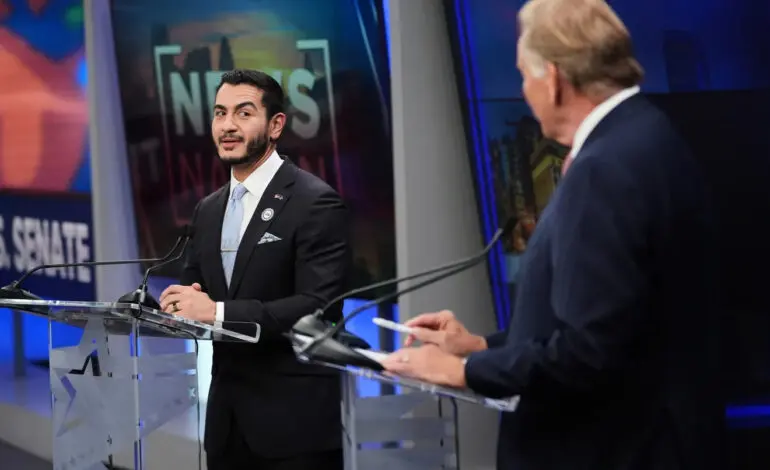

DETROIT — Underscoring Michigan’s importance as a decisive battleground in the fight for control of Congress in November, President Trump and former President Obama are planning visits to the state over the coming week, as voters continue casting mail ballots amid an intense contest for Michigan’s U.S. Senate seat between Democrat Abdul El-Sayed and Republican Mike Rogers.
El-Sayed and Rogers faced off in their first televised debate on Thursday. Most opinion polls indicate a closely contested race between the two leading candidates seeking to succeed incumbent Sen. Gary Peters, who decided not to seek another six-year term, opening the door to a fierce battle that could determine the majority in the next U.S. Senate.
Democrats must retain Peters’ seat as they seek to regain a majority in the Senate, which Republicans currently control with 53 seats to the Democrats’ 47.
Trump said on Monday that he planned to visit Michigan in “about a week and a half”, without specifying a date or location for the campaign stop.
The president’s last visit to Michigan was also for campaign purposes, in late July, when he addressed approximately 3,000 people at a General Motors facility in Milford Township to support several of his endorsed candidates in the August primaries.
During that visit, Trump highlighted his administration’s efforts to strengthen manufacturing and combat inflation, assuring those attending that they would “see the results very soon.”
As the worsening fuel-price crisis casts a shadow over the election, Trump’s visit will precede Obama’s arrival in the state. The former Democratic president plans to participate in a major campaign rally supporting El-Sayed and Michigan gubernatorial candidate Jocelyn Benson in Detroit on October 24, coinciding with the start of early in-person voting statewide.
The location of the anticipated Detroit rally has not been announced. However, an event registration website said further details would be released 24 hours before the event.
“Join President Barack Obama, Abdul El-Sayed, Jocelyn Benson and the rest of the Michigan Democratic ticket as we kick off early voting,” the website stated.
Obama has made several campaign visits to Michigan since leaving office. Two years ago, on October 22, 2024, he addressed a crowd at Huntington Place in downtown Detroit in support of Democratic presidential candidate Kamala Harris. Musician Eminem introduced him at that event.
Obama also visited Detroit in late October ahead of the previous two midterm elections, in 2018 and 2022.
Obama and El-Sayed spoke by phone about the U.S. Senate race following the August primary.
Throughout his campaign, El-Sayed has frequently referred to Obama’s political rise when discussing doubts about whether someone with a name like his could succeed in politics.
“I have to be honest with you: That was the first time I ever saw a reflection of myself in the political landscape,” El-Sayed previously said about Obama’s 2008 presidential victory and arrival at the White House.
First debate
In the first of two debates agreed upon by their campaigns, El-Sayed and Rogers faced off at the studios of local Channel 8, WOOD-TV, in Grand Rapids Thursday evening. The candidates exchanged personal attacks throughout the hourlong debate, moderated by a veteran broadcaster.
In live analysis for the New York Times, political reporter Bayliss Wagner said El-Sayed had proved to be the “more skilled debater”, noting that he repeatedly put Rogers on the defensive over his congressional record and personal wealth.
NBC News described the debate as particularly heated, with exchanges descending into “sharp and harsh criticism” over real estate and political loyalties from both sides, without producing a clear winner.
The evening featured heated exchanges and repeated interruptions, prompting the moderator more than once to ask the candidates to allow him to help manage the discussion.
At one point, he noted that their verbal sparring had continued even during the commercial break — something he said he had never witnessed in 30 years of moderating televised debates.
The debate addressed the war with Iran, U.S. support for Israel, immigration and deportation policies, the practices of U.S. Immigration and Customs Enforcement, tariffs on Canada, living costs and rising prices.
Personal attacks repeatedly punctuated the discussion. Rogers accused El-Sayed of receiving money from the Muslim Brotherhood and from parties supporting Hamas, Hezbollah and even Al-Qaeda.
El-Sayed, in turn, seized the opportunity to highlight what he described as Rogers’ inconsistencies, citing his reversal of earlier positions on tariffs against Canada and the war with Iran.
After supporting Trump’s policies on both issues, Rogers had called for ending the trade war with Canada and stopping the war with Iran in light of their disastrous economic consequences for American businesses and consumers.
El-Sayed characterized his opponent’s shifting positions as an attempt to distance himself from Trump’s policies when they become politically costly. He accused Rogers of becoming merely a puppet of the Republican president rather than defending Michigan residents’ interests.
El-Sayed faced pointed questions about his opposition to sending American money and weapons to Israel, even if it were attacked by another country.
He responded that he did not want American taxpayers’ money used to finance wars abroad, reiterating that his campaign primarily focuses on Michigan residents’ interests and helping them afford the high cost of living.
Rogers, who did not attend a debate organized by Detroit’s local Fox station last month, did not remain passive in response to El-Sayed’s attacks, which unsettled him more than once.
He called his opponent a “fraud” and said he was “not a doctor”, adding that El-Sayed would face penalties for breaking the law if he practiced medicine.
Trump also launched a sharp attack on El-Sayed on the night of the debate, describing him in a Truth Social post as a “disastrous candidate.”
“Mohammed El-Sayed is a disastrous candidate for the Democratic Party (…) Mohammed goes back to the days of jihad,” Trump said, identifying El-Sayed by the wrong first name. “He is a radical extremist, a terrorist sympathize, and no different from his close friend, the America-hating Hasan Piker.”
El-Sayed and Rogers will meet for a second televised debate on October 21 on Detroit’s Channel 7, WXYZ-TV, moderated by broadcaster Chuck Stokes.
State of the race
On the eve of the debate, opinion polls showed El-Sayed holding a slight lead over his Republican opponent.
A Mitchell Research & Communications poll placed the Arab American candidate at 45.6 percent, compared with Rogers’ 41.4 percent, with a margin of error of 3.8 percentage points.
Another poll, conducted by Fox, showed El-Sayed ahead by one percentage point. A third poll, conducted by Marist, placed the Democratic candidate at 51 percent, compared with Rogers’ 44 percent.


Leave a Reply