



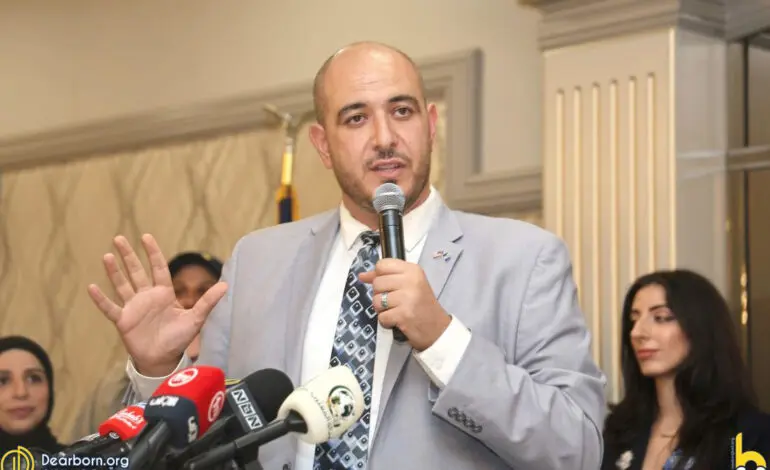

DEARBORN — Democrat Abbas Alawieh made history Tuesday by becoming the first Arab American and first Muslim elected to the State Senate.
The Lebanese American activist’s victory in the Second District, which includes Dearborn and Dearborn Heights, had been widely expected since he secured the Democratic nomination in August.
Alawieh easily defeated Republican opponent Harry Sawicki, receiving more than 71 percent of the vote.
The Arab American activist, who helped establish the Uncommitted voting movement during the 2024 presidential election, received 72,311 votes, compared with Sawicki’s 27,252, or 27 percent, according to preliminary results from the November 3 election.
The traditionally Democratic Second District covers Dearborn, Dearborn Heights, Melvindale and Allen Park, along with portions of Taylor and Detroit.
Alawieh will join 22 other Democratic senators when the new Senate convenes early next year. Democrats expanded their majority by three seats, increasing their representation from 20 seats in the current chamber to 23 in the next, compared with 15 Republicans.
The State Senate consists of 38 senators representing districts across the state. Unlike State House members, who are elected every two years, state senators serve four-year terms.
The election results showed Democrats retaining every district they currently hold while capturing three additional seats:
- District 9, in Oakland and Macomb Counties: Theresa Brooks defeated Republican incumbent Michael Webber by approximately 10,000 votes.
- District 30, in the Grand Rapids area: Democrat Carol Glanville defeated Republican incumbent Mark Huizenga by more than 13,000 votes.
- District 32, in western Michigan: Rebecca Amidon defeated Republican Kim Cole by fewer than 2,000 votes. She will succeed Republican Sen. Jon Bumstead, who could not seek reelection because of constitutional term limits.
Victory speech
Alawieh opened his victory speech before supporters at Byblos Banquet Center in Dearborn with an enthusiastic welcome, emphasizing the election’s historic significance.
He said the victories of Arab American candidates, led by Dr. Abdul El-Sayed in the U.S. Senate race, went beyond local electoral successes to represent a political turning point for the country.
The results, he said, demonstrated the community’s ability to elect candidates who reject money from corporations and powerful interest groups and instead embrace politics rooted in the people and serving their interests. Such an approach could change course when the economy benefits only the wealthiest or when foreign policy serves war profiteers and bomb manufacturers at the expense of families’ lives.
Alawieh renewed his commitment to representing and fighting for everyone in the district as one family.
When he takes office early next year, he said, he will be accessible to everyone, regardless of ethnicity, race or political views.
He explained that his decision to run grew out of his experience working in government and within the Democratic Party to demand a ceasefire and an end to the war and genocide affecting civilians and innocent people in Palestine and Lebanon.
Alawieh, who worked in the offices of several members of Congress, emphasized the community’s collective strength when it comes together to pursue change.
The election results, he said, demonstrated its ability to win across Michigan, influence national politics and help shape the road to the next presidential election.
Any candidate seeking the White House, he added, would have to engage with southeastern Michigan communities and answer their questions about supporting working people and stopping the killing of their relatives abroad.
Alawieh told The Arab American News his highest priorities in the State Senate would include developing an agenda to urgently address the housing affordability crisis.
“It became very clear to me as I visited community members across the Second Senate District that people are struggling enormously to meet their basic needs amid federal government policies contributing to the rising cost of living,” he said.
Alawieh said his election as the first Arab American and Muslim senator representing a district of more than a quarter-million residents carried significance beyond the election itself.
“I truly feel that this moment is much bigger than any one of us. It is certainly bigger than me alone,” he said. “Having my perspective as an Arab and Muslim American at the highest levels of decision-making in our state is extremely important because it enriches the diversity of discussions taking place statewide.
“I am honored to show young children across Michigan who may share my ethnic and religious background that we belong everywhere, including where decisions about the future of our communities are made,” he added.


Leave a Reply