



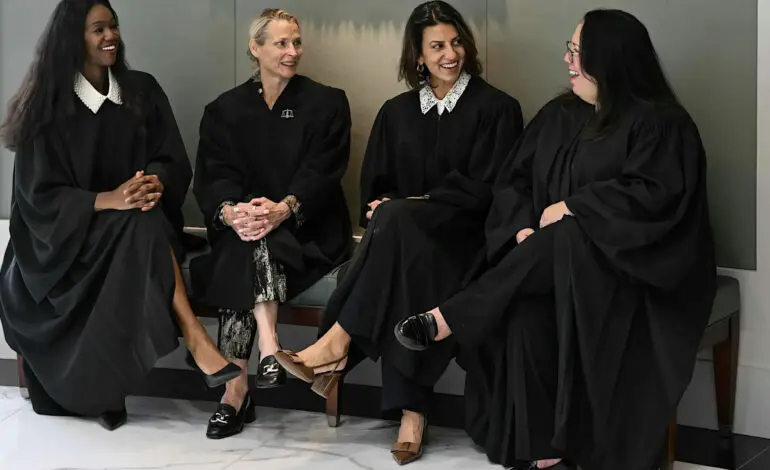

SAGINAW — A documentary premiering Dec. 1 at Saginaw’s Temple Theatre marks 250 years of American independence through the stories of five Michigan women judges. Their experiences span generations, from a family’s account of a 1939 lynching to the barriers women still encounter in courtrooms today.
A More Perfect Union: 250 Years of Law, Liberty & the American Promise features Michigan Supreme Court Justice Kyra Harris Bolden, Michigan Court of Appeals Judges Michelle Rick, Mariam Saad Bazzi and Allie Greenleaf Maldonado, and Saginaw County Judge Julie A. Gafkay. Laura E. Swanson directed and produced the film, and Zenell Brown narrates.
The National Association of Women Judges and the Great Lakes Bay Region of the Women Lawyers Association of Michigan are hosting the free premiere on Tuesday, Dec. 1. Doors open at 5:30 p.m., and the 23-minute film starts at 6:15 p.m. Rick, Bazzi, Maldonado, Brown and Swanson are expected to join a discussion after the screening.
Making historic firsts the norm
Bazzi, the first Arab American Muslim woman to serve on the Michigan Court of Appeals, told The Arab American News that the role carries a pressure the public rarely sees. She said she often has to explain the diversity of the Arab and Muslim communities she represents to people who treat them as a single group.
“It is our responsibility to have candid conversations so that the next person does not feel that same pressure to explain who and what we are,” Bazzi said.
“I definitely want to be remembered as someone who made these achievements the norm for our community,” Bazzi said when asked how she wants future generations to remember her. “It is my responsibility to make sure the avenues and opportunities that opened for me are available to anyone else who seeks these types of positions.”
Judge Mariam Saad Bazzi tells The Arab American News she wants milestones like hers to become the norm in her community.
For Bazzi, that means making herself available to people who seek guidance and reaching out to mentor people outside her own circles. Brown, who worked with Bazzi at the Third Circuit Court in Wayne County, recalled that Bazzi helped develop the court’s first diversity and inclusion strategic plan.
“She symbolizes hope. She symbolizes a dream,” Brown said.
Rick said she hopes that, in another 25 years, a woman reaching a leadership post on the bench, in Congress, at the White House or in a corporate boardroom will no longer be an exceptional event. The film, she said, shows how judges’ life experiences shape what they see in a case.
“It is critical for those who depend upon the courts to know that while we are always bound to follow the rule of law, those perspectives matter,” Rick said.

Michigan judges featured in A More Perfect Union, Allie Greenleaf Maldonado, Mariam Saad Bazzi, Michelle Rick and Kyra Harris Bolden.
Whose stories are heard
Brown, the fairness and accountability administrator at Michigan’s State Court Administrative Office, said the anniversary looks different to Indigenous peoples, African Americans, immigrants, Arab Americans and Muslim Americans. Speaking in her personal capacity, she said the pursuit of justice links those histories and that access to the courts should never depend on money or status.
In her first documentary as a narrator, Brown connects the judges’ stories with Indigenous history, slavery, immigration and the civil rights movement. Among the turning points is Brown v. Board of Education, the U.S. Supreme Court ruling that declared racial segregation in public schools unconstitutional.
For Brown, the account that stayed with her came from Bolden, the first Black woman to serve on the Michigan Supreme Court. Bolden’s great-grandfather, Jesse Lee Bond, was lynched in Tennessee in 1939 after asking a store owner for a receipt. Brown recalled being taught as a young Black woman to leave stores with a bag and a receipt so she could prove she had paid. She still passes that advice on to her grandchildren.
Maldonado, a former tribal judge and the first citizen of a federally recognized tribe to serve on the Michigan Court of Appeals, said the anniversary also calls for remembering the broken treaties, forced removal and near-total genocide that Indigenous peoples endured. She spoke of honoring the sacrifices of the seven generations that came before her and building a fairer future for the seven generations to come.
“Visibility simply means being seen, acknowledged and included,” Maldonado said. “However, a meaningful voice means having a seat at the table where decisions are actually made.”
The barriers a courtroom can overlook
Gafkay, chief judge of Saginaw County’s 10th Circuit Court and 70th District Court, pointed to a practical problem for breastfeeding attorneys. Finding the time and a private place to pump can be difficult during a day in court. In 2019, the State Court Administrative Office worked with a committee led by the Women Lawyers Association of Michigan to develop guidance on courthouse lactation rooms.
“Women have had to be cautious to fit in,” Gafkay said. “They have endured bias, harassment and unfair treatment, a lot of times while remaining silent, and that silence has taken an invisible toll.”
Beyond the premiere
Swanson said additional screenings are planned for 2027 and that the film will be available to a wider audience beginning in May 2027. She hopes to build on the National Association of Women Judges’ existing outreach to Michigan law students and eventually develop the film into a national educational initiative.
Brown hopes viewers leave thinking about what they can do themselves, whether that means voting, running for office, holding elected officials accountable or educating others.
Maldonado put it this way: “Justice is never finished; it must be pursued anew with every single case.”


Leave a Reply