



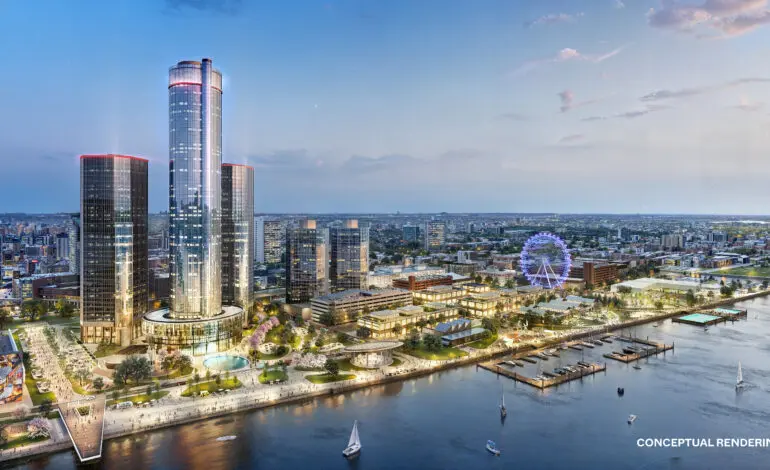

DETROIT — The Detroit City Council voted 7–2 on Nov. 24 to advance a $2.2 billion redevelopment of the Renaissance Center and the east riverfront. The plan by Bedrock and General Motors would remove two of the complex’s original towers and create new housing, offices and public space along the Detroit River. The project still needs state approval for a major portion of its financing.
The Council approved roughly $473 million in proposed tax incentives. A separate $75 million commitment from Detroit’s Downtown Development Authority brings the total public support to about $548 million. The Michigan Strategic Fund is expected to consider a $300 million request under the state’s Transformational Brownfield program on Dec. 15, according to Bedrock.
Tax incentives and neighborhood investment
Council Members Gabriela Santiago-Romero and Denzel McCampbell voted against the measures after more than three hours of public comment. Opponents urged the Council to delay the vote, questioning the size of the subsidy and whether developers would follow through on their commitments. Supporters, including construction and skilled trades workers, pointed to the jobs and expanded public access to the riverfront. Council Member Renata Miller, who voted in favor, said leaving the complex as it is could turn a symbol of Detroit into a symbol of blight.
Mayor Mary Sheffield welcomed the vote, saying it moved Detroit closer to a new chapter for the riverfront and the Renaissance Center. Dan Gilbert has pledged $1 billion to the redevelopment through a nonprofit structure set up to oversee his investment.
The Council also approved a community benefits package valued at about $133 million. The developers committed roughly $45 million to city projects and about $90 million in payments to Detroit in lieu of taxes over 30 years. Council Member Latisha Johnson said a resolution backed by Sheffield would direct those payments toward affordable housing, neighborhood beautification and anti-poverty efforts beyond downtown and Midtown.
What the plan would change
The two 39-story towers closest to the river, Towers 300 and 400, would come down to make room for waterfront public space. The central tower’s Marriott hotel would shrink from about 1,300 rooms to 858, with apartments, event space and an observation deck also planned for the building. The broader redevelopment calls for 934 mixed-income homes, modernized offices and about 17 acres of new public space, including parks, plazas and a marina.
City documents estimate the project would generate 6,162 construction jobs and 1,463 direct full-time jobs. The redevelopment would proceed in three phases, with completion projected for 2038.


Leave a Reply