




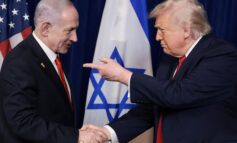
At the conclusion of a four-day visit to Washington, which included daily meetings with President Trump and senior members of his administration, Israeli Prime Minister Benjamin Netanyahu expressed conditional approval of a temporary ceasefire agreement in Gaza and a partial prisoner exchange with Hamas. He also threatened to resume his genocidal war if Hamas did not agree to disarm and relinquish power in the devastated enclave.
Netanyahu’s position coincided with ongoing indirect negotiations between Israel and Hamas in Doha and came as a direct result of pressure from President Trump. Trump has demanded a deal be reached within a week based on a U.S.-backed draft that includes an initial 60-day ceasefire and a partial prisoner swap.
While Netanyahu showed some flexibility regarding the temporary truce talks, he set out stringent conditions for not resuming the war, asserting that a comprehensive prisoner exchange, as desired by Trump and the hostages’ families, is not currently achievable. Speaking on Thursday, he said negotiations to end the Gaza war would begin once the truce starts.
“If Hamas is not disarmed and dismantled within 60 days, we will return to fighting,” he warned.
From Congress, Netanyahu said he wanted a deal for Gaza, but emphasized that it would not come “at any cost” and clarified that he was working with Trump to achieve Israel’s security requirements.
“Any permanent agreement must meet Israel’s minimum conditions, which include the complete disarmament of Hamas and the removal of any military or governing capabilities it holds in the Gaza Strip,” Netanyahu said in a recorded video posted on X before departing Washington.
He noted that Israel had succeeded in dismantling most of Hamas’s military capabilities, though not all. It’s worth mentioning that during Netanyahu’s visit, Israeli forces suffered heavy losses due to Palestinian resistance ambushes, particularly in Beit Hanoun, an area supposedly under full Israeli military control.
Netanyahu, who did not hold a joint press conference with Trump, said his government was exerting “intense efforts” to reach an agreement that would include the release of some hostages — alive or dead — in exchange for a 60-day ceasefire. During this period, further negotiations would be held to reach a permanent agreement to end the ongoing war.
He reiterated that Israel is committed to bringing back all hostages.
“This is a promise I’ve made to their families.
“If these conditions can be met through negotiations, that’s a positive outcome,” he added. “If not within 60 days, we will achieve them by other means — primarily through military force.”
Netanyahu also drew a parallel with Iran.
“The same applies to Iran… If an agreement on its nuclear file is reached within 60 days of negotiations between Washington and Tehran, that’s good. If not, we’ll find another way.”
Meanwhile, Secretary of State Marco Rubio expressed optimism about reaching a deal, saying U.S. envoy Steve Whitkoff was also hopeful.
“I believe we’re closer than we were before,” Rubio said. “Challenges remain, and one of the key ones is Hamas’ unwillingness to disarm. There should be no hostages; all must be released. If they disarm and release the hostages, everything ends.”
In response, Hamas issued a statement condemning Netanyahu’s comments to hostage families about the impossibility of reaching a comprehensive deal as revealing his “malicious intentions.”
“War criminal Netanyahu is placing obstacles in the way of reaching an agreement that would result in the release of hostages and an end to aggression against our Palestinian people in Gaza,” Hamas stated.
Hamas emphasized that it had previously offered a comprehensive exchange deal — releasing all hostages in one go in return for a permanent ceasefire, complete Israeli military withdrawal and free-flowing humanitarian aid. Netanyahu, it said, had rejected this and continues to obstruct the process.
Hamas concluded by affirming it was acting responsibly and positively in negotiations to reach a deal that would bring an end to the aggression, lead to Israeli military withdrawal and allow unrestricted aid to enter Gaza so the people can rebuild and live in dignity, in exchange for a mutual release of prisoners.
Agence France Press (AFP) reported that Qatari mediators were “shuttling between the parties to exchange ideas, aiming to close remaining gaps and maintain momentum toward a deal.”
Hamas had earlier stated its opposition to a truce that would end Israeli forces in Gaza while agreeing to release 10 hostages. Of the 251 hostages captured during the “Al-Aqsa Flood” operation, 49 remain in Gaza — 27 of whom Israel has declared dead.
While awaiting a final draft from the Doha talks, far-right Israeli ministers continued to push against negotiations.
“The more reckless deals are discussed, the more Hamas is encouraged to carry out kidnappings,” National Security Minister Itamar Ben-Gvir said. “The lives of soldiers and residents of southern Israel are more important than any normalization or economic deals. I say to Netanyahu: negotiating with Hamas is forbidden — we must crush them.”
He demanded a halt to negotiations.
Finance Minister Bezalel Smotrich warned that any withdrawal from areas seized by the Israeli army in Gaza would be “a stab in the back” to soldiers and families of those killed in battle.
Under pressure from the far-right, observers fear the truce talks may collapse due to Israel’s insistence on occupying one-third of Gaza, amid deep internal political disputes and maneuvering.
While Hamas insists on a full Israeli withdrawal, Israel seeks to retain control over about a third of the Gaza Strip, including the Morag corridor between Rafah and Khan Younis, and to maintain a controversial aid distribution system overseen by the so-called Gaza Humanitarian Foundation, backed by the United States.
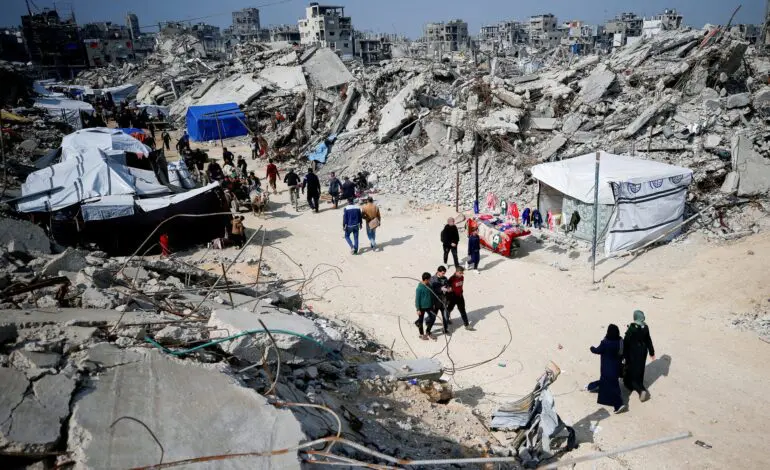
Since October 7, 2023, Israel — with U.S. support — has committed genocide in Gaza involving killing, starvation, destruction and displacement, in defiance of international calls and International Court of Justice rulings.
The war has left more than 195,000 Palestinians killed or wounded — mostly women and children — with more than 10,000 missing, hundreds of thousands displaced and widespread famine. Meanwhile, Palestinian resistance continues to inflict heavy losses on Israeli forces, particularly in the past week.
According to the Israeli military, 888 officers and soldiers have been killed, and 6,060 wounded since the start of the war on Gaza.
Yemen escalates
In parallel, Yemen’s Ansarallah movement has intensified its Red Sea operations and missile/drone strikes on Israel. Its leader, Abdul-Malik al-Houthi, affirmed that “The blockade on Israeli navigation through the Red Sea, Gulf of Aden and Arabian Sea remains in effect at all stages.”
He said recent activity stemmed from certain companies violating the ban.
Al-Houthi declared Yemen would not allow the Eilat Port to reopen, describing the sinking of the Magic Seas and Eternity C vessels last week as a clear warning to all shipping firms working with Israel.
Yemen’s forces used 45 ballistic and hypersonic missiles, drones and naval vessels in operations last week targeting cities deep in Israel, including Jaffa (Tel Aviv), Ashdod, Ashkelon and Eilat.
Yemeni forces also fired a “Zulfiqar” ballistic missile at Ben Gurion Airport, halting air traffic and triggering alarms in 300 settlements around Tel Aviv.
Contrary to Israeli claims that the missile was intercepted, Yemeni spokesperson Brig. Gen. Yahya Saree said it hit its target successfully.
Syria normalizing relations?
In a significant shift, the U.S. removed Hay’at Tahrir al-Sham (HTS) from its terror list and announced direct talks between Syria and Israel, with President Trump reportedly supporting this normalization track.
Syria’s transitional President Ahmad Al-Sharaa visited the U.A.E. for the second time since taking office — signaling progress toward Syria joining the Abraham Accords, which previously brought U.A.E., Bahrain, Morocco and Sudan into normalization agreements with Israel.
Initial talks aim at limited security and intelligence agreements, despite Israel’s insistence on maintaining control of the Golan Heights and other key territories seized after the fall of Bashar al-Assad’s regime.
The timing of the U.S. delisting HTS — coinciding with U.S. envoy Thomas Barrack’s visit to Beirut and the announcement of talks between Syria and Israel — was seen as a major American push for Syrian-Israeli normalization. The decision was signed on June 23.
Washington also submitted a proposal to remove Al-Sharaa and HTS from U.N. terrorism lists before September, when Al-Sharaa is expected to address the U.N. General Assembly, becoming the first Syrian leader in 60 years to do so.
Israel’s Channel 24 did not rule out a Netanyahu–Al-Sharaa meeting in Washington ahead of the UNGA.
Meanwhile, Israel Hayom, citing White House sources, revealed that Trump’s envoy had traveled to Damascus to finalize a U.S.-guaranteed deal between Israel and Syria — in exchange for Netanyahu agreeing to end the Gaza war.
Lebanon: U.S. demands Hezbollah disarmament
Washington sent its clearest message to Lebanon in years via Barrack, who delivered a political and security framework under the guise of a settlement. The core demand: Hezbollah must disarm within five months in exchange for a gradual Israeli withdrawal and a conditional economic roadmap.
While not entirely new, the proposal shifts responsibility to the Lebanese state, offering no guarantees and no clear plan to avoid political or security collapse.
Following Lebanon’s rejection of the proposal last week, Washington’s next move is awaited amid Hezbollah’s firm stance on retaining its weapons as a deterrent against Israeli threats from the south and new threats from Syria’s eastern and northern borders.
Iran: Talks conditional on guarantees
As Netanyahu threatened from Washington to launch new attacks on Tehran if it reactivates its nuclear program, Iranian Foreign Minister Abbas Araghchi expressed openness to dialogue — but ruled out negotiating over Iran’s missile capabilities, which he called a defensive and deterrent force, proven during the recent war with Israel.
In an interview with Le Monde, Araghchi said Iran remains willing to talk, but demands clear guarantees against military aggression and respectful relations from the U.S., including acknowledgment of past mistakes.
Trump claimed Iran wants to negotiate and predicted talks would resume within two weeks.
“To return to the negotiating table, we must first receive guarantees that the U.S. will not resort to military action during talks,” Araghchi emphasized, however. “These conditions require us to be cautious and take more time. But the doors of diplomacy will never close.”


Leave a Reply