



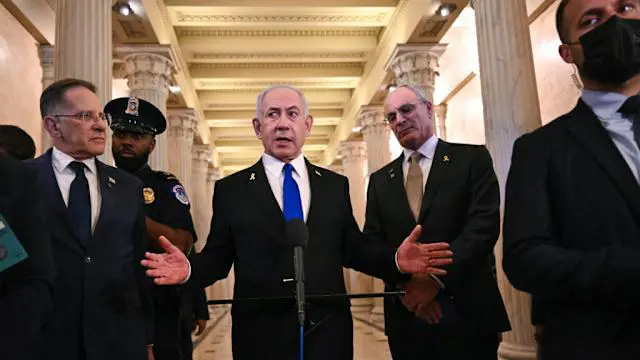

Prime Minister Benjamin Netanyahu said on Wednesday his meeting with President Trump had focused on freeing hostages held in Gaza, as Israel continued to pound the Palestinian territory amid efforts to reach a ceasefire.
Netanyahu said on X that the leaders also discussed the consequences and possibilities of “the great victory we achieved over Iran” following an aerial war last month in which the United States joined Israeli attacks on the Islamic Republic’s nuclear sites.
Netanyahu is making his third U.S. visit since Trump took office on January 20 and had earlier told reporters that while he did not think Israel’s campaign in the Palestinian enclave was done, negotiators are “certainly working” on a ceasefire.
Trump met Netanyahu on Tuesday for the second time in two days to discuss the situation in Gaza, with the president’s Middle East envoy indicating that Israel and Hamas were nearing an agreement on a ceasefire deal after 21 months of war.
Hamas official Taher al-Nono told Reuters they were engaged in a “difficult round” of negotiations.
A source familiar with Hamas’ thinking said four days of talks in Doha did not produce any breakthroughs on three main sticking points.
These are the free flow of aid into Gaza, withdrawal lines for Israeli forces and guarantees that negotiations would pave the way to a permanent ceasefire
The source said Israel has demanded it retain control of about one-third of the enclave, including the Morag Axis, a corridor between the Gaza cities of Rafah and Khan Younis.
On aid, Israel has insisted on sticking with the controversial U.S.-backed Gaza Humanitarian Foundation’s system, the source added. The United Nations and humanitarian groups have criticized this as unsafe and leading to at least 613 deaths.
While the Hamas source saw three major unresolved obstacles, Steve Witkoff, Trump’s special envoy to the Middle East, said the number had decreased from four to one, expressing optimism for a temporary ceasefire deal by the end of the week.
Witkoff told reporters at a Cabinet meeting that the anticipated agreement would involve a 60-day ceasefire, with the release of 10 living and nine deceased hostages.
In recent weeks Israel’s military has continued to hammer Gaza, where a teddy bear lay in the rubble on Wednesday at the site of one overnight airstrike in southern Gaza’s Khan Younis.
Umm Mohammed Shaaban, a Palestinian grandmother mourning the deaths of three of her grandchildren in the attack, questioned the timing of a proposed ceasefire.
“After they finished us, they say they’ll make a truce?” she said.
In Gaza City, people removed debris after another overnight airstrike, searching through a three-story house for survivors to no avail.
One resident, Ahmed al-Nahhal, said there was no fuel for trucks to help in rescue efforts.
“From midnight till now, we have been looking for the children,” he said.
Nearby men carried bodies in shrouds while women wept. Some kissed bodies placed in the back of a vehicle.
The Gaza conflict began with a Hamas attack on southern Israel in October 2023 that killed approximately 1,200 people and saw 251 hostages taken, according to Israeli figures. Around 50 hostages remain in Gaza, with 20 believed to be alive.
Israel’s retaliatory war has killed more than 57,000 Palestinians, Gaza’s health ministry says, and reduced much of Gaza to rubble.
Hamas has long demanded an end to the war before it would free the remaining hostages. Israel has insisted it would not agree to stop fighting until all hostages are released and Hamas dismantled.
The United Nations estimates that most of Gaza’s population of more than 2 million has been displaced, with experts saying in May that nearly half a million people faced the risk of starvation.
Israeli strike kills children near Gaza clinic with no immediate truce in sight
On Thursday, an Israeli airstrike hit Palestinians near a medical center in Gaza, killing 10 children and six adults, local health authorities said, as ceasefire talks dragged on with no immediate deal expected.
Verified video footage from the strike in Deir al-Balah in the central Gaza Strip showed the bodies of women and children lying in pools of blood amid dust and screaming. One clip showed several motionless children lying on a donkey cart.
“She didn’t do anything, she was innocent, I swear. Her dream was for the war to end and that they announce it today, to go back to school,” said Samah al-Nouri, sitting by the body of her daughter who was killed in the blast.
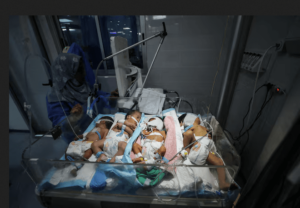
Al-Helou hospital faces fuel crisis. In Gaza City Palestinian newborns share an incubator at Al-Helou hospital due to a fuel crisis, according to medics, amid the Israeli military offensive, in Gaza City, July 10. REUTERS
“She was only getting treatment in a medical facility. Why did they kill them?” she said, with other bodies laid out around her at a nearby hospital.
Israel’s military said it had struck a militant who took part in the Hamas-led October 7, 2023, attack that triggered the war. It said it was aware of reports regarding a number of injured bystanders and that the incident was under review.
The Deir al-Balah missile strike came as Israeli and Hamas negotiators hold talks with mediators in Qatar over a proposed 60-day ceasefire and hostage release deal aimed at building agreement on a lasting truce.
A senior Israeli official said on Wednesday that an agreement was not likely to be secured for another one or two weeks, however U.S. Secretary of State Marco Rubio said on Thursday he was hopeful of a deal.
“I think we’re closer, and I think perhaps we’re closer than we’ve been in quite a while,” Rubio told reporters at the ASEAN summit in Malaysia.
Several rounds of indirect talks between Israel and Hamas have failed to produce a breakthrough since the Israeli military resumed its campaign in March following a previous ceasefire.
Repeated attacks by Israeli forces in recent weeks have killed hundreds of Gazans, many of them civilians, and injured thousands, according to local health authorities, putting an enormous strain on the enclave’s few remaining hospitals.
Dwindling fuel supplies risk further disruption in the semi-functioning hospitals, including to incubators at the neonatal unit of al-Shifa hospital in Gaza City, doctors there said.
“We are forced to place four, five or sometimes three premature babies in one incubator,” said Dr Mohammed Abu Selmia, the hospital director, adding that premature babies were now in a critical condition.


Leave a Reply