



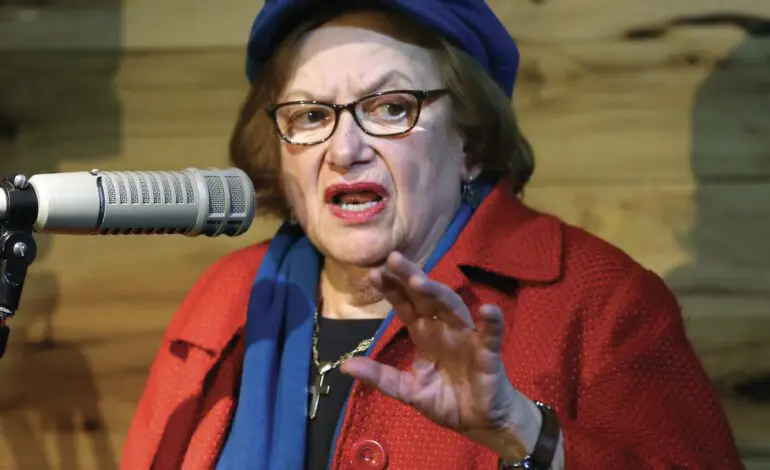

Passing of a political pioneer
At the age of 85, veteran political and civil rights leader Mary Rose Oakar passed away on Saturday, September 13, in Cleveland, Ohio. In honor of her extraordinary public service, Ohio Governor Mike DeWine ordered flags lowered to half-staff at all state government buildings on the day of her funeral, scheduled for September 20.
Born in 1940 to parents of Syrian and Lebanese descent, Oakar became the first Arab American woman elected to the U.S. House of Representatives, where she represented Ohio for eight consecutive terms between 1977 and 1993. Throughout her tenure in Congress, she was distinguished by her strong advocacy for women’s economic and health rights.
Leading the Arab American civil rights struggle
From 2003 until 2010, Oakar served as president of the American-Arab Anti-Discrimination Committee (ADC). She led the organization during a particularly sensitive period following the September 11 attacks, when Arab Americans faced unprecedented waves of discrimination and government surveillance.
Under her leadership, the ADC concentrated on protecting the civil rights of Arab Americans, building alliances with civil rights groups and providing legal support to victims of discrimination. She worked to raise awareness of federal anti-discrimination laws, advance legislative initiatives and strengthen civil society coalitions to safeguard Arab American communities across the United States.
Legislative legacy in the Congress
Oakar’s legacy in Congress was marked by relentless efforts to institutionalize equality. She was a co-founder of the Congressional Women’s Caucus and she consistently championed the rights of senior citizens through her service on the House Select Committee on Aging.
She introduced and supported numerous pieces of legislation to protect the elderly from abuse and expand their access to care services. In recognition of her leadership, President Clinton appointed her in 1995 to the Advisory Council of the White House Conference on Aging.
Alongside her legislative work, Oakar rose within the Democratic Party, serving as vice chair of the House Democratic Caucus from 1985 to 1989 — making her one of the very few women in leadership positions within the party at the time.
From working-class roots to public office
Oakar was born into a working-class family in Cleveland and grew up in a diverse urban setting that profoundly shaped her political and social outlook. To pay for her education, she worked as a telephone operator.
She graduated with a bachelor’s degree in education from Ursuline College in 1962 and earned a master’s in education from John Carroll University in 1966. She also studied drama at the Royal Academy of Dramatic Art in London and pursued broader studies in the humanities and education at Columbia University.
The “Model T” campaign
In 1976, Oakar launched her groundbreaking campaign for Congress. Her campaign featured a flower-adorned Model T Ford, and she distributed pens shaped like roses to remind voters of her name.
“We would drive around the cities in that car and people would come out to see it,” she later recalled. “That gave me the chance to meet them.”
She won her seat and went on to serve in Congress until 1992, when she lost to Republican Martin Hoke.
Continued public service in Ohio
After leaving Congress, Oakar remained active in state politics. She served in the Ohio House of Representatives from 2001 to 2003 and later on the Ohio State Board of Education from 2012 to 2016.
She was deeply committed to advancing Cleveland’s prominence locally and nationally. Among her efforts were:
-
Advocating for the establishment of the Rock and Roll Hall of Fame in Cleveland to boost tourism and celebrate musical culture.
-
Supporting affordable housing initiatives for senior citizens.
-
Promoting the protection of Lake Erie.
-
Championing NASA Glenn Research Center projects in Cleveland.
A personal legacy of humility and strength
Beyond her public achievements, Oakar was known for her humility, warmth and ability to connect with people. She demonstrated resilience in the face of political and health challenges and remained actively engaged with her community until her final days.



Leave a Reply