



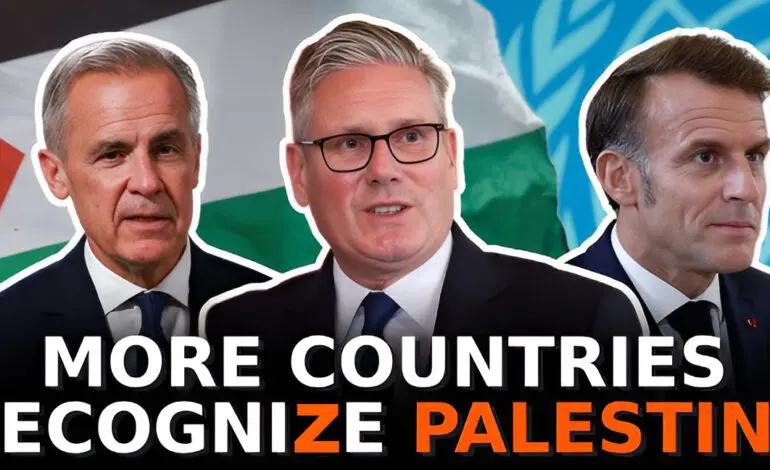

While Netanyahu heads to Washington amid intensifying Israeli offensives in Gaza, Trump unveils elements of a U.S. plan to halt the war, block West Bank annexation and reshape the regional landscape. Europe’s symbolic recognitions of Palestine and a sweeping U.N. declaration raise new political fault lines.
WASHINGTON — President Trump dismissed the wave of European and other Western countries’ recognition of the State of Palestine at the United Nations General Assembly as “just talk”, even as he promised to end the Gaza war “soon” and prevent Israel from annexing the West Bank.
Trump’s remarks reflected a rare rebuke of Israel’s far-right government while also doubling down on Washington’s role as chief broker of a postwar settlement. The comments came as Israeli Prime Minister Benjamin Netanyahu prepared for a highly anticipated meeting at the White House this coming Monday.
A 21-point U.S. plan for Gaza
Reports leaked by Axios revealed a 21-point U.S. proposal designed to bring an end to the nearly two-year conflict in Gaza. Key elements include:
-
Release of all hostages held in Gaza.
-
A permanent ceasefire and cessation of Israeli military operations.
-
Gradual Israeli troop withdrawal from Gaza.
-
Exclusion of Hamas from any governing role in the Strip.
-
Formation of an Arab-led security force to handle security.
-
Arab funding for a new administrative authority to govern Gaza and oversee reconstruction.
-
Only limited participation from the Palestinian Authority.
“I will not allow Israel to annex the West Bank,” Trump told reporters in the Oval Office. “I will not allow it. It’s not going to happen. That’s enough. It’s time to stop now.”
“We are close to reaching some kind of agreement on Gaza,” Trump added during his meeting with Turkish President Recep Tayyip Erdoğan. “Many people are dying, but we want the hostages returned.”
Hamas seeks direct U.S. intervention
In an unusual move, Hamas sent Trump a personal message urging U.S. intervention to secure a 60-day truce in exchange for releasing half of the Israeli hostages. The letter underscores the increasingly direct role Washington is being asked to play amid intensifying humanitarian and political crises.
European recognition of Palestine Shakes Israel
A wave of conditional recognitions of a Palestinian state came from France, Britain, Canada, Australia, Belgium and Luxembourg. France, however, tied full recognition to the release of Israeli hostages before opening a Palestinian embassy.
Analysts stressed the move was largely symbolic — a way to absorb public anger and pressure in Europe, where mass protests have swelled against Israel’s ongoing war. Since October 2023, more than 66,000 Palestinians have been killed and 168,000 wounded in Gaza.
At a major New York conference, 142 U.N. member states endorsed the “New York Declaration”, reaffirming support for a two-state solution and charting an “irreversible path” toward Palestinian statehood. The declaration demanded an immediate Gaza ceasefire but also called for the disarmament of Hamas and its replacement by an internationally-backed Palestinian authority.
Israel rejected the recognitions outright. Netanyahu’s government labeled them a “reward for terrorism.” Far-right ministers Itamar Ben-Gvir and Bezalel Smotrich openly called for Israel to annex the West Bank in retaliation. Netanyahu himself vowed to continue expanding settlements.
“I have resisted international pressure for years by strengthening our presence in the land of Israel,” he said.
Escalating the brutal Israeli war on Gaza
On the ground, Israel pushed ahead with the second phase of “Operation Gideon Chariots 2.” Military officials announced that divisions 162, 98 and 36 had completed storming Gaza City and were engaged in fierce urban combat.
Israeli media reported thousands of additional infantry, armored and engineering units entered Gaza last week, aiming to speed up the takeover of the city despite ongoing strong resistance.
Before leaving for Washington, Netanyahu met with Defense Minister Israel Katz, Chief of Staff Eyal Zamir and top commanders. They reinforced plans to add more brigades during the Jewish holidays.
“We are fighting for victory over our enemies, to dismantle the Iranian axis,” Netanyahu declared. “The new Hebrew year will be historic for Israel’s security.”
Meanwhile, Israel’s Foreign Ministry vowed to block the “Global Freedom Flotilla” of aid ships sailing from Spain and Italy. Organizers condemned Israel’s threats, insisting their mission is legal under international law and aimed solely at delivering humanitarian aid.
Spain and Italy have sent naval ships into the Mediterranean Sea, charged with protecting the Global Sumud Flotilla (GSF), which is carrying aid towards Gaza.
On Thursday, Italy said that it is sending a second ship, while Spain said its navy will also act. Rome dispatched a frigate the previous day following a drone attack on the GSF in international waters after it came under drone attack en route to Gaza to deliver aid.
“We have sent one ship and another is on its way, ready for any eventuality,” Defense Minister Guido Crosetto said in a speech to the lower house of parliament.
Spanish Prime Minister Pedro Sanchez said on Wednesday that his country’s navy will join Italy in sending warships.
Gaza’s Health Ministry warned that the healthcare system was “breathing its last” under relentless attacks on hospitals and clinics.
Syria: Transitional president seeks legitimacy
In a stunning development, Ahmad al-Sharaa, Syria’s transitional president, became the first Syrian leader in nearly 60 years to address the U.N. General Assembly. His attendance was made possible by a U.S.-sponsored waiver at the Security Council, part of efforts to legitimize a potential security agreement with Israel.
Al-Sharaa pledged to rebuild a Syria “destroyed by Assad”, promising accountability for all war criminals “no matter their position.” He acknowledged Israel’s 1,000 airstrikes and 400 incursions into Syria since he took power, but said Damascus sought calm, adherence to the 1974 disengagement agreement and possible negotiations over the Golan Heights.
U.S. officials, however, told Israel Hayom that major gaps remain — especially concerning Israel’s control of Mount Hermon and the Golan, and security guarantees for Druze communities allied with Israel.
In Sweida, Druze factions recently united under the “National Guard”, pledging allegiance to Sheikh Hikmat al-Hijri and rejecting a U.S.-Jordan-Syria roadmap for the region.
Yemen: Hypersonic strikes on Israel
Yemen’s Ansarallah (Houthis) intensified attacks on Israel with drones and “Palestine-2” hypersonic missiles. A drone struck near the HaYam Mall in Eilat, wounding civilians. Israeli media showed footage of the UAV flying low before exploding.
Israel responded with airstrikes on Sana’a, targeting the Dhahban power station and a residential area, killing two and injuring 48. Yemen retaliated swiftly with a multi-warhead Palestine-2 missile that hit Tel Aviv, forcing a shutdown at Ben Gurion Airport.
Ansarallah spokesperson Yahya Saree confirmed the strikes, while leader Sayyed Abdul-Malik al-Houthi vowed continued escalation in solidarity with Gaza. He accused the U.S. of providing Israel full political and military cover.
Al-Houthi also condemned Israeli massacres in Bint Jbeil (Lebanon) and cross-border attacks on civilian villages, criticizing Lebanon’s government as “weak and submissive.”

Lebanon: “The army will never be Israel’s border guard”
In Beirut, a giant image of Sayyed Hassan Nasrallah and Sayyed Hashem Safieddine was projected onto the iconic Raouche Rock, drawing political controversy.
Parliament Speaker Nabih Berri forcefully rejected U.S. envoy Tom Barrack’s call for Lebanon to disarm Hezbollah.
“The Lebanese Army will never be Israel’s border guard, and its weapons are sacred for defending Lebanon,” Berri declared.
Marking one year since Israel’s war on Lebanon, Berri reaffirmed Lebanon’s commitment to the November 27 ceasefire, even as Israel continues repeated violations.
Israeli strikes last week killed five people, including three children, in Bint Jbeil. President Joseph Aoun, attending U.N. sessions in New York, condemned the attack.
“While we are here discussing peace and human rights, Israel persists in violating international resolutions and escalating aggression.”
Leave a Reply