



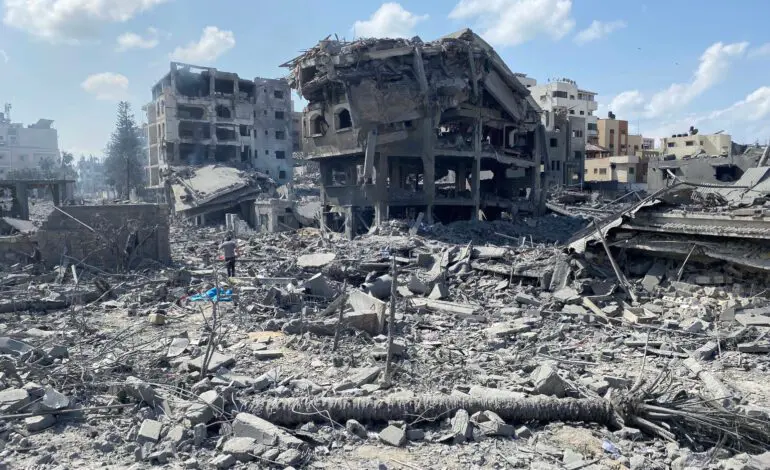

The Gaza war has become more than a humanitarian disaster — it has become a lens through which we see the truth about power, leadership and representation. For Muslims around the world, it has been a moment to face difficult questions about who governs in our name, whose interests they serve and whether they share the moral convictions of the people they claim to lead.
The contrast between people’s moral clarity and their rulers’ political caution has never been more glaring.
As Gaza burned, ordinary people across the Muslim world responded with compassion and solidarity. From Jakarta to Amman, Istanbul to Rabat, crowds filled streets, waved Palestinian flags and demanded an end to the violence. These demonstrations were not orchestrated; they were born of shared humanity and conscience. But while citizens acted with urgency and moral clarity, governments often stayed silent, offered cautious statements, or spoke in vague language about “concern” and “restraint.” That silence raised a painful but essential question: Do our governments truly speak for us — or only for themselves and the Western powers that sustain them?
For years, we have been told that international politics is complicated, that diplomacy requires patience and that maintaining alliances sometimes requires compromise. But Gaza has shown the human cost of compromise. It has revealed that some rulers act not out of principle or the will of their people, but out of fear — fear of losing favor with Western governments, fear of economic pressure, fear of citizens demanding accountability.
The contrast between ordinary people and their rulers has never been clearer. On the streets, one could see raw emotion, empathy and moral clarity. In government offices, one often saw caution, calculation and carefully worded statements. This lens shows us a persistent gap: the people’s moral clarity versus the rulers’ political convenience.
This is not just about Palestine. Gaza reflects deeper issues across the Muslim world: leaders who claim to represent citizens but make decisions to protect power and foreign relationships. The war is a stark reminder that liberation abroad cannot be separated from accountability at home. We cannot demand justice for others if we tolerate injustice in our own societies.
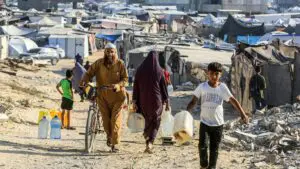
The world fails its international obligations in Gaza, as famine and starvation spreads in the strip – File photo
Liberation abroad begins with accountability at home, without it, solidarity becomes a slogan, not a principle.
Recent developments in Gaza have only sharpened this lesson. A U.S.-brokered ceasefire is now in place. Israel has released nearly 2,000 Palestinian prisoners, and Hamas has freed about 20 Israeli hostages. Hamas is working to restore order, while international actors pledge aid for reconstruction. But beneath these announcements lies a more difficult truth: the war revealed how fragile authority can be when it is not rooted in the trust and support of the people it claims to serve.
Citizens have seen firsthand the difference between real accountability and performative gestures. Many governments issued statements or participated in diplomatic maneuvers, but for ordinary people, these actions often felt hollow. Gaza showed that many governments serve the interests of power, not the people. Public statements may appease international allies, but they cannot replace moral responsibility to the citizens whose voices are ignored.
Yet in the midst of tragedy, there is hope. Ordinary people have seen clearly what leadership grounded in justice and conscience looks like. They have realized that change cannot be left solely to rulers. It requires citizens to insist on accountability, transparency and fairness. When leaders fail to act morally, it is up to the people to demand better. Gaza has shown that empathy and moral outrage are not enough on their own; they must be paired with action.
The reconstruction of Gaza will be a test of this principle. International aid and political support are necessary, but reconstruction will only succeed if it responds to the needs of the people, not just the interests of governments or foreign donors. Local voices must guide the rebuilding process. Otherwise, the same power dynamics that fueled the war will persist, and the lessons of Gaza will be lost.
The lens of Gaza has also revealed the limits of traditional diplomacy in the region. Governments may compete to host summits, broker deals or claim credit for ending conflict, but these actions often mask the moral failures that caused public outrage in the first place. Citizens now watch carefully, no longer trusting polished rhetoric or staged diplomacy. They have learned to separate the language of power from the demands of justice.
Empathy without accountability is powerless, and leadership without legitimacy is destined to crumble.
Gaza’s story is not just about borders, occupation or hostilities — it is about dignity, representation and moral courage. It is about whether we, as citizens, are willing to demand that our leaders act in accordance with our values rather than the convenience of powerful allies. The war has forced us to see the truth: empathy without accountability is powerless, and leadership without legitimacy is fragile.
The lens is harsh, but it is clear. We have seen the reflection of our leaders and the gap between them and the people. Now we must decide: will we act on what we see, or will we turn away and let the cycle continue? Gaza shows us the truth, and that truth cannot be ignored.
Every protest, every act of solidarity, every cry for justice is a reminder that moral clarity exists beyond the walls of government offices. Leaders who fail to respond to this moral clarity may maintain power for a time, but the people’s conscience cannot be silenced. Gaza teaches that accountability begins at home, and that the struggle for justice abroad is inseparable from the struggle for justice within our own societies.
We have looked through this lens. We have seen what it reveals. The question now is whether we will use that clarity to demand a better, more accountable world — or whether we will forget the lessons once the headlines fade.
Gaza has given us both a tragedy and a lesson. It has shown us suffering, but also moral courage. It has exposed failure, but also the possibility of action. And above all, it has reminded us that empathy is not enough without accountability, and solidarity is not complete without justice.
– Jamal I. Bittar is a university professor and opinion writer focused on Middle East politics and U.S. foreign policy. He is based in Toledo, Ohio. The views expressed are solely his own and do not represent those of any institution with which he is affiliated.



Leave a Reply