



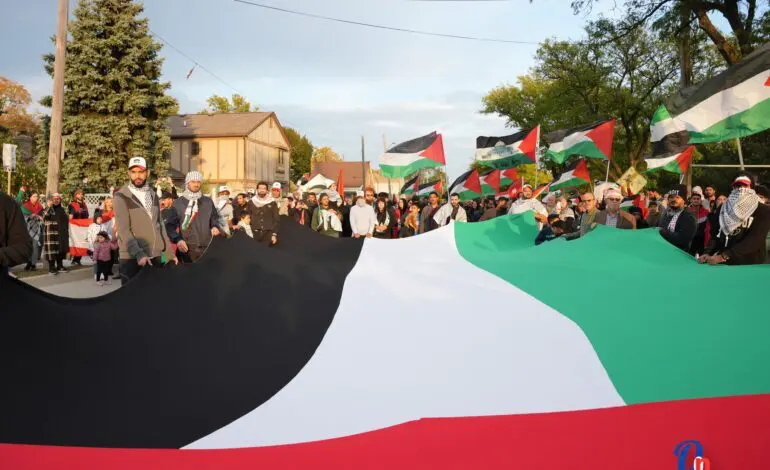

DEARBORN — “Cautious optimism and distrust of Israel and the Trump administration” best describe the mood among Arab and Muslim communities in Metro Detroit following the announcement of the Gaza ceasefire agreement, which began its first phase on October 9 with the release of Israeli hostages — four days before it was formally signed at the Sharm el-Sheikh Summit by President Trump, Egyptian President Abdel Fattah el-Sisi, Qatari Emir Sheikh Tamim bin Hamad Al Thani and Turkish President Recep Tayyip Erdoğan, in the presence of U.N. Secretary-General António Guterres and representatives from more than 20 countries.
The agreement supposedly aims to secure a comprehensive ceasefire, pave the way for reconstruction in Gaza and alleviate the suffering of civilians in the Strip.
Commonly referred to as the “Trump Peace Plan for Gaza”, the deal calls for an immediate halt to hostilities between Israel and Hamas, release of prisoners and hostages, safe humanitarian corridors, a phased Israeli withdrawal, the deployment of an international monitoring force, the voluntary disarmament of Hamas and the reconstruction of Gaza, with an emphasis on protecting civilians and resolving future conflicts through diplomacy.
Osama Siblani: “A murky deal that whitewashes Israeli war crimes”
Osama Siblani, publisher of The Arab American News and president of the Arab American Political Action Committee (AAPAC), described the agreement as “vague and morally distorted”, accusing it of being designed to “pull Israel out of its historical and moral quagmire” after nearly two years of genocide that killed more than 70,000 Palestinians, injured 180,000 and displaced more than 2.2 million, either fully or partially.
Siblani expressed deep disappointment in the failure of international diplomacy, including that of the United States, to stop what he called Israel’s “barbaric war on Gaza”, despite unprecedented global protests and student solidarity with Palestinian rights all over the country.
“Israel has a long record of violating treaties,” he said. “It will not honor this one, either — a deal that equates the victim with the executioner and seeks, in part, to absolve Israeli Prime Minister Benjamin Netanyahu of his crimes against Palestinians, Lebanese, Yemenis, Iranian and Syrians.
“Israel signed a U.S.-brokered ceasefire with Lebanon in December 2024, yet it continues its daily attacks on civilians in the south, in the Bekaa and elsewhere in the capital. Is that the peace President Trump envisions for Gaza, which has been turned into a mound of rubble and despair? Where are the rights of the victims? Is this the peace we were promised?”
Siblani also criticized Trump’s call in the Israeli Knesset to pardon Netanyahu, who has faced criminal indictments in Israel since 2019.
“What about Netanyahu’s crimes against Palestinians?” he asked. “What about the tens of thousands of children, women and innocent civilians killed? Are their lives worthless?”
Imad Hamad: “Netanyahu is a war criminal — Israel never keeps its word”
Imad Hamad, executive director of the American Human Rights Council (AHRC), warned against “placing trust in war criminal Benjamin Netanyahu”, whom he accused of repeatedly violating peace accords with Lebanon and Syria.
“Our optimism is minimal,” Hamad said, “but the most important thing right now is that the killing stops — that the suffering of Gaza’s civilians finally eases after two years of horror during which the world failed to protect them, even near U.N. aid centers.”
A Palestinian American himself, Hamad also warned that Israel is expanding its illegal settlements in the West Bank even as it negotiates peace over Gaza.
“This ceasefire may allow Israel to refocus its aggression inside and outside Palestine,” he said, adding that he doubts Israel will engage in any genuine peace process.
While acknowledging that Trump “succeeded in forcing Israel to stop the war”, Hamad voiced skepticism about the U.S. president’s intentions.
“Trump and Netanyahu are mirror images, both erratic, both driven by self-interest,” he said. “Trump wants a Nobel Peace Prize; Netanyahu wants a biblical ‘Greater Israel.’ We want to believe this is a real chance for peace, but we’re not sure it will happen in our lifetime.”
Dr. Nidal Jboor: “This is not peace — It’s a new colonialism”
Dr. Nidal Jboor, president of the international medical NGO Doctors Against Genocide, condemned the deal as a “form of modern colonialism” that imposes “guardianship over Palestinians while denying them self-determination.”
“This so-called peace agreement, involving some Arab states, is a lifeline for Israel,” he said. “It’s a political maneuver to rescue Israel’s image and shield it from international accountability.”
Jboor said Israel had already violated the agreement, citing its reduction of aid trucks entering Gaza from 600 to just 100 per day within the first week.
“They’re ignoring catastrophic conditions that demand massive humanitarian aid immediately,” he said.
He added that Israel continues to block the Rafah crossing, preventing not only aid shipments but also the evacuation of medical emergencies.
“Our organization, along with other humanitarian groups, has identified over 17,000 medical cases in Gaza that require urgent treatment abroad,” Jboor said. “We raised $1 million to build a field hospital at Al-Shifa Medical Complex in Gaza City, but Israel still won’t let us begin construction.”
Despite the obstacles, he acknowledged the relief many Palestinians felt after two years of relentless war.
“It’s good news, no doubt,” he said, “but seeing the scale of devastation in Gaza reminds us that our moral responsibility is long-term — to help the survivors rebuild their lives, homes and health systems.”
Dawud Walid: “No peace without Palestinian self-determination”
Dawud Walid, executive director of the Michigan chapter of the Council on American-Islamic Relations (CAIR–Michigan), expressed hope that “the ceasefire will hold and that Gazans will finally experience safety and dignity.”
However, he criticized the Trump plan for lacking any vision of Palestinian self-determination.
“As Gazans return to the ruins of their homes, they’re given no promise of freedom or sovereignty,” Walid said. “Without self-determination, there can be no lasting peace.”
He stressed that the root cause of violence in the region is the illegal Israeli occupation.
“This occupation fuels extremism,” Walid said. “Until Israel ends its occupation of Palestinian lands, and stops its attacks on Lebanon and Syria — there will be no lasting peace in the Middle East.”
Jewish community reactions: Celebration and caution
In contrast, parts of Michigan’s Jewish community welcomed the ceasefire with joy and relief.
A celebration took place at Temple Shir Shalom in West Bloomfield.
“We’ve prayed, hoped, dreamed this would one day happen,” said Rabbi Mike Moskowitz before the ceremony, which wasn’t open to the public. “Part of us couldn’t believe it would happen; we were afraid it might never actually happen.”
The Anti-Defamation League of Michigan (ADL) also issued a statement welcoming the agreement.
“Seeing the videos and pictures of the reunification of the hostages with their loved ones is a moment the people of Israel and Jews around the world have been anxiously awaiting for two years,” said Elyssa Schmier, regional director of ADL Michigan, in a statement. “At the same time, we anxiously await the return of the bodies of all the hostages from Gaza and join with the families of those murdered hostages in their grief and sorrow as they prepare to say goodbye to their loved ones.”
Between hope and distrust
For many Arab and Muslim Americans in Metro Detroit, the ceasefire represents both a desperately needed pause in bloodshed and a reminder of Israel’s record of broken promises and violating agreements.
Whether this agreement truly ushers in peace — or merely postpones the next chapter of violence, remains an open question in the eyes of those who have seen Gaza’s agony unfold from afar.


Leave a Reply