



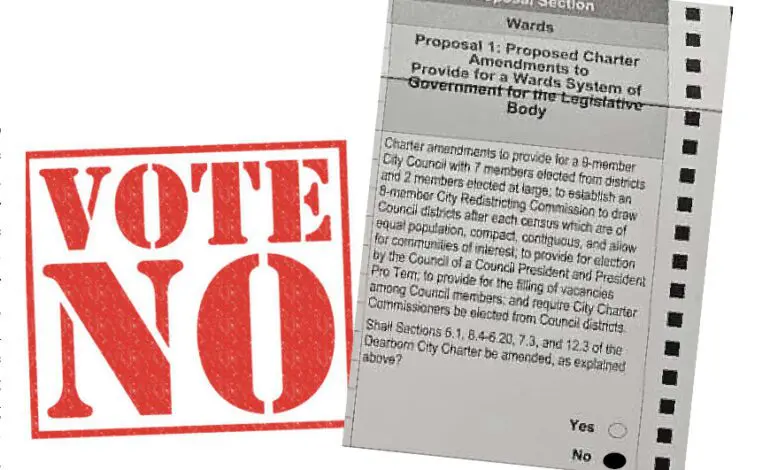

AAPAC warns that Proposal 1 would divide the city and weaken representation
DEARBORN — The Arab American Political Action Committee (AAPAC) has urged voters in Dearborn to vote “No” on the proposal to divide the city into electoral wards in the November 4 election, warning that the measure — which seeks to change the structure and method of electing City Council members — could “fragment the city’s unity, weaken representation and increase financial and bureaucratic burdens.”
Proposal 1, listed on the ballot alongside the mayoral, City Council and clerk races, calls for dividing Dearborn into seven electoral districts and expanding the City Council from seven to nine members starting with the 2029 election. Under the plan, one Council member would be elected from each district, while two others would be elected citywide — similar to the system used in neighboring Detroit.
In its statement, AAPAC, founded in 1998, said it has always worked to ensure fair representation for Arab Americans at all levels of government while promoting unity across local communities and rejecting ethnic, sectarian or religious divisions. The organization said it focuses on public issues that affect all residents equally.
“Let’s keep Dearborn united,” AAPAC’s statement read. “Let’s maintain the current at-large council election system so the City Council continues to serve all residents without distinction. We urge Dearborn voters to vote ‘No’ on Proposal 1 — passing it in November will harm Dearborn’s unity and the effectiveness of its government.”
Concerns about representation and costs
According to official estimates, Dearborn has a population of roughly 110,000 residents according to the 2020 U.S. Census, with an area of 24 square kilometers, meaning each of the proposed seven districts would have around 15,700 residents. AAPAC warned that this would make the redistricting process highly complex, requiring neighborhoods to be combined in ways that may not serve the declared purpose of the division of the city by the organizers. For example, the city’s South End would need to be merged with other areas to form a district, since the process is based on population rather than geography.
If adopted, the new system would take effect in 2029, with district boundaries redrawn every 10 years following the U.S. Census, the next of which will be held in 2030.
AAPAC’s statement also noted that Proposal 1 would transfer some powers from voters to politicians by allowing Council members to select their own Council president, instead of the current system in which the position automatically goes to the candidate with the highest number of votes citywide.
The committee further warned that implementing the proposed charter changes would cost hundreds of thousands of dollars, including the creation of a special redistricting commission.
Reasons for opposition
AAPAC listed several reasons why it believes the proposed ward system is “unsuitable for Dearborn”:
-
City division: The system would create divisions among neighborhoods, pushing Council members to focus on their own districts rather than the city as a whole.
-
Reduced representation and accountability: Currently, all seven Council members are elected by — and accountable to — all city voters. Under the proposed system, each voter would elect only three of nine members (their district representative and two citywide members), reducing overall accountability.
-
Creation of mini-cities: Each ward would include around 15,200 residents — about 3,000 more than the entire population of neighboring Melvindale — effectively turning Dearborn into seven smaller “cities within a city.” The proposal also does not guarantee that a district’s representative must live in that neighborhood.
-
Limited citywide knowledge: The at-large system encourages Council members to understand and address issues across the entire city. A ward system, AAPAC warned, would narrow their focus and reduce knowledge of citywide challenges.
-
Higher costs and bureaucracy: The new system would bring major expenses — including the creation of a redistricting commission every decade, hiring new staff, building additional Council offices, paying two more Council salaries and printing separate ballots for each ward.
A call to preserve unity
AAPAC urged residents to seek accurate information before voting, emphasizing that Dearborn’s progress and representative fairness should not be undermined by divisive changes.
“Dearborn is a unified city where people of diverse backgrounds share common aspirations for their families and their future,” the committee concluded. “Let’s protect that unity — and vote a big ‘No’ on Proposal 1 this November.”



Leave a Reply