



Three young Arab Americans charged with terrorism-related offenses after alleged ISIS-inspired Halloween plot; community leaders decry “reckless hysteria” and “Islamophobic targeting”
DEARBORN — Three young Arab Americans, aged between 19 and 20, are facing terrorism-related charges after being arrested by the Federal Bureau of Investigation (FBI) at two separate homes in Dearborn on the morning of Friday, October 31, allegedly for planning an ISIS-inspired terrorist attack targeting gay and transgender bars in Ferndale during Halloween.
Federal raids and FBI announcement
In an atmosphere of secrecy and confusion, federal agents launched coordinated predawn raids targeting two homes on Horger Street and Middlepointe Street in east Dearborn, as well as a storage unit in Inkster. Within hours, FBI Director Kash Patel posted on the social-media platform X, announcing that the agency had thwarted a potential Halloween-night terrorist attack.
His brief statement ignited intense media attention and local concern, particularly since the raids followed weeks of incitement and negative portrayals of the majority-Arab and Muslim city of Dearborn.
Confusion persisted for three days, as rumors spread about the arrest of a “terror cell.” The picture began to clear when only two defendants appeared before a federal court in Detroit: Mohmed Ali and Majed Mahmoud, both 20-years-old. Three others were interrogated but not charged initially.
On Wednesday, federal prosecutors expanded the indictment to include a third Dearborn resident, Ayob Ismail Nasser, 19, the younger brother of Mohmed Ali. Both were arrested at the family’s home on Horger Street. The updated indictment also revealed another alleged target — the Cedar Point amusement park in Sandusky, Ohio.
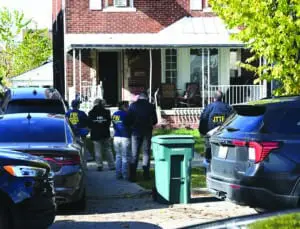
Federal agents search a house on Horger Street in East Dearborn on the eve of Halloween.
Federal charges and defense responses
The three defendants were charged with conspiracy to provide material support to a terrorist organization and possession of firearms that could be used in a terrorist act.
The first charge carries up to 20 years in federal prison, the second up to 15 years.
Defense attorney Hussein Bazzi, representing Nasser, “categorically denied” any involvement by his client.
In a statement to the Detroit News, Bazzi said there was “no credible evidence that any attack was planned, discussed or even intended”, stressing that “there was no such conspiracy.” He criticized statements made by the FBI director and senior officials as “reckless and irresponsible, and not based on evidence”, adding that “Washington pressure may have been the decisive factor in filing charges.”
According to federal prosecutors, the suspects had obtained weapons and ammunition, trained at firing ranges and searched for LGBTQ bars and nightclubs in Detroit suburbs during September for a possible Halloween attack. The 72-page criminal complaint claims they were inspired by the so-called Islamic State (ISIS), a charge the defense strongly denies.
Federal investigators said they relied on months of surveillance, including a camera mounted on a pole outside a Dearborn home, interception of encrypted messages and analysis of social-media posts.
John Miller, CNN’s chief intelligence analyst, reported that an undercover FBI agent had entered an encrypted chatroom months earlier after suspecting that some participants were in the U.S. and others abroad, potentially linked to ISIS.
The Detroit Free Press reported that the FBI’s surveillance of Ali, Mahmoud and a third juvenile suspect began nearly a year ago and intensified after a group call recorded by an informant in July.
Authorities claim Mahmoud recently purchased more than 1,600 rounds of ammunition for AR-15-style rifles, that the men practiced reloading quickly and that their repeated references to “Pumpkin Day” led agents to believe an attack was planned for Halloween weekend.
Prosecutors also allege that a juvenile active in the chats consulted a “local extremist cleric” about when to perform a “righteous act”, though his identity was not disclosed.
Nasser is accused of scouting possible targets in Ferndale and across the Midwest, using encrypted apps to share ISIS-related material. Surveillance footage allegedly shows him visiting Cedar Point on September 18–19, arriving six hours before the park opened.
When his home was searched on Halloween morning, investigators found a computer that had been used to check whether the park would be crowded that weekend.
Statements from U.S. officials and defense
U.S. Attorney General Pam Bondi said the suspects had a “detailed plan to launch an attack on U.S. soil”, adding on X, “This plot was thwarted before innocent lives were lost.”
Despite the seizure of tactical vests, backpacks, AR-15 rifles, ammunition, loaded handguns and GoPro cameras, defense attorney Amir Makled — representing Mohmed Ali — rejected any suggestion of a terrorist plot, calling the FBI’s operation “hysteria and fear-mongering.”
Makled told the Associated Press that the young men were American citizens aged 16–20 who were “video-game and recreational firearm enthusiasts” and that the FBI had acted prematurely.
He said the online conversations cited by agents were typical of bragging among gamers.
“If these young men were in forums they shouldn’t have been in, we’ll see,” he said, “but I don’t believe any of their activity was illegal.”
He emphasized that all weapons were legally purchased and that the case involved “a small group of young men interested in recreational firearms, not a terrorist cell.”
Makled also expressed concern about the rise in anti-Arab and anti-Muslim rhetoric in Michigan, particularly in Dearborn, following the FBI announcement. Speaking to CNN, he said he was “confident that when the facts are objectively reviewed, it will be clear there was no plan for a mass attack or coordinated conspiracy of any kind.”
Local reaction and civil rights concerns
The surprise raids and Patel’s statement sparked deep anxiety in the Dearborn community, where many doubted the official narrative and viewed the FBI operation as part of a broader pattern of federal targeting of Arab and Muslim Americans.
Nasser Beydoun, president of the Arab American Civil Rights League (ACRL), said the government appeared to be “depicting the situation in the worst possible light.”
“Until the defendants are convicted, we presume them innocent,” he said. “Dearborn is a safe, welcoming and diverse community, but these sensational headlines have a direct and damaging impact on our city.”
Beydoun expressed concern that “the racism against Arabs and Islamophobia we’ve faced since September 11, 2001 — and again after October 7, 2023 — may never end.”
“Look at the national media and what they’re doing to Dearborn — the attacks, the lies,” he said. “Anything like this fuels hatred of Muslims and paints Dearborn as if it were some kind of Islamic-law capital.”
Nabih Ayad, civil rights attorney and founder of the ACRL, criticized the sensational media coverage of the FBI’s operation.
“As soon as someone says ‘Dearborn’ and ‘terrorism’ it becomes an irresistible story for the media,” he said, adding that Arabs and Muslims in Dearborn “have earned the right to distrust the government.”
Ayad accused federal authorities of using pre-emptive and entrapment tactics to target Arab and Muslim youth, including through undercover agents and paid informants. He said the government monitors Arab Americans as “pre-suspects” while failing to equally surveil White extremists who have committed real acts of terror.
“How many terrorist attacks has this community ever committed?” He asked rhetorically. “And the answer is ‘zero.’”
Dawud Walid, executive director of the Council on American Islamic Relations (CAIR)–Michigan, said he spoke to numerous community members after the news broke.
“Every comment I heard was, ‘Here we go again — the government is setting up or entrapping young people,’” Walid said, noting the FBI’s long history of using informants and taxpayer money to “manufacture” terror plots.


Leave a Reply