



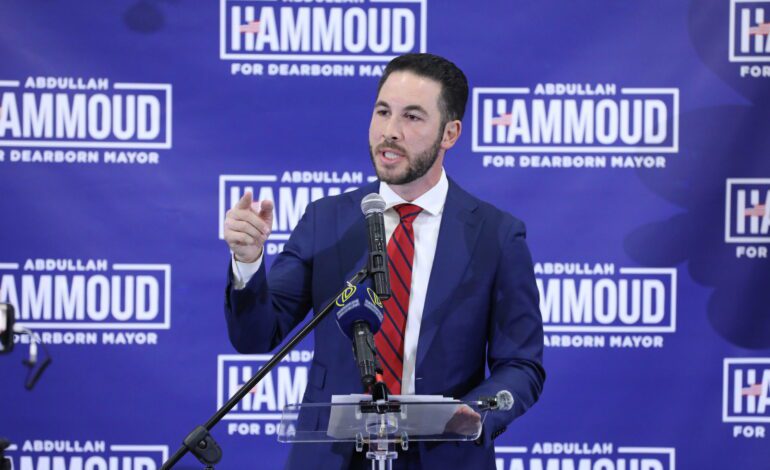

DEARBORN — The Dearborn City Council unanimously approved significant salary increases for the mayor and City Council members at its most recent meeting, acting on recommendations from the city’s special Local Officials Compensation Commission (LOCC).
Under the new pay structure, Mayor Abdullah Hammoud’s base annual salary will increase by 25.7 percent, rising from $168,775 to $212,083 by the beginning of next year. The increase will make him the second-highest-paid mayor in Michigan, behind Detroit Mayor Mike Duggan, whose base salary stands at $224,573 annually. However, the mayor of Detroit resides with his family rent free at the mayor’s official residence, the Manoogian Mansion.
Hammoud was initially set to earn a base salary of $168,775 this year. Under the new plan, his salary will instead increase by 22 percent to $205,906 this year, applied retroactively for all of 2025. In 2026, he will receive an additional 3 percent raise, bringing his base salary to $212,083.
City Council President Michael Sareini will see his base annual salary increase by 18 percent to $23,152 for 2025, retroactive for the full year, followed by an additional 3 percent raise in 2026, bringing his salary to $23,846.
The remaining members of the seven-seat City Council will also receive an 18 percent raise for all of this year, increasing their base salaries to $19,273, followed by a 3 percent increase in 2026 to $19,851 annually. Council members will continue to receive $100 per meeting, with the annual cap raised from 80 to 85 meetings, allowing for a maximum of $8,500 per year. Health benefits for elected officials will remain unchanged.
The raises also apply to City Clerk George Darany, whose base salary will increase by nearly 20 percent to $124,115 annually.
Transparency questions raised by an often critic journalist
In a report published by the Detroit Free Press, writer Niraj Warikoo, a regular and consistent critic of Mayor Hammoud and his administration, questioned the transparency of the salary increases, noting that a majority of members of the Elected Officials Compensation Commission were appointed by Hammoud himself, and that some had donated to his re-election campaign last month. This includes the commission’s chair, Karl Fava, who was originally appointed by former Mayor Jack O’Reilly, Jr.
Warikoo also pointed out that the commission did not submit its recommendations until after the election had concluded. He noted that the mayor’s salary became a contentious campaign issue after challenger Nagi Almudhegi highlighted that Hammoud’s pay exceeded that of Gov. Whitmer.
He further referenced meetings held in October between Hammoud, City Council members and Compensation Commission members, suggesting possible influence over the commission’s decision.
Warikoo also cited concerns from some residents regarding the salary increases in light of recent cuts to retiree health care benefits, while noting that similar objections were raised in 1999, when late Mayor Michael Guido received a 37 percent pay raise.
The commission, which consists of eight members and meets every two years under the Michigan Constitution to review elected officials’ salaries, stated in its recommendation that the mayor’s and other officials’ salaries were “not competitive compared to similar cities and require adjustment.” Warikoo countered this by citing mayoral salaries in comparable municipalities, including Warren ($125,642), Canton ($150,000) and Livonia ($144,954), noting that Hammoud’s salary will be slightly below that of Wayne County Executive Warren Evans, who is set to earn $230,000 in 2026.
City defends raises as legal and justified
In response, Dearborn city spokesperson Hassan Abbas said Hammoud had no role in the decision to increase the salaries.
“Mayor Hammoud neither requested nor supported an increase in his annual compensation package,” Abbas said, explaining that the compensation commission “meets every two years under state law to review compensation packages for elected officials and then submits its recommendations to the City Council for a vote.”
Abbas added that the commission, “recommended adjusting the current mayor’s compensation to match that of the previous mayor and to align with salaries of executive officials in comparable entities.”
Dearborn operates under a strong mayor system, meaning the mayor’s position is a full-time role, unlike in cities such as Sterling Heights, Ann Arbor and Hamtramck, where mayoral duties are part-time or largely ceremonial.
City Council Pro Tem Leslie Herrick also defended the increases, saying elected officials in Dearborn are paid less than their counterparts in other cities.
“This is work we do out of love,” said Herrick, who will leave the Council at the end of the year. “For most of us, we run for office because we believe we can make a difference in our city, or because we can listen to others and help them in their lives in Dearborn.”
Herrick praised the compensation commission’s efforts, noting that its members “conducted numerous interviews and found that salaries for elected officials in Dearborn are well below the state average, and in many cases below the national average.”
In addition to Fava, the members of the LOCC listed on the city website are Hassan Bazzi, Nadia Berry, Patrick J. D’Ambrosio (who’s also a Dearborn schools board member), Sandra K. Daniels, Kalid (Mike) Kaid, David Norwood and Maha Zriek Sabbagh. A majority were appointed by Hammoud and the others by O’Reilly.


Leave a Reply