



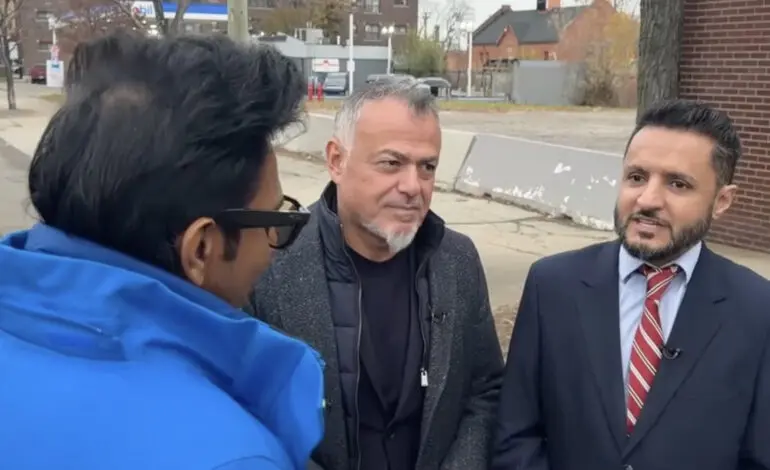

DETROIT, HAMTRAMCK — Hamtramck Mayor-elect Adam Alharbi took another decisive step toward confirming his victory in the November 4 municipal election after a Wayne County Circuit Court judge ruled on Tuesday to reject a request by his opponent, Muhith Mahmood, to count 37 absentee ballots that had been excluded by the county’s Board of Canvassers.
In an effort to keep his challenge alive, Mahmood, who serves on the Hamtramck City Council, quickly appealed the Wayne County ruling to the Michigan Court of Appeals, seeking to overturn the election outcome before Alharbi is sworn into office early next year.
Final certified results show Alharbi winning the mayoral race by 11 votes, a margin Mahmood, a Bangladeshi American candidate, continues to contest, insisting that the rejected ballots should be included.
Court upholds canvassers’ decision
Wayne County Circuit Court Judge Patricia Fresard ruled that the Board of Canvassers acted properly in excluding the 37 absentee ballots, which were discovered inside open envelopes in the office of Hamtramck City Clerk Rana Faraj two days after polls closed.
The four-member Board of Canvassers split along party lines, with two Republican members voting against counting the ballots and two Democratic members voting in favor. The tie resulted in the ballots being excluded from the final tally.
In her ruling on the lawsuit filed by Mahmood on November 24, Fresard said the Board acted within its authority under Michigan election law, noting that “the city clerk failed to comply with mandatory requirements designed to safeguard the integrity of ballots during and after the election.”
Faraj had reported discovering the ballots in her office after staff access had compromised the chain of custody, preventing the ballots from being included in the count. Most of the ballots reportedly came from voters of Bangladeshi descent — a factor that could have flipped the election result in Mahmood’s favor.
During testimony before the Board of Canvassers in mid-November, Faraj — who is suing the city of Hamtramck following her suspension — acknowledged that she could not certify the integrity of the 37 ballots.
Support for the court’s ruling
Following the decision, attorney Nabih Ayad, who represented Alharbi, said there was “no possible way” to allow ballots of questionable integrity to be counted after election deadlines had passed.
“The law is clear that these ballots cannot be counted,” Ayad said, emphasizing that election integrity must outweigh other considerations.
Mahmood’s attorney, Mark Brewer, the former chair of the Michigan Democratic Party, argued that excluding the ballots effectively disenfranchised voters. Ayad countered that election integrity must take precedence.
The larger and more important issue here is the integrity of our election system. — Nabih Ayad
Ayad added that Michigan law explicitly prohibits counting ballots that were not properly secured or that may have been tampered with, warning that doing so would undermine public trust in elections.
Addressing Mahmood’s request to allow the affected voters to cast replacement ballots, Ayad said such a move could open the door to improper influence.
“The judge got it right. Mayor Elect Adam Alharbi will be Hamtramck’s next mayor come January 1.”
Alharbi welcomes Judge Fresard’s ruling
Alharbi welcomed the ruling.
“Today, Wayne County Circuit Court reaffirmed the integrity of our election process by rejecting the counting of 37 undocumented ballots,” he wrote on Facebook.
In a statement posted in Arabic, English, Bengali and Polish, Alharbi, 41, said the decision clears the way to focus on governing.
“With this matter closed, it is time to turn the page and dedicate ourselves to serving our beloved city,” he wrote. “I am ready to begin working in your service and to honor the trust you have placed in me.”
Alharbi stressed that his opposition to counting the ballots was not driven by fear of losing, but by a commitment to safeguarding election integrity.
“If there is a solution, the only path forward is to accept the results as they are,” he told the Detroit News. “We have already gone through four stages: ballot correction, canvassing boards, a hand recount and the courts.”
Election results and background
Initial results showed Alharbi leading Mahmood by 11 votes. After verification of additional ballots, the margin narrowed to six votes, before a hand recount restored the 11-vote lead.
Final certified results show:
-
Adam Alharbi: 2,066 votes (44.6 percent)
-
Muhith Mahmood: 2,060 votes (44.4 percent)
-
Lynn Blasey (write-in): 504 votes (10.8 percent)
Alharbi is expected to succeed outgoing Mayor Amer Ghalib, who endorsed him after declining to seek re-election while pursuing an unsuccessful nomination as U.S. ambassador to Kuwait.
Under Hamtramck’s city charter, the mayor presides over the City Council, while executive authority rests with the city manager. The mayoral role is part-time, with an annual salary of less than $7,000.
Hamtramck has a population of approximately 28,000 residents, the majority of whom are Yemeni and Bangladeshi Muslims.
Mahmood appeals Judge Fresard ruling
Mahmood has appealed Judge Fresard’s ruling, with Brewer arguing that Michigan legal precedent holds voters should not lose their right to vote due to mistakes by election officials.
Brewer urged the Michigan Court of Appeals to expedite the case ahead of Alharbi’s January swearing-in, stating that the 37 ballots could still change the election outcome.
He also dismissed Alharbi’s separate lawsuit challenging Mahmood’s residency eligibility as a “desperate attempt” to block Mahmood from taking office should the results be reversed.
Earlier this year, the city of Hamtramck conducted an investigation concluding that Mahmood may not have met the city charter’s one-year residency requirement for candidates, a finding Alharbi cited in seeking an injunction if the election result were overturned.


Leave a Reply