




By James Allen
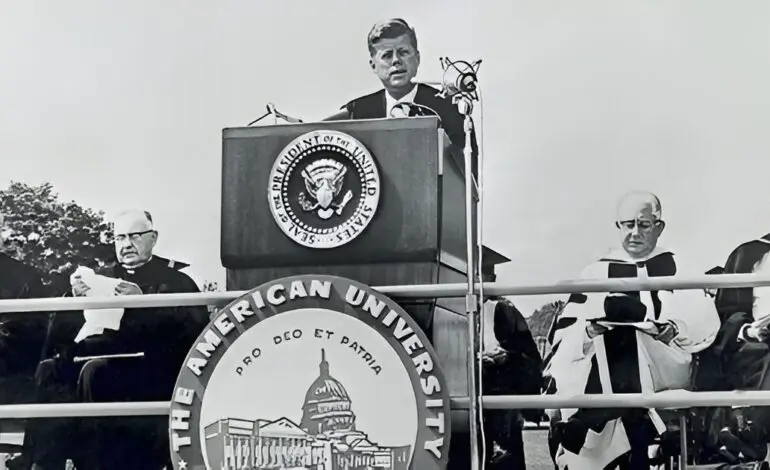
On June 10, 1963, standing at American University, John F. Kennedy said something that now feels almost radical in its simplicity: “We all breathe the same air. We all cherish our children’s future. And we are all mortal.” It was not just rhetoric. It was a direct challenge to a way of thinking about war that had quietly taken hold after World War II, the idea that conflict could be engineered, managed and even profited from by a small ruling class insulated from its consequences.
In the atomic age, the old rules no longer applied. War could no longer be treated as a chessboard maneuver between elites. The margin for error was gone. The costs were universal.
That speech did not emerge in a vacuum. It came after the Cuban Missile Crisis, after the world had stared directly into the abyss of nuclear annihilation and stepped back, barely. Kennedy understood something that many of his advisors did not, or would not acknowledge: That in the atomic age, the old rules no longer applied. War could no longer be treated as a chessboard maneuver between elites. The margin for error was gone. The costs were universal.
Fletcher Prouty, a career military officer and Pentagon insider, would later argue that Kennedy’s speech represented an existential threat, not to America’s enemies, but to a powerful internal apparatus he called “the Secret Team.” Prouty believed that after the atomic bomb, a new worldview took hold among those who managed power: one shaped by Malthusian arithmetic (too many people, too few resources), Darwinian struggle (survival of the strongest systems), technological supremacy and geopolitical control. Nuclear weapons did not end this thinking; they refined it. Total war became unacceptable, but permanent conflict became essential.
Prouty traced this mindset back even further, to Dwight Eisenhower’s failed attempt at détente with the Soviet Union. Eisenhower had planned a peace initiative that would culminate in a summit with Khrushchev. It was sabotaged by the U-2 incident, an American spy plane shot down over the USSR just days before the talks. According to Prouty, the mission was greenlit under circumstances that ensured failure: The pilot, Gary Powers, was allowed to carry identifying materials that standard protocols would normally forbid. The result was predictable. The summit collapsed. The Cold War hardened.
Attorney James Allen
Where Eisenhower was undermined, Kennedy persisted. He reopened the channel. He spoke directly to the Soviet people. And, critically, Khrushchev believed him. That personal credibility, the sense that Kennedy was sincere, played a decisive role during the Cuban Missile Crisis. It may well have saved the world.
Prouty’s claim was stark: When bureaucratic sabotage failed to stop Kennedy’s trajectory, it escalated. The tools changed. The objective did not.
Whether one accepts Prouty’s conclusions in full or in part, what is harder to dismiss is the trajectory itself. Since the early 1960s, decisions about war, surveillance, finance and resource allocation have steadily migrated away from public accountability and into opaque systems insulated from democratic control. The language has softened — national security, rules-based order, deterrence — but the consolidation of power has continued.
Fast forward to today, and something feels different. Accelerated. Unstable.
In just the past few years, institutions that once dismissed public skepticism as paranoia have quietly revised their own narratives. Revelations surrounding elite corruption, intelligence abuses and the manipulation of public perception are no longer fringe topics. Files once sealed are now discussed openly. Behavior once waved off as “conspiracy theory” is acknowledged, if not fully explained.
At the same time, the pace of escalation has quickened. Defense budgets swell to numbers that would have been politically unthinkable a decade ago. Proxy conflicts multiply. Nuclear rhetoric, once carefully avoided, reenters mainstream discussion with alarming casualness. Scenarios that were previously treated as catastrophic failures of policy are now discussed as “manageable risks.”
Has the atomic taboo, the shared understanding that nuclear war is unthinkable, begun to erode among those who believe they can survive it?
It raises an uncomfortable question: Has the ruling class recalculated? Has the atomic taboo, the shared understanding that nuclear war is unthinkable, begun to erode among those who believe they can survive it?
If Prouty was right about anything, it was this: Systems that depend on secrecy panic when exposure looms. And panic produces urgency. Urgency produces risk-taking. When legitimacy is threatened, power tends to double down, not retreat.
That helps explain the vertigo many people feel right now. The sense that events are outrunning explanation. That everything is moving too fast. That what we see on television, the hearings, the speeches, the partisan theatrics, is not where the real decisions are being made. It feels like kabuki theater because, in many ways, it is. The performance continues while the structure behind the stage shifts under stress.
None of this requires belief in a single “cabal” or a cartoon villain. Bureaucratic power doesn’t work that way. It is emergent, self-protective and often amoral rather than immoral. But it does respond to threat. And right now, the threat is visibility.
Kennedy’s American University speech matters because it pointed in the opposite direction. It insisted that survival in the nuclear age required humility, restraint and a willingness to see adversaries as human beings rather than abstractions. It rejected the idea that a small class could permanently set the terms of conflict without consequence.
That is the through line, from 1963 to now.
So the question becomes: What do we do with this moment?
No bunker, balance sheet or border wall changes the basic fact that we all breathe the same air.
First, we resist normalization. We refuse to accept endless war, permanent emergency or trillion-dollar militarization as the natural order of things. Second, we demand transparency, not perfection, not purity, but sunlight. Third, we slow the conversation down. Panic is the ally of consolidation. Deliberation is its enemy.
Most of all, we remember what Kennedy reminded the world: The stakes are shared. No bunker, balance sheet or border wall changes the basic fact that we all breathe the same air.
The ruling class may want to decide the game before the rest of us understand the rules. History suggests that when that happens, the consequences are catastrophic.
The alternative is harder — but it’s the only one that has ever worked.
– James Allen is a local attorney


Leave a Reply