





Among the most significant electoral contests this year, voters in Dearborn and Dearborn Heights will choose their representatives to the Michigan House of Representatives and the Michigan Senate. Party primaries will take place August 4, ahead of the general election on November 3.
The two cities — home to large Arab American communities — are represented by two members in the Michigan House (Districts 3 and 15) and one senator in the Michigan Senate (District 2).
With roughly six months before the primaries, the contours of the three races are taking shape as multiple candidates have entered the field. The filing deadline for Democratic and Republican candidates is April 21, while independent candidates have until July 16 to qualify.
Dearborn and Dearborn Heights traditionally lean Democratic, making the August primary effectively decisive in determining who will represent the two cities in Lansing. Democratic nominees typically win the general election comfortably.
Michigan’s House of Representatives consists of 110 districts, while the Senate comprises 38 districts.
Michigan Senate — District 2
This election cycle, Dearborn and Dearborn Heights voters will elect a new state senator in District 2, whose newly redrawn boundaries now include all of Melvindale and Allen Park, the northern half of Taylor and the heavily Arab American Warrendale neighborhood in Detroit.
Arab American and White voters constitute the two largest voting blocs in the district, currently represented by Democratic State Senator Sylvia Santana, who is term limited.
Under Michigan’s constitutional term limits — amended by voters in 2022 — lawmakers may not serve more than 12 total years in the legislature. By the end of 2026, Santana will have completed two Senate terms (2019–2026) and one House term (2017–2018), totaling 10 years. A third Senate term would exceed the limit.
Her departure has opened the race.
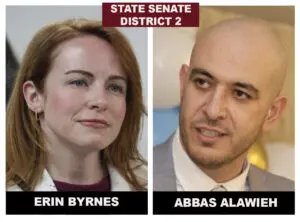
So far, the Democratic field includes Abbas Alawieh, an Arab American activist with strong progressive backing, and State Rep. Erin Byrnes, who represents Michigan House District 15, covering west Dearborn and all of Dearborn Heights except for limited neighborhoods in the far northwest corner of the city.
Byrnes is relying on her longstanding political ties in Dearborn. She chaired the Dearborn Beautification Commission and served on the West Downtown Development Authority before first being elected to the Dearborn City Council in 2017. She was reelected in 2021 but left before completing her term after winning the 2022 race for the Michigan House in District 15. She was reelected to a second House term in 2024.
Alawieh has not previously held elected office but has legislative experience, having worked in the congressional offices of U.S. Reps. Rashida Tlaib, Cori Bush and Andy Levin. He has been active in opposing the Israeli war on Gaza and played a leadership role in the “Uncommitted” movement during the 2024 presidential election cycle.
Alawieh has secured endorsements from prominent local leaders, including Wayne County Executive Warren C. Evans, who joined current and former officials at a February 12 campaign event held at Byblos Banquet Center in Dearborn. He later received the endorsement of Dearborn Mayor Abdullah Hammoud, further strengthening his standing within the city’s voters.
Michigan House — District 15
With Byrnes vacating her House seat to pursue the Senate, District 15 is expected to see a competitive Democratic primary.
Two Democratic candidates have emerged: former Dearborn City Council member Leslie Herrick and Arab American attorney Jalal Abdallah.
Abdallah recently launched his campaign at HYPE Athletic Center in Dearborn Heights before a large crowd that included local officials from Dearborn and Dearborn Heights, as well as Senate candidates Byrnes and Alawieh.

Abdallah brings extensive legal experience and familiarity with district issues, having been born and raised in the area.
Michigan Secretary of State records show that Herrick filed her candidacy paperwork on January 29. She served eight years on the Dearborn City Council, first elected in 2017 and reelected in 2021. She currently serves as president of the Dearborn Rotary Club and remains active in several organizations, including the Dearborn Education Foundation, the Dearborn Symphony Orchestra and the League of Women Voters of Dearborn and Dearborn Heights.
Michigan House — District 3
The only Arab American currently serving in the Michigan legislature, State Rep. Alabas Farhat, is seeking reelection in District 3 for another two-year term. He was first elected in 2022 and reelected in 2024.
District 3 covers most of Dearborn, excluding neighborhoods west of downtown, and includes the Warrendale area of west Detroit, particularly neighborhoods south of Warren Avenue.

Farhat currently faces one Democratic challenger: former Dearborn Board of Education member Hussein Berry, who filed his candidacy in December.
A recent MIRS news poll found Farhat (D-Dearborn) was voted the most effective Democratic legislator in the Michigan House.
Secretary of State records also indicate that Arab American activist Gus Tarraf is running as a Republican in District 3. Unless another Republican enters the race, Tarraf will not face a primary challenge in August.
————————————————————————————————–
Primary filing deadlines and signature requirements set for 2026 Michigan legislative candidates
The deadline to qualify for the August primary election as a Democratic or Republican candidate is 4 p.m. on April 21. Candidates must submit proof of identity and either pay a $100 filing fee or file partisan nominating petitions containing between 200 and 400 valid signatures for Michigan House candidates and between 500 and 1,000 valid signatures for Michigan Senate candidates.
For nonpartisan (independent) candidates, the filing deadline remains open until 4 p.m. on July 16. Unlike partisan candidates, independent candidates are not given the option of paying a filing fee. Instead, they must submit nominating petitions containing between 600 and 1,200 valid signatures to run for the Michigan House and between 1,500 and 3,000 valid signatures to run for the Michigan Senate.
If independent candidates successfully collect the required signatures within a period not exceeding 180 days, their names are placed directly on the ballot for the November general election, without having to compete in the August primary.
Candidates must be U.S. citizens, reside within the district they seek to represent and be at least 21 years old.
Additionally, the Michigan Constitution prohibits individuals from running for the State House or Senate if they have been convicted of offenses involving the overthrow or destabilization of the political system, or of any felony involving a breach of public trust within the 20 years preceding their candidacy.

Leave a Reply